
Your lorry’s rear axle carries the weight of your entire business — literally. Every tonne of cargo, every hill climbed, every tight delivery deadline met on time: it all rides on that heavy steel assembly tucked beneath your chassis. Yet most operators never give it a second thought until something goes wrong.
Think of your rear axle as the hardest-working teammate you never thank. It converts raw engine power into forward motion while simultaneously shouldering thousands of kilograms of payload. It doesn’t complain, doesn’t call in sick, and doesn’t ask for overtime pay — but it does eventually wear out if you ignore it.
This guide covers everything you need to know about the lorry rear axle: how it works, how to choose the right rear axle ratio, what your axle weight rating actually means, and how proper differential maintenance can save you from catastrophic (and expensive) failures down the road.
What Is a Lorry Rear Axle and Why It Matters
Core Function of the Drive Axle
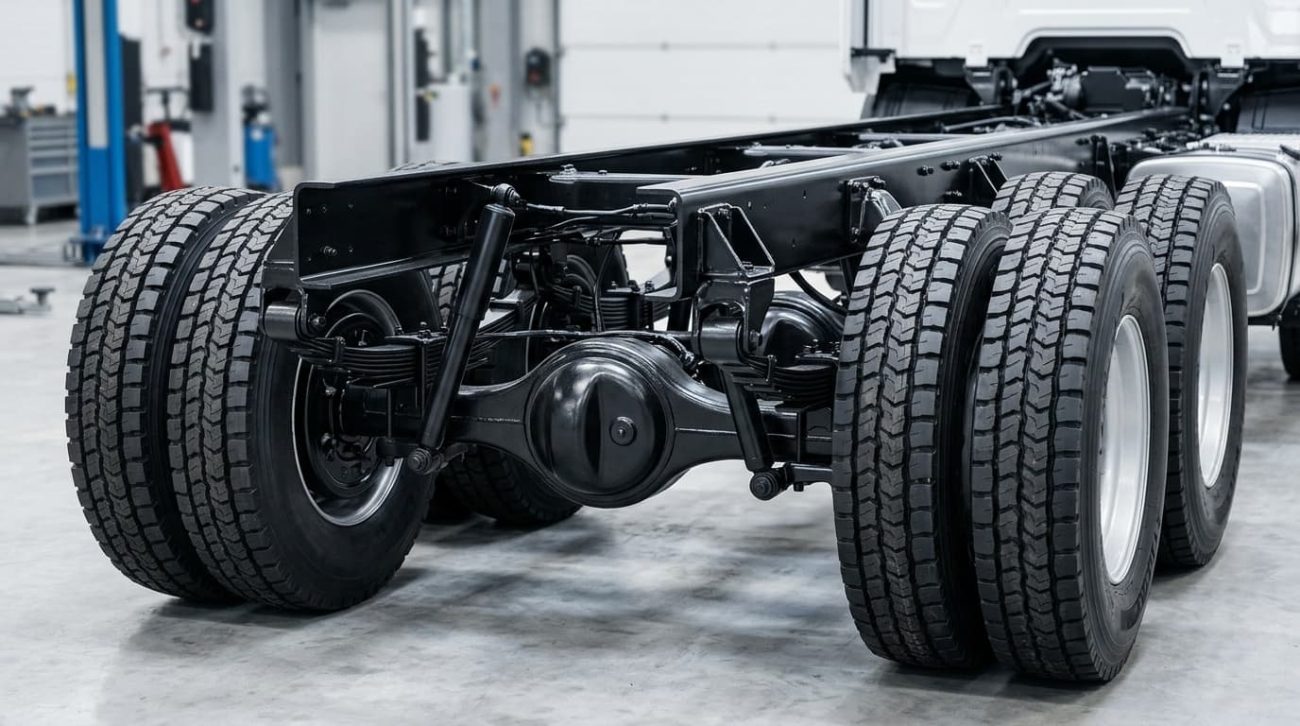
The rear axle on a commercial lorry performs two critical jobs simultaneously. First, it multiplies torque from the engine and transmission, converting rotational force from the driveshaft into the wheel-turning power that moves your loaded vehicle forward. Second, it bears the full weight of whatever you’re hauling.
This dual role — power transmission and load bearing — makes the heavy duty truck axle one of the most stressed components in your entire drivetrain. A typical rear axle on a Class 8 lorry handles torque loads exceeding 20,000 Nm while supporting 10,000+ kg of static weight. That’s like spinning a merry-go-round while an elephant stands on it.
Types of Rear Axles in Commercial Lorries
Not all lorry rear axles are created equal. The configuration you need depends entirely on what you’re hauling and where you’re hauling it.
Single drive axle — One powered rear axle (4×2 configuration). Lighter, more fuel-efficient, ideal for distribution work and long-haul routes where gross vehicle weight stays moderate. You’ll find these on most European highway tractors pulling up to 40 tonnes GVW.
Tandem drive axle — Two powered rear axles (6×4 or 8×4 configurations). The extra axle spreads load over more tyres and provides superior traction. Construction lorries, heavy haulage, and off-road applications rely on tandem setups. The inter-axle differential (power divider) splits torque between the two axles.
Full-floating vs semi-floating designs — Full-floating axles support the vehicle’s weight entirely through the axle housing and wheel bearings, meaning the axle shaft only transmits torque. Semi-floating designs make the shaft bear some vehicle weight. Virtually all commercial lorries use full-floating designs because they allow shaft removal without the wheel falling off — a significant safety and serviceability advantage.
Key Components Breakdown
Every lorry rear axle is an assembly of precision-engineered parts working in concert. When one fails, the others often follow quickly. Here’s what lives inside that housing:
| Component | Function | Common Failure Sign |
|---|---|---|
| Differential | Distributes torque between left and right wheels, allowing speed differences in turns | Whining noise, gear oil leak |
| Ring & Pinion Gear | Sets the rear axle ratio, multiplies torque from driveshaft | Grinding sound, vibration under load |
| Axle Shafts | Transmit rotational power from differential to wheels | Clicking on turns, visible twist marks |
| Wheel Bearings | Support axle weight rating load while reducing friction | Humming or rumbling at speed |
| Axle Housing | Structural backbone enclosing all internal components | Cracks, oil seepage at seams |
Rear Axle Ratio — Choosing the Right Gear for Your Operation
What Rear Axle Ratio Means (Plain Language)
The rear axle ratio is simply how many times your driveshaft must spin to turn the wheels once. A ratio of 4.11:1 means the driveshaft rotates 4.11 times for every single wheel revolution. Think of it like bicycle gears — a higher number gives you more pulling power but less top-end speed.
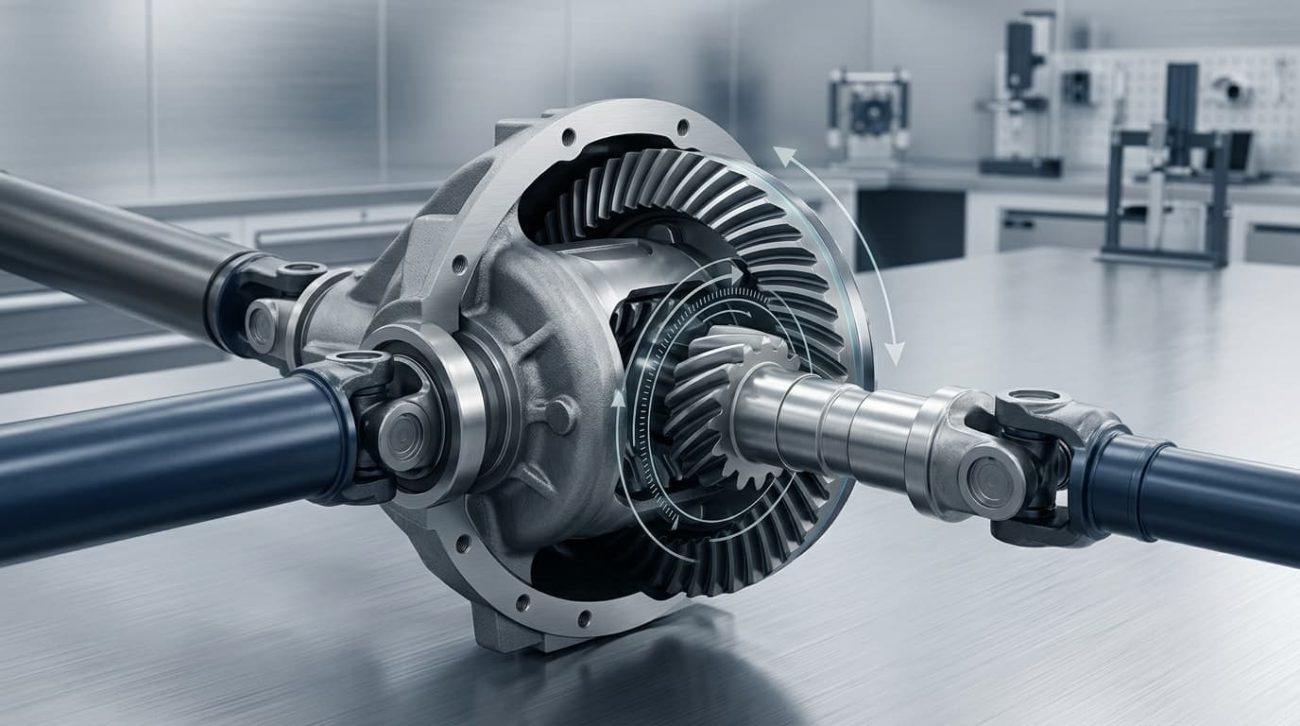
A higher ratio (numerically larger, like 4.63:1) multiplies torque more aggressively. Your lorry pulls harder from a standstill and climbs grades more easily, but the engine revs higher at cruising speed, burning more fuel. A lower ratio (numerically smaller, like 3.08:1) lets the engine loaf along at lower RPM on the highway, saving fuel — but your driver will feel the strain on steep hills or when pulling away fully loaded.
Common Ratios and Their Best Applications
| Rear Axle Ratio | Best For | Trade-off |
|---|---|---|
| 3.08 – 3.42 | Highway long-haul, flat terrain, lighter loads | Less startability on grades, slower acceleration |
| 3.55 – 3.90 | Mixed/regional routes, moderate payloads | Balanced performance, slight fuel penalty vs lower ratios |
| 4.10 – 4.63 | Construction, heavy loads, frequent stops | Higher fuel consumption at highway speeds |
| 4.88 – 5.29 | Off-road, steep terrain, maximum GVW operations | Limited top speed, highest fuel burn |
How to Match Ratio to Payload and Route Profile
Let’s make this practical. Imagine you’re speccing a tractor unit for 40-tonne GVW operation. If your routes are predominantly flat motorway — say, the corridor between major port cities — a 3.36:1 ratio paired with an overdrive transmission keeps engine RPM around 1,200 at 85 km/h. Fuel savings over 200,000 km annually can exceed €8,000.
Now put that same lorry on hilly regional routes with frequent starts and stops. That 3.36 ratio forces the driver to downshift constantly, the clutch takes a beating, and departure from traffic lights fully loaded becomes an exercise in patience (and horn-honking from cars behind). A 3.90 or 4.10 ratio transforms the experience — the lorry pulls confidently from rest and maintains speed on 6% grades without dropping three gears.
The golden rule: match your rear axle ratio to the hardest work your lorry regularly does, not the easiest. An over-geared lorry struggling daily costs more in clutch replacements and driver frustration than the fuel you’d save on the occasional flat stretch.
Axle Weight Rating and Load Capacity
Understanding Axle Weight Rating
Every heavy duty truck axle comes with a rated capacity stamped on its identification tag. This number represents the maximum load the axle is engineered to carry continuously under normal operating conditions. It is not the breaking point — manufacturers build in safety margins, typically 15–25% above rated capacity.
However, those safety margins exist to absorb dynamic loads: potholes, emergency braking, uneven weight distribution. They are not an invitation to routinely overload. Operating at rated capacity is fine. Operating above it eats into your safety margin and accelerates wear exponentially.
Single vs Tandem Drive Axle Load Limits
| Configuration | Typical Axle Weight Rating | Legal Limit (Common Markets) |
|---|---|---|
| Single rear axle | 9,000 – 13,000 kg | 10,000 – 11,500 kg |
| Tandem drive axle | 16,000 – 21,000 kg | 18,000 – 20,000 kg |
| Tridem axle group | 21,000 – 27,000 kg | 24,000 kg |
Note that legal limits are often lower than engineering capacity. Your axle might handle 13,000 kg mechanically, but the law says 11,500 kg on that road. Fines for overloading in the EU start around €1,500 and escalate quickly — not to mention the insurance implications if an overloaded axle contributes to an accident.
Consequences of Overloading
The numbers are sobering. Industry data from fleet maintenance studies shows that consistently overloading a rear axle by just 20% above its rated capacity can reduce component life by up to 50%. That’s not a typo — half the lifespan, gone.
Here’s what happens mechanically when you push beyond the axle weight rating:
- Bearing fatigue — Roller bearings develop micro-pitting under excessive load, leading to spalling and eventual collapse. A bearing rated for 800,000 km at proper load may fail at 400,000 km when consistently overloaded.
- Housing stress fractures — The axle housing flexes under load. Repeated overloading causes fatigue cracks, typically at weld seams or mounting points. Once cracked, the housing leaks oil and loses structural integrity.
- Premature differential failure — Ring and pinion gears are heat-treated for specific load ranges. Excess torque demand causes surface fatigue, pitting, and eventually tooth breakage — often catastrophically.
A single differential rebuild on a heavy-duty tandem drive axle runs €3,000–€7,000 in parts and labour. Multiply that by shortened intervals, add towing costs and lost revenue from downtime, and overloading becomes the most expensive “savings” in trucking.
Differential Maintenance — Keeping the Heart of Your Axle Alive
Gear Oil — The Lifeblood
If the differential is the heart of your rear axle, gear oil is the blood keeping it alive. The standard specification for heavy duty truck axle differentials is API GL-5, with 85W-140 being the most common viscosity grade for temperate and warm climates. In colder regions (regular operation below -20°C), 75W-90 synthetic provides better cold-flow protection at startup.
Synthetic gear oils cost roughly twice as much as mineral equivalents, but they maintain viscosity better across temperature extremes and typically allow extended drain intervals — often 50% longer. For fleets operating in varied climates or severe duty cycles, the total cost of ownership often favours synthetic.
One critical point: if your tandem drive axle has a limited-slip or locking differential, always use oil with the correct friction modifier additive. Using standard GL-5 without the modifier causes chatter, accelerated clutch pack wear, and premature lock-up failure.
Differential Maintenance Schedule
| Service Item | Light Duty Cycle | Severe Duty Cycle |
|---|---|---|
| Oil level check | Every 10,000 km | Every 5,000 km |
| Full oil change | 60,000 – 80,000 km | 30,000 – 40,000 km |
| Bearing inspection | 150,000 km | 80,000 km |
| Backlash measurement | 200,000 km | 100,000 km |
“Severe duty” includes construction sites, frequent off-road operation, sustained heavy loads near axle weight rating, mountainous terrain with prolonged braking, and ambient temperatures regularly exceeding 40°C. If any of these describe your operation, use the shorter intervals — your axle will thank you with longer life.
Warning Signs You Shouldn’t Ignore
Your axle is crying for help when you hear, feel, or see any of these symptoms. Don’t turn up the radio — listen:
- Whining on acceleration — Often indicates worn ring and pinion teeth or incorrect gear mesh pattern. The pitch changes with speed. Your differential is telling you its gears are tired.
- Clunking when shifting from drive to reverse — Excessive backlash in the gear set, worn spider gears, or loose pinion nut. Something has too much play, and play becomes damage quickly.
- Vibration through the driveline — Could be a worn U-joint, but if it persists after U-joint replacement, suspect pinion bearing wear or a bent axle shaft.
- Oil leaks at the pinion seal or axle ends — Seals are cheap. The damage caused by running low on oil is not. A €15 seal ignored becomes a €5,000 rebuild.
- Overheating (housing too hot to touch) — Low oil level, wrong viscosity, or internal damage causing excessive friction. Pull over and investigate before you weld the gears together permanently.
Common Lorry Rear Axle Problems and Solutions
Top 5 Failure Modes (With Real Repair Cost Ranges)
Based on fleet maintenance records and workshop data, these are the most frequent rear axle failures in commercial lorries, ranked by occurrence:
| Failure Mode | Typical Cause | Repair Cost (Parts + Labour) | Estimated Downtime |
|---|---|---|---|
| 1. Pinion seal leak | Worn seal, scored pinion journal | €150 – €500 | 4 – 8 hours |
| 2. Worn ring and pinion | High mileage, contaminated oil, overloading | €2,000 – €4,500 | 1 – 2 days |
| 3. Spider gear failure | Aggressive driving, traction control issues | €1,200 – €3,000 | 1 – 2 days |
| 4. Axle shaft fatigue fracture | Overloading, material fatigue, impact damage | €800 – €2,000 | 8 – 16 hours |
| 5. Bearing collapse | Lubrication failure, contamination, excess load | €1,500 – €4,000 | 1 – 3 days |
The real cost isn’t just the repair bill — it’s the revenue lost while your lorry sits in the workshop. A lorry earning €800–€1,200 per day in freight revenue loses that income for every day it’s down. A €3,000 ring and pinion job with two days downtime actually costs €5,000–€5,400 when you factor in lost earnings.
Rebuilt vs New Axle — When Each Makes Sense
This decision comes down to three factors: mileage on the housing, extent of damage, and your budget timeline.
Choose a rebuilt axle when:
- The housing is structurally sound (no cracks, proper alignment)
- Damage is limited to internal components (gears, bearings, seals)
- The lorry has significant remaining service life (3+ years)
- Budget is constrained but you need reliability — a quality rebuild typically costs 50–65% of a new axle assembly
Choose a new axle when:
- The housing is cracked, bent, or has worn mounting surfaces
- Multiple internal systems have failed simultaneously
- You want a different rear axle ratio for changed operational needs
- Warranty coverage matters — new axles typically carry 2-year warranties vs 6–12 months for rebuilds
A third option worth considering: a remanufactured axle assembly from a reputable supplier. These are factory-rebuilt to OEM specifications with new wear components, typically priced 30–40% below new, and carry solid warranties. For many fleet operators, this hits the sweet spot between cost and confidence.
Frequently Asked Questions
How long does a lorry rear axle last?
With proper differential maintenance — regular oil changes, correct lubricant specification, and operation within the axle weight rating — a quality heavy duty truck axle typically lasts 500,000 to 1,000,000 km. Long-haul highway operations tend toward the higher end, while construction and off-road applications see shorter life due to higher stress cycles. The biggest life-shorteners are contaminated oil, chronic overloading, and ignored warning symptoms.
What happens if the rear axle ratio is wrong for my load?
A ratio that’s too low (numerically small) for your typical payload causes the engine to lug — operating below its efficient RPM range. This creates excessive heat in the drivetrain, premature clutch wear, and poor fuel economy despite the “fuel-saving” intent of the lower ratio. Conversely, a ratio that’s too high forces the engine to over-rev at highway speeds, wasting fuel and accelerating wear on every rotating component. Either mismatch typically costs 8–15% in excess fuel consumption and significantly shortens drivetrain component life.
Can I upgrade from a single to a tandem drive axle?
It’s technically possible but far from simple. Converting from a single rear axle to a tandem drive axle involves chassis frame extension or modification, new suspension mounting points, additional driveshaft and inter-axle differential, brake system modifications, and re-certification of the vehicle’s GVW rating. The cost typically exceeds €15,000–€25,000 and requires engineering approval in most jurisdictions. In many cases, it’s more economical to sell the existing lorry and purchase one factory-built with the tandem configuration you need.
How do I know my axle weight rating?
Look for the axle identification tag — a metal plate riveted to the axle housing, usually on the differential cover or the right-hand tube near the spring seat. It lists the manufacturer, model, ratio, and rated capacity. If the tag is missing or illegible, you can decode the axle model from your vehicle’s VIN through the chassis manufacturer’s parts system. Alternatively, the axle manufacturer’s website often has specification lookup tools by model number.
What oil does a heavy duty truck axle differential need?
The standard specification is API GL-5 gear oil. The most common viscosity for temperate climates is 85W-140 (mineral) or 75W-140 (synthetic). For operations in consistently cold environments (below -15°C), 75W-90 synthetic provides better cold-start protection. Synthetic oils offer superior thermal stability, longer drain intervals, and better protection under extreme loads — but they cost roughly double. For severe-duty operations or extended drain programs, synthetic typically pays for itself in reduced wear and fewer oil changes.
How often should I inspect a tandem drive axle inter-axle differential?
The inter-axle differential (power divider) on a tandem drive axle should be inspected every 80,000–100,000 km under normal conditions, or every 40,000–60,000 km in severe duty. Key signs of power-divider wear include difficulty engaging or disengaging the lock, uneven tyre wear between the forward and rear drive axles, and unusual noise when the lock is engaged. The power divider shares oil with the forward rear axle differential, so maintaining proper oil level and quality in that housing directly protects both components.
Your Rear Axle Deserves Better Than Neglect
Your rear axle doesn’t ask for much — just the right parts, the right oil, and a little attention before small problems become roadside emergencies. A €15 seal replacement today prevents a €5,000 rebuild next month. A correct rear axle ratio saves thousands in fuel annually. Proper differential maintenance doubles the distance between major overhauls.
The lorry rear axle is the foundation your business rolls on. Treat it well, and it returns the favour with hundreds of thousands of reliable kilometres.
We have 15 years of hands-on experience in this industry. Contact us at Mettlead — we’ll give you a genuinely workable solution, whether you need a specific ring and pinion set, a complete axle assembly, bearings, seals, or any other component for Chinese-brand lorry axles. We provide the most reasonable and competitive pricing on Chinese-brand truck parts, shipped globally.
Get in touch today for


