Core Roles of Key Truck Components: Transmission, Clutch & Steering
Truck transmission, clutch, and steering system parts are three critical components that jointly ensure the safe and efficient operation of heavy-duty vehicles.
Each plays a unique and irreplaceable role, directly determining the vehicle’s performance, safety, and operational reliability in various working scenarios.
These scenarios include long-haul highways, rugged construction sites, urban delivery routes, and remote mining areas.
These three component categories form the backbone of a truck’s drivability and safety. They work in perfect harmony to deliver a smooth, controlled driving experience.
A faulty transmission disrupts power delivery, making the truck struggle with acceleration and gear changes.
A worn clutch reduces gear shifting precision, leading to slipping, grinding, or difficulty engaging gears.
A malfunctioning steering system compromises control, putting drivers and cargo at risk.
All these issues increase fuel consumption, cause frequent breakdowns, and raise maintenance costs.
Truck Transmission, Clutch & Steering System Parts
For fleet managers and repair professionals, understanding the unique role of each component category is essential to maintaining fleet efficiency and minimizing operational disruptions.
Neglecting any of these parts—whether it’s a worn transmission gear, a slipping clutch disc, or a loose steering tie rod—can lead to delayed deliveries, damaged brand reputation, and increased operational costs.
You can avoid these issues by using high-quality, reliable components built to withstand the rigors of heavy-duty use.
Key Features of High-Quality Components
Not all truck components are created equal, and high-quality transmission, clutch, and steering system parts share core characteristics that ensure long-term reliability and performance.
These features cater to the unique demands of heavy-duty trucking, helping components withstand heavy loads, extreme temperatures, constant vibration, and long-hour operation.
Our truck transmission parts are designed to meet the rigorous demands of heavy-duty operations, serving as the critical link between the engine’s power and the vehicle’s wheels.
As the “power converter” of the truck, the transmission is responsible for adjusting torque and speed.
This ensures the engine operates at optimal efficiency, no matter the load or terrain.
Our product line covers all essential transmission components, including gear sets, synchronizers, transmission housings, shift forks, and input/output shafts.
We craft these parts from high-strength alloy steel and heat-treat them to boost wear, corrosion, and impact resistance. We subject each transmission part to strict quality testing.
For example, we conduct load-bearing, high-temperature resistance, and wear resistance tests. This ensures parts handle the high pressures and temperatures of heavy-duty operation.
This ensures parts handle the high pressures and temperatures of heavy-duty operation.
For detailed specifications and compatibility information, visit ourproduct specification page (non-keyword anchor text, avoiding over-optimization).
This page provides comprehensive details on model compatibility, technical data sheets, and installation guidelines to simplify the selection process.
Durable Truck Clutch Parts
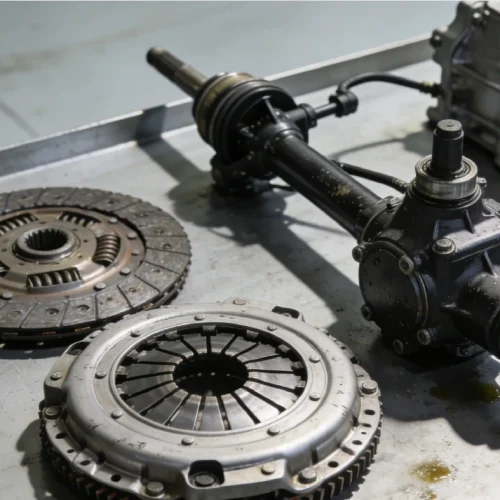
Our truck clutch parts complement our transmission parts, engineered for smooth gear shifting and reliable power transfer between the engine and transmission.
The clutch acts as a “buffer” that disengages and engages the engine’s power during gear changes, allowing for smooth gear changes without damaging the engine or transmission components.
Our clutch product line includes all essential components, such as clutch discs, pressure plates, release bearings, and master cylinders.
We make each part from high-friction, heat-resistant materials. These materials withstand the intense pressure and temperature during gear changes.
They ensure consistent performance even after long hours of use. Precision manufacturing ensures a perfect fit with various truck models.
This reduces installation time and minimizes mismatch risks.
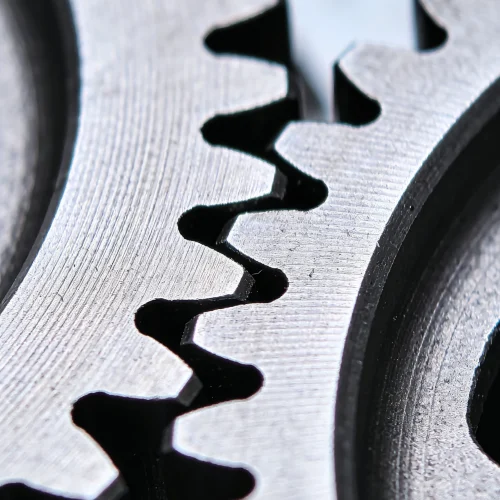
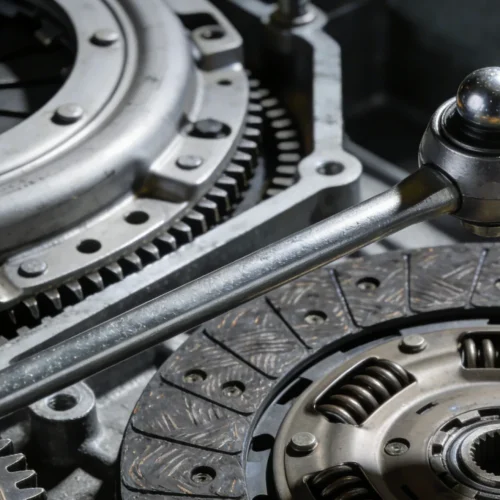
Close-Up of Transmission Gear, Clutch Disc & Steering Tie Rod
Reliable Truck Steering System Parts
Safety starts with control, so we build our truck steering system parts for stability and precision. The steering system serves as the truck’s “control center, ” allowing drivers to maneuver the vehicle accurately.
This remains true even when carrying heavy loads or navigating rough terrain.
Our steering product line includes steering gears, tie rods, steering knuckles, power steering pumps, and steering hoses.
All are made of high-strength, corrosion-resistant materials. We precision-machine each steering component for smooth, responsive steering.
This reduces driver fatigue and improves overall safety. The parts withstand harsh heavy-duty conditions, such as dust, moisture, and extreme temperatures.
They maintain performance and reliability over time.
Common Issues & Practical Maintenance Tips
Even high-quality transmission, clutch, and steering system parts need regular maintenance. This extends their service life, reduces breakdowns, and keeps your fleet running smoothly.
Below are common issues and corresponding maintenance tips for each component category.
These tips help you avoid costly repairs and unplanned downtime.
⚙️ Transmission Parts Are a Load Chain, Not Independent Components
Truck transmission components do not operate independently. Instead, they form a continuous load chain where each part depends on the performance of the next.
Engine torque enters the clutch system first, then passes into the gearbox where it is redistributed through gear sets. The shafts carry this load forward, while bearings maintain rotational stability. Finally, seals and lubrication systems ensure the entire structure operates under controlled friction.
If any single part in this chain begins to degrade, the entire load distribution changes. This is why transmission failures rarely stay isolated to one component.
🔥 What Actually Fails First in a Truck Transmission (Real Priority Order)
In real-world truck operation, transmission parts do not fail randomly. There is a predictable failure order based on stress and heat exposure.
The first components to degrade are usually clutch elements and transmission fluid. These parts are directly exposed to friction and heat cycles during every gear change.Once lubrication quality drops, synchronizers and bearings begin to wear faster due to increased internal resistance.
After that, gear surfaces start to show damage from uneven torque distribution.In late-stage failure, shafts and housing components may also be affected due to prolonged mechanical imbalance.
🧠 Why Transmission Failures Are Often Misdiagnosed
One of the biggest problems in truck maintenance is misdiagnosing transmission failure.A common mistake is replacing gears or even the entire gearbox when the actual issue originates from lubrication breakdown or clutch inefficiency.
For example, gear slipping may not mean gear damage—it may indicate insufficient hydraulic pressure or clutch wear.Similarly, noise inside the transmission is often caused by bearing fatigue rather than gear failure.This is why experienced technicians always test fluid condition and load behavior before replacing hard parts.
⚠️ Why Small Transmission Parts Cause Big Failures
Truck transmission systems are highly sensitive to small component degradation.A worn synchronizer may only affect shifting smoothness at first, but over time it increases friction during gear engagement. This additional stress gradually damages gears and shafts.
A small oil leak from a seal may seem insignificant, but it reduces lubrication efficiency. Once oil pressure drops, internal temperature rises quickly, accelerating wear across the entire system.This cascading effect explains why minor transmission issues often turn into full system failure if ignored.
💰 Fleet-Level Cost Reality of Transmission Parts Failure
From a fleet management perspective, transmission failure is rarely about part replacement cost.The real cost comes from:
vehicle downtime
delayed logistics
repeated misdiagnosis
unnecessary part replacement cycles
In many cases, fleets replace multiple components before identifying the real root cause, leading to unnecessary maintenance costs.Understanding the relationship between transmission parts is therefore more important than simply replacing individual components.
Transmission Parts: Common Issues & Maintenance
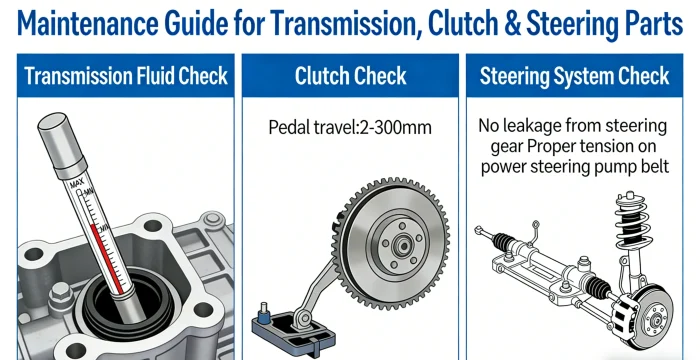
Transmission parts often face oil leaks, gear jamming, and reduced power transmission. To prevent these issues, check the transmission oil level and quality regularly.
Contaminated or insufficient oil causes excessive internal component wear. Replace the oil every 30,000 to 50,000 kilometers.
Change it more frequently if the truck operates in harsh conditions. These include constant heavy loads, extreme temperatures, or dusty environments.
Also, inspect the transmission housing and connections for leaks. Tighten any loose bolts to prevent oil loss.
Clutch Parts: Common Issues & Maintenance
Clutch parts commonly experience slipping, difficulty shifting, and abnormal noise. For instance, slipping often stems from a worn clutch disc or insufficient clutch pressure.
Difficulty shifting may indicate a faulty release bearing. Regularly inspect the clutch pedal free travel and adjust it if necessary. Check the clutch fluid level.
Replace it per the manufacturer’s guidelines for smooth operation.
Steering System Parts: Common Issues & Maintenance
Steering system parts often have loose tie rods, unresponsive steering, and power steering fluid leaks. Specifically, loose tie rods reduce steering precision and increase tire wear.
Unresponsive steering poses a serious safety hazard. Therefore, regularly check tie rod connection tightness. Replace worn or damaged parts.
Maintenance Guide for Transmission, Clutch & Steering Parts
For more detailed maintenance instructions, refer to our maintenance guide (non-keyword anchor text), which includes step-by-step procedures for inspection, cleaning, and minor repairs.
Compared to ordinary parts on the market, our products offer three key advantages. First, they boast better durability. They’re made of high-strength materials and precision-manufactured. This lets them withstand long-term heavy-load use.
This cuts down on replacement frequency and downtime. Second, they have strong compatibility. They fit a wide range of heavy-duty truck models. This eliminates mismatched part hassles.
Finally, we provide comprehensive after-sales support. Our experts offer personalized recommendations, technical guidance, and quick responses. They solve your selection, installation, and maintenance issues.
Whether you’re a fleet manager looking to maintain fleet efficiency or a repair professional in need of reliable parts, our transmission, clutch, and steering system parts are the perfect choice.
We are committed to providing high-quality components that help you reduce operational costs, minimize downtime, and keep your fleet running smoothly.
For personalized recommendations or technical support, visit our contact page to get in touch with our team of experts. We’re here to help you select the right parts for your specific truck models and operational needs.
❓ FAQ – Truck Transmission Parts & Failure Analysis
What are the key components inside a truck transmission system?
A truck transmission system consists of multiple interconnected mechanical components that work together to transfer engine power to the wheels. The main parts include the clutch assembly, gear sets, input and output shafts, synchronizers, bearings, seals, and the lubrication system.
Each component plays a specific role in maintaining torque transfer, rotational stability, and smooth gear shifting. The clutch manages power engagement, gears control torque ratios, shafts transmit mechanical force, and bearings support rotational movement.Although these parts are often listed separately, they function as a single mechanical load system where each component depends on the performance of the others.
Which transmission parts wear out the fastest in real operation?
In real-world trucking conditions, clutch components and transmission fluid typically wear out first. These parts are exposed to continuous friction, heat, and load stress during every gear shift cycle.Once fluid quality begins to degrade, synchronizers and bearings experience increased friction due to reduced lubrication efficiency. This accelerates internal wear and affects shifting smoothness.
Over time, gear surfaces may also begin to show damage, especially under heavy load or frequent stop-and-go driving conditions. This makes early-stage maintenance of fluid and clutch systems critical to preventing deeper mechanical failure.
Why do truck transmission parts fail in a chain reaction?
Transmission failures usually occur as a chain reaction rather than a single-point breakdown. When one component begins to degrade, it changes the load distribution across the entire system.
For example, worn clutch components may cause improper torque engagement, forcing gears and shafts to absorb uneven stress. Similarly, degraded lubrication increases friction, which accelerates wear on bearings and gear surfaces.This cascading effect explains why a small initial issue can eventually lead to full gearbox failure if not detected early.
Why is it difficult to identify the real failed transmission part?
Identifying the actual failed component in a transmission system is difficult because symptoms often overlap across multiple parts.A single issue, such as gear noise or shifting difficulty, may be caused by different root problems including clutch wear, bearing fatigue, or lubrication failure.
This overlap leads to frequent misdiagnosis in repair environments, where technicians may replace visible components without addressing the underlying system issue.Accurate diagnosis requires analyzing system behavior rather than relying only on surface-level symptoms.
Can transmission problems exist even if gears are not damaged?
Yes, transmission problems can occur even when gears are physically intact. Many issues originate from external or supporting components rather than the gears themselves.For example, clutch slippage, low hydraulic pressure, or degraded transmission fluid can all cause shifting problems without any gear damage.
Similarly, bearing wear or synchronizer fatigue can lead to noise and vibration while gears remain structurally healthy.This is why transmission diagnosis must always consider the full system, not just the visible gear condition.
Why do transmission repairs sometimes fail after replacement?
Transmission repairs may fail after replacement because the root cause of the problem was not fully identified or resolved.In many cases, only the damaged component is replaced while underlying issues such as contamination, lubrication breakdown, or system imbalance remain.
As a result, the new component is quickly exposed to the same operating conditions that caused the original failure, leading to repeated breakdowns.Effective repair requires addressing both the failed part and the system environment that caused the failure.
What happens when small transmission parts fail but are not replaced?
When small components such as seals, bearings, or synchronizers begin to fail and are not replaced, they gradually affect the entire transmission system.A minor oil leak from a seal can reduce lubrication efficiency, increasing internal heat and friction. Similarly, worn bearings can introduce vibration that affects gear alignment and performance.
Over time, these small issues accumulate and lead to larger mechanical failures, making early detection and replacement essential for system stability.
Why do transmission issues get worse under heavy load conditions?
Transmission issues become more severe under heavy load because increased torque places additional stress on internal components.Higher load conditions increase friction, heat generation, and mechanical strain, especially on clutch and gear systems.
If the transmission is already experiencing minor wear or lubrication issues, heavy load operation accelerates the degradation process significantly.This is why vehicles operating under continuous heavy-duty conditions require more frequent inspection and maintenance.
How can early transmission failure signs be detected?
Early transmission failure signs can often be detected through changes in driving behavior and system performance.Common early indicators include delayed gear engagement, subtle noise during shifting, slight vibration, or inconsistent power delivery.
These symptoms usually appear before major mechanical damage occurs and often indicate early-stage wear in clutch systems, bearings, or lubrication performance.Early detection is critical because it allows maintenance before the failure spreads to other components.