Why Overheating Is the Silent Killer of Heavy-Duty Powertrains
If you operate trucks or industrial machinery, you already know that a diesel engine running hot is more than a minor inconvenience — it can warp heads, crack blocks, and leave you stranded with a five-figure repair bill. According to a 2025 fleet maintenance survey by the Technology & Maintenance Council, thermal failures account for nearly 18% of unplanned roadside breakdowns in Class 8 trucks. The good news is that most overheating issues trace back to a handful of preventable causes.
In this guide we will walk through the most frequent culprits, share a clear diagnostic approach, and explain how sourcing the right replacement components keeps your equipment running cool and profitable.

The Most Common Causes of Overheating
1. Coolant System Failures
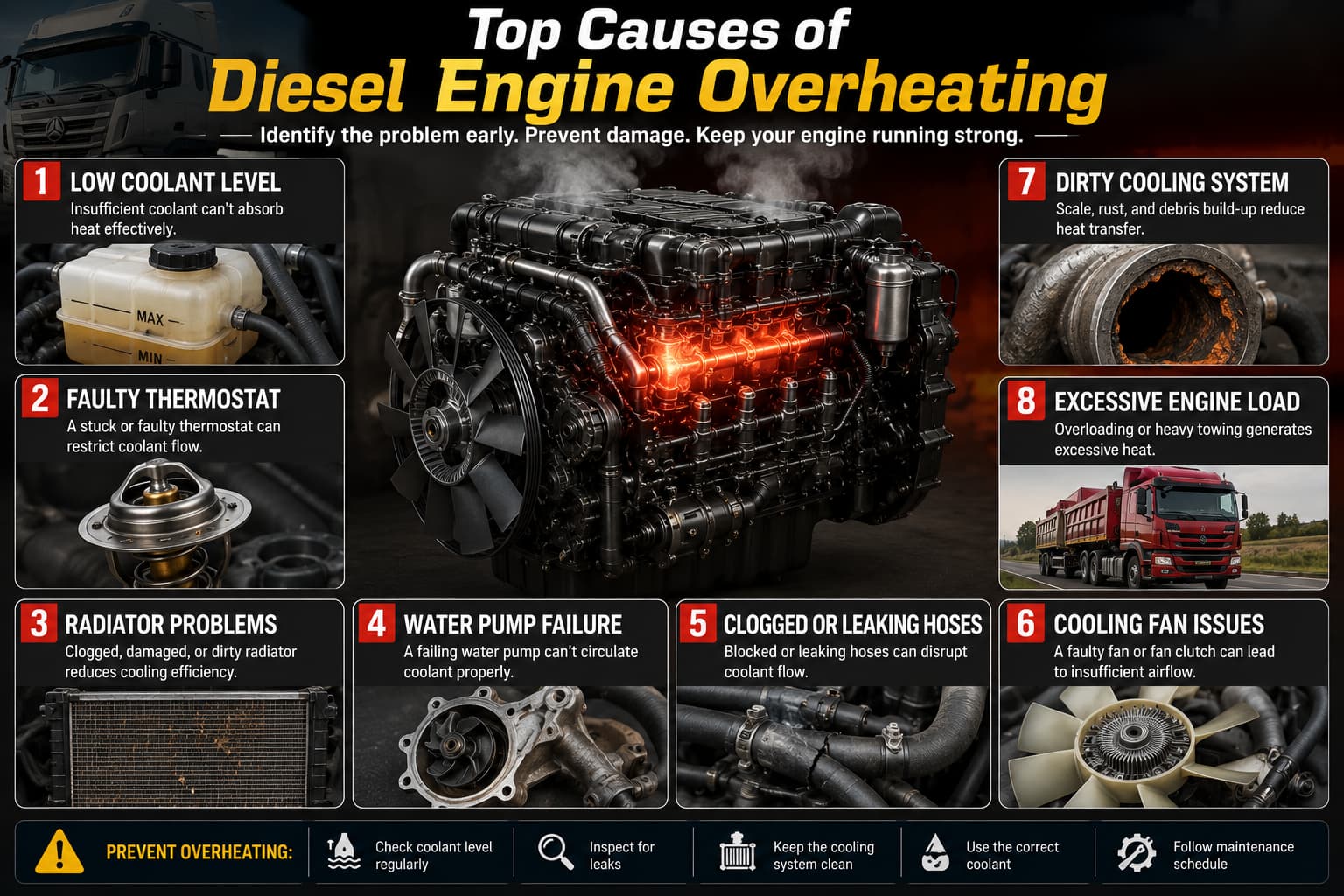
Low coolant level is the number-one trigger. Leaks at hose clamps, water pump seals, or the radiator core allow fluid to escape gradually — often unnoticed until the temperature gauge spikes. Contaminated coolant that has lost its corrosion inhibitors can also clog passages inside the cylinder block, reducing heat transfer dramatically.
2. Thermostat Malfunction
A thermostat stuck in the closed position prevents coolant from circulating through the radiator. Because these compression ignition powertrains generate significantly more heat under load than gasoline counterparts, even a few minutes of restricted flow can push temperatures into the danger zone.
3. Radiator Blockages and Airflow Restriction
Debris, insects, and road grime pack the radiator fins over time. Internally, scale buildup narrows coolant passages. Both scenarios reduce the radiator’s ability to dissipate heat. In dusty environments — mining, agriculture, construction — this problem accelerates quickly.
4. Water Pump Wear
The water pump is the heart of the cooling circuit. Worn impeller blades or a failing bearing reduce flow rate, meaning heat is carried away from the combustion chambers too slowly. A telltale sign is a slight wobble on the pulley or coolant weeping from the weep hole.
5. Fan and Fan Clutch Issues
Electric or viscous fan clutches that fail to engage leave the radiator without adequate airflow at low speeds or idle. This is especially critical during stop-and-go operation or prolonged stationary running with a PTO load.
6. Head Gasket or Liner Seal Failure
When combustion gases breach into the cooling jacket, they create air pockets and pressurize the system. This pushes coolant out through the overflow and dramatically reduces cooling efficiency. Exhaust emissions containing white steam and a sweet smell are classic indicators.
7. Fuel Injection Timing Problems
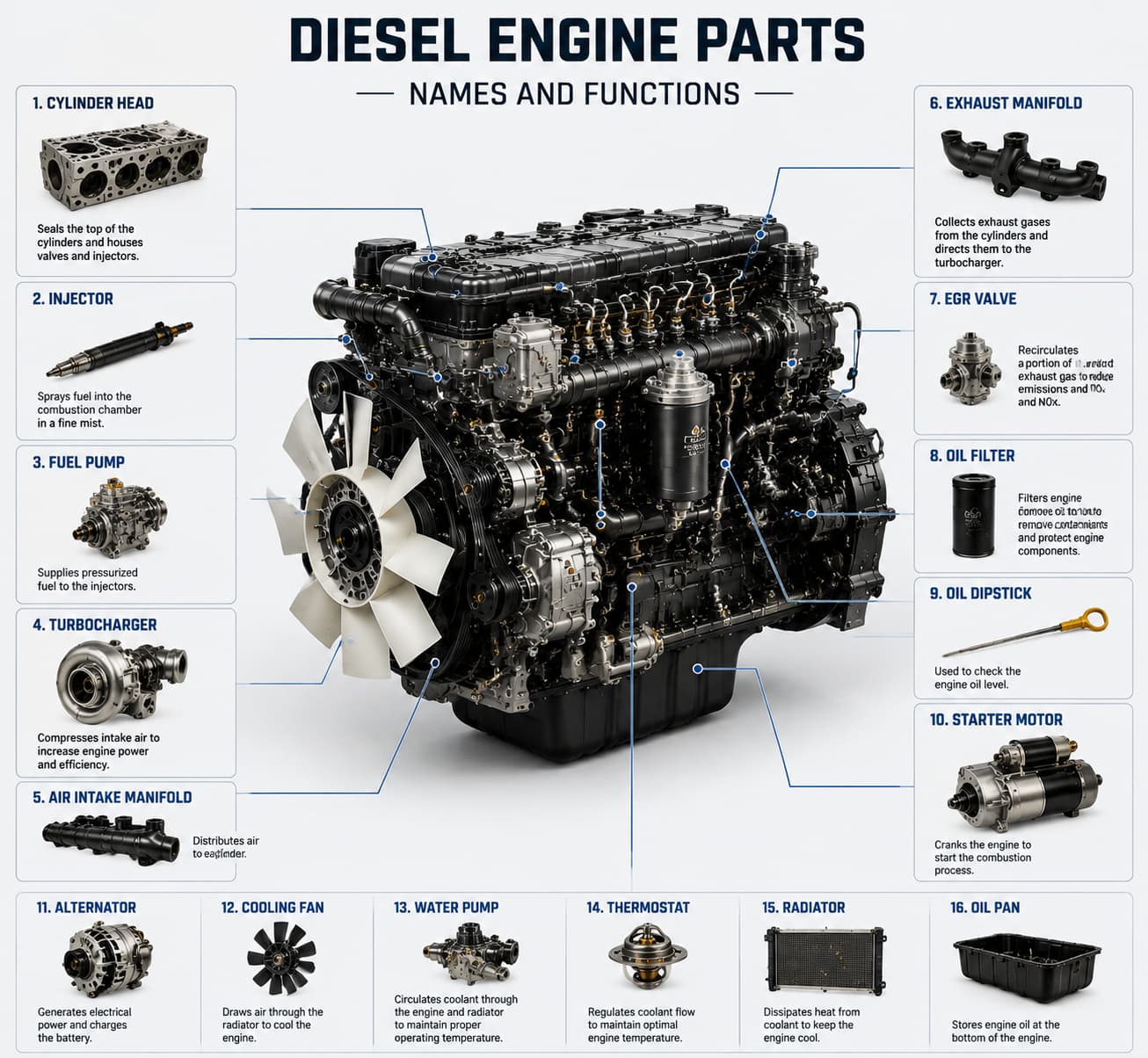
Incorrect fuel injection timing causes incomplete combustion, generating excess heat that the cooling system was never designed to handle. Over-fueling from a faulty injector can raise exhaust gas temperatures by 100–200 °C above normal.
8. Turbocharger Malfunction
A failing turbocharger — whether from oil starvation, damaged seals, or foreign object impact — disrupts the air-fuel balance. The result is higher combustion temperatures and increased thermal load on every downstream component.
Diagnostic Flowchart: Pinpointing the Problem
| Step | Check | Tool / Method | Expected Result |
|---|---|---|---|
| 1 | Coolant level and condition | Visual inspection, refractometer | Full level, correct freeze point, no oil contamination |
| 2 | Thermostat operation | Infrared thermometer on upper hose | Temp rise within 5 min of warm-up |
| 3 | Radiator airflow | Visual check of fins, pressure wash | Unobstructed fin surface ≥ 90% |
| 4 | Water pump flow | Feel upper hose surge at 1500 RPM | Strong, consistent pulse |
| 5 | Fan engagement | Listen/observe at operating temp | Fan fully engaged above 95 °C |
| 6 | Combustion gas in coolant | Block tester (chemical strip) | No color change (no gases detected) |
| 7 | Injector and timing | Scan tool, EGT probe | All cylinders within 50 °C of each other |
Following this sequence from simplest to most complex helps you avoid unnecessary teardowns. If you need detailed walk-throughs for any step, our technical support library covers each procedure with photos and torque specs.
Real-World Case: Fleet Overheating in the Middle East
A logistics company operating 45 Sinotruk HOWO trucks across Saudi Arabia experienced repeated thermal shutdowns during summer months. Initial inspections revealed aftermarket thermostats with incorrect opening temperatures and radiator hoses made from substandard rubber that collapsed under pressure. After switching to OEM-spec parts — including correctly rated thermostats and silicone-reinforced hoses — the fleet’s overheating incidents dropped by 87% over a six-month period. You can read similar stories in our cooperative case archive.
This case highlights a crucial point: knowing how to identify genuine diesel engine spare parts online can mean the difference between a quick fix and a recurring nightmare.
Choosing the Right Replacement Parts
Overheating repairs are only as good as the components you install. Here are practical tips for choosing reliable diesel engine replacement parts that actually last:
- Verify OEM part numbers — Cross-reference numbers with the manufacturer’s catalog before ordering.
- Check certification marks — ISO 9001 or TS 16949 stamps indicate controlled manufacturing quality.
- Inspect packaging and labeling — Holographic seals, consistent print quality, and traceable batch codes signal authenticity.
- Buy from authorized distributors — Knowing where to buy certified diesel engine spare parts near me (or an international equivalent) protects you from counterfeit risk.
For heavy-duty fleets, the best quality diesel engine spare parts for heavy duty trucks in 2026 come from suppliers who maintain direct factory relationships and rigorous quality-control inspection at their own warehouses.
How to Avoid Counterfeits
Understanding how to avoid counterfeit diesel engine spare parts when shopping online is increasingly important as e-commerce grows. Counterfeit cooling components — water pumps with pot-metal impellers, gaskets with incorrect thickness — are a leading cause of repeat thermal failure. Always request test reports, insist on branded packaging, and work with sellers who can provide after-sales accountability.
Mettlead maintains a full catalog of verified parts organized by product category brand and product category system, so you can cross-match exactly what your vehicle requires without second-guessing authenticity.
Prevention: Keeping Temperatures in Check
| Preventive Action | Frequency | Benefit |
|---|---|---|
| Coolant flush and refill | Every 2 years or 250,000 km | Removes scale, restores inhibitors |
| Radiator pressure test | Every 6 months | Detects micro-leaks early |
| Belt and tensioner inspection | Every 50,000 km | Ensures water pump and fan drive integrity |
| Thermostat replacement | Every 3 years | Prevents stuck-closed failures |
| EGT monitoring (where fitted) | Continuous | Early warning of injector or timing faults |
If you manage a mixed fleet, stocking critical Truck parts — thermostats, water pumps, fan clutches, and hoses — in your own warehouse dramatically reduces downtime when issues arise.
When to Call in a Professional
Some overheating scenarios demand more than a parts swap. If your block tester shows combustion gases in the coolant, or if the head surface shows warping beyond 0.05 mm, specialist machining is required. Similarly, repeated thermal events may have compromised internal seals in ways that only a full teardown can reveal.
For sourcing guidance, engineering specs, or bulk pricing for fleet-scale orders, feel free to contact us directly. Our team — with over a decade of experience in heavy-duty commercial vehicle components — is ready to help. Learn more about-us and our quality commitment.
Frequently Asked Questions
What is the most common cause of overheating in heavy-duty trucks?
Low coolant level due to undetected leaks is the single most frequent cause. Regular visual inspections and pressure tests catch these issues before they escalate into major thermal damage.
How can I tell if my thermostat is stuck closed?
Use an infrared thermometer on the upper radiator hose. If the hose stays cold after the engine reaches operating temperature on the gauge, the thermostat is likely not opening. Replacement is inexpensive and should be done immediately.
Does using non-genuine parts increase the risk of overheating?
Yes. Counterfeit or substandard components — especially water pumps, gaskets, and hoses — often fail prematurely because they are manufactured outside OEM tolerances. Always verify part numbers and buy from authorized sources.
Can a faulty injector cause the engine to overheat?
Absolutely. An injector that over-fuels or sprays at the wrong angle raises combustion temperatures significantly. Monitoring exhaust gas temperatures across all cylinders helps identify the offending unit quickly.
How often should I flush the cooling system?
Most manufacturers recommend a full coolant flush every two years or 250,000 km, whichever comes first. In harsh environments with high ambient temperatures or heavy dust exposure, shortening that interval to 18 months is advisable.


