The airbag shock absorber is a core component of heavy truck suspension systems, playing a crucial role in reducing road vibration, protecting the chassis, and ensuring driving safety.
Unlike traditional spring shock absorbers, it uses a rubber airbag structure to buffer impacts, adapting perfectly to heavy loads and complex road conditions.
Many truck drivers overlook daily maintenance of this component, leading to premature air leakage, poor shock absorption, and even safety hazards.
This article shares professional tips to help you use, maintain, and select the right one for your heavy truck.
It cooperates with the truck’s suspension system to absorb road vibrations and impact forces, effectively reducing damage to the vehicle chassis caused by uneven road surfaces.
For heavy-duty trucks often operating in complex road conditions—such as construction sites, mountainous areas, and remote roads—this component is particularly critical.
Basic Introduction to Airbag Shock Absorber
As a key part of the heavy truck suspension system, it connects the vehicle body and chassis.
Its core function is to absorb road impacts, reduce cab vibration, and keep the vehicle stable during transportation, especially under full load.
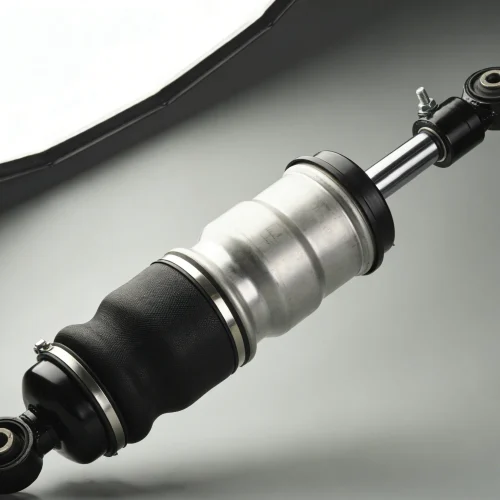
It consists of a high-strength rubber airbag, metal mounting joints, and internal damping components.
The airbag inflates with compressed air to provide flexible cushioning, which is far more durable than traditional springs for heavy-duty use.
Heavy truck airbag shock absorber
There are various types of it on the market, each tailored to different working needs and vehicle models.
Single-acting ones have a simple structure, strong durability, and easy maintenance, making them suitable for basic transportation scenarios with stable loads.
Double-acting ones, however, offer more precise control, which is ideal for trucks that require frequent loading and unloading or long-distance transportation tasks.
Common Faults and Troubleshooting of Airbag Shock Absorber
Common Fault Phenomena of Airbag Shock Absorber
After long-term use, it may develop several typical faults.
The most common issue is air leakage, which causes insufficient air pressure, reduced shock absorption, and uneven cab height.
Other problems include abnormal noise during driving, slow response to road bumps, and visible cracks or wear on the rubber airbag.
These faults directly affect driving safety and require timely inspection.
Practical Troubleshooting Methods for Airbag Shock Absorber
When faults occur, first park the truck in a safe area.
For air leakage, check the airbag surface, air pipe connections, and seals, replacing damaged parts immediately.
For abnormal noise, inspect the mounting joints and bolts, tightening loose parts to eliminate vibration.
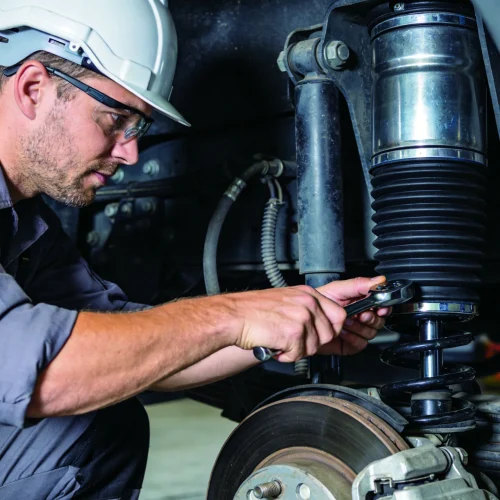
Technician inspecting heavy truck airbag shock absorber
How to Choose a High-Quality Airbag Shock Absorber
When selecting it, first confirm it matches your truck’s model, load capacity, and suspension system.
Mismatched components will cause poor performance and safety risks.
Focus on the quality of the rubber airbag and metal components.
High-quality products use wear-resistant, aging-resistant rubber and precision-machined metal joints, ensuring stable performance under harsh conditions.
Choose products from reliable manufacturers with complete quality certification.
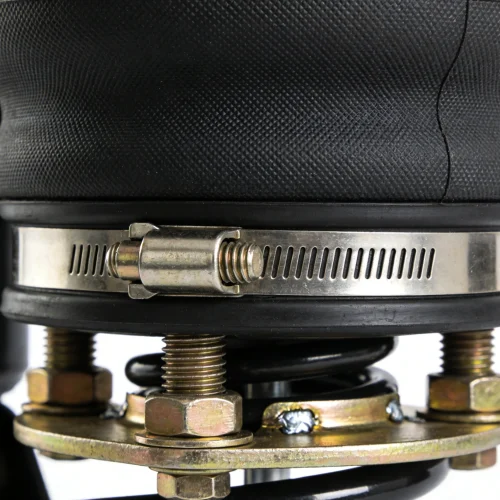
Close-up of heavy truck airbag shock absorber structure
🧠 Air Suspension and Shock Absorbers Work as a Combined Load Control System
In heavy-duty trucks, airbag systems and shock absorbers do not function independently. Instead, they work together as a combined load control system designed to stabilize vehicle height, absorb road impact, and maintain tire contact under varying load conditions.
Airbags are primarily responsible for adjusting ride height and supporting vertical load distribution, while shock absorbers control the speed of suspension movement and prevent excessive bouncing.When these two systems work in balance, the truck maintains stability whether it is running empty or fully loaded.
One of the key characteristics of heavy-duty truck suspension systems is that their behavior changes significantly depending on load conditions.When the truck is empty, air pressure in the airbags is lower, and suspension movement becomes more noticeable. When fully loaded, air pressure increases, reducing body movement but increasing system stress.
Shock absorbers must continuously adapt to these changing conditions to prevent uncontrolled oscillation and maintain tire-road contact.This dynamic behavior is one of the reasons why heavy-duty suspension systems require more precise maintenance compared to passenger vehicles.
⚠️ What Happens When Airbags and Shocks Are Not Balanced
If airbags and shock absorbers are not properly balanced, the entire suspension system begins to lose stability.For example, if air pressure drops due to leakage, the vehicle may sag, forcing shock absorbers to operate outside their optimal range. This increases rebound motion and accelerates wear on both shocks and tires.
Similarly, if shock absorbers are worn, airbags alone cannot control oscillation, leading to excessive bouncing and instability during braking or cornering.This imbalance creates a chain reaction across the suspension system.
🔥 Why Air Suspension Systems Reduce Tire Wear (When Working Properly)
When functioning correctly, air suspension systems significantly improve tire life by maintaining more consistent road contact and reducing uneven load distribution.Unlike traditional leaf spring systems, air suspension adjusts continuously to load changes, keeping the vehicle at a stable ride height.
This reduces abnormal tire deformation and helps distribute weight evenly across all axles, which improves both fuel efficiency and tire longevity.
💰 Fleet Impact of Poor Air Suspension Maintenance
From a fleet management perspective, air suspension issues often lead to hidden operational costs rather than immediate mechanical failure.Small leaks or pressure inconsistencies may not stop vehicle operation, but they gradually increase tire wear, fuel consumption, and driver fatigue.
Over time, this leads to higher maintenance frequency and reduced vehicle uptime, especially in long-haul operations.
Conclusion
Mastering the correct maintenance methods and product selection skills for it is vital for heavy-duty truck operation.
It can effectively reduce the occurrence of faults, ensure driving safety, improve transportation efficiency, and reduce overall operating costs.
For more professional knowledge, visit our Official Page.
This not only protects the vehicle and components but also brings more economic benefits to the operator.
❓ FAQ – Airbag Shock Absorber System
How do air suspension and shock absorbers work together in a truck?
Air suspension and shock absorbers work as a combined system where each component performs a different but complementary function.
Airbags are responsible for supporting vehicle weight and maintaining ride height by adjusting air pressure based on load conditions. Shock absorbers, on the other hand, control the speed of suspension movement and prevent excessive bouncing.
Without shock absorbers, airbags alone cannot control rebound motion. Without airbags, shocks alone cannot properly adjust for changing load conditions. Their coordination is essential for maintaining stability, especially in heavy-duty truck operations.
What happens if the air suspension system loses pressure?
If the air suspension system loses pressure, the ride height of the truck will drop on the affected axle or side. This creates an uneven load distribution across the suspension system.As a result, shock absorbers are forced to operate outside their normal damping range, which increases stress on both mechanical components and tires.
Continued operation in this condition can lead to instability, uneven tire wear, and additional strain on connected suspension components.
Why does a truck feel more unstable when air suspension is partially damaged?
A truck feels unstable when air suspension is partially damaged because the system can no longer maintain balanced load distribution.
Even if only one airbag is leaking or underperforming, the entire suspension geometry is affected. This causes uneven ride height, inconsistent damping response, and irregular tire contact with the road surface.
These small imbalances become more noticeable under load or during cornering, where suspension precision is critical for stability.
Can worn shock absorbers affect air suspension performance?
Yes, worn shock absorbers can significantly affect air suspension performance.
When shock absorbers lose damping efficiency, they allow excessive vertical movement that airbags alone cannot fully control. This leads to uncontrolled bouncing, increased stress on air components, and reduced ride stability.
Over time, this imbalance accelerates wear across the entire suspension system.
Why does air suspension feel softer than leaf spring suspension?
Air suspension feels softer because it uses compressed air to absorb and adjust load dynamically, rather than relying on fixed metal spring stiffness.
This allows the system to adapt to different load conditions in real time, resulting in smoother response to road irregularities.However, this softness is controlled by shock absorbers, which prevent excessive motion and ensure stability during driving.
What are the most common failures in airbag suspension systems?
The most common failures in airbag suspension systems include air leakage, valve block malfunction, uneven pressure distribution, and rubber fatigue over time.These issues often develop gradually due to continuous load cycles and environmental exposure such as temperature changes and road vibration.
If not detected early, these failures can lead to uneven ride height and reduced suspension efficiency.
How does air suspension affect tire life in heavy trucks?
Air suspension improves tire life by maintaining more consistent load distribution across all axles.When the system is functioning properly, it reduces uneven pressure on tires and minimizes abnormal tread wear patterns. This helps extend tire lifespan and improves overall fuel efficiency.
However, if air suspension is damaged or unbalanced, it can have the opposite effect and accelerate uneven tire wear.
Can air suspension problems increase fuel consumption?
Yes, air suspension problems can increase fuel consumption indirectly.When ride height is inconsistent or the vehicle is unstable, rolling resistance increases and aerodynamic efficiency decreases. The engine must work harder to maintain speed, especially under load conditions.
Over time, this leads to higher fuel usage and reduced operational efficiency in fleet applications.
Is it safe to drive a truck with a damaged air suspension system?
Driving with a damaged air suspension system is not recommended, especially under heavy load conditions.While the vehicle may still operate, reduced stability, uneven load distribution, and compromised shock absorption can increase safety risks.
In addition, continued operation can accelerate damage to related suspension components and increase repair costs.
How can air suspension and shock absorber systems be maintained properly?
Proper maintenance includes regular inspection of air pressure levels, leak detection in air lines and airbags, and monitoring shock absorber performance.
It is also important to check ride height consistency and ensure that suspension components are operating within normal load ranges.Preventive maintenance helps ensure system balance and reduces the risk of cascading suspension failures.