
Heavy-duty diesel trucks rely entirely on precise mechanical coordination inside the engine to cope with long-distance transportation, heavy-load climbing and complex road condition operations. The valve train system is the core guarantee of engine air intake, exhaust and combustion efficiency, while the rocker arm assembly acts as the key transmission component connecting the camshaft and engine valves. Unlike external wearing parts that are easy to inspect and replace, the rocker arm assembly is hidden under the valve cover, working in a high-temperature, high-pressure and high-frequency friction environment for a long time. It is one of the most easily ignored failure-prone parts in diesel engines, and also a major hidden danger leading to power attenuation, excessive fuel consumption and even engine cylinder damage for commercial vehicles.
A large number of on-site maintenance cases show that most truck power faults that cannot be solved by replacing filters, cleaning oil circuits and overhauling fuel injectors are ultimately caused by hidden wear and failure of the rocker arm assembly. For mainstream heavy-duty truck models including SINOTRUK HOWO, SITRAK C7H, SHACMAN X3000/X5000, FAW J6P/J7 and FOTON Auman EST, the rocker arm assembly maintains accurate valve timing under normal working conditions. However, long-term overload operation, inferior lubricating oil, non-standard maintenance and harsh driving environments will accelerate component aging, resulting in a series of progressive faults. Different from other engine parts, rocker arm failure has no sudden explosion damage in the early stage, and all faults are accumulated slowly, which is also the fundamental reason why many fleet owners and drivers miss the best maintenance time.
Most truck maintenance personnel have formed fixed maintenance thinking, focusing on visible and wearable parts such as tires, brakes, oil filters and water tanks, while ignoring the internal precision valve train components. The working state of the rocker arm assembly directly determines the opening and closing accuracy of the intake and exhaust valves. Once the wear gap increases, the spring fatigues or the roller is stuck, the valve timing will be disordered, the cylinder combustion balance will be broken, and a series of performance problems such as jitter, power weakness and black smoke will occur. This article will comprehensively elaborate the structural characteristics, working principles, full-stage failure symptoms, core inducements and standardized maintenance schemes of heavy-duty truck rocker arm assemblies, providing systematic technical guidance for truck daily maintenance and fault troubleshooting.
Basic Structure & Working Principle of Truck Rocker Arm Assembly
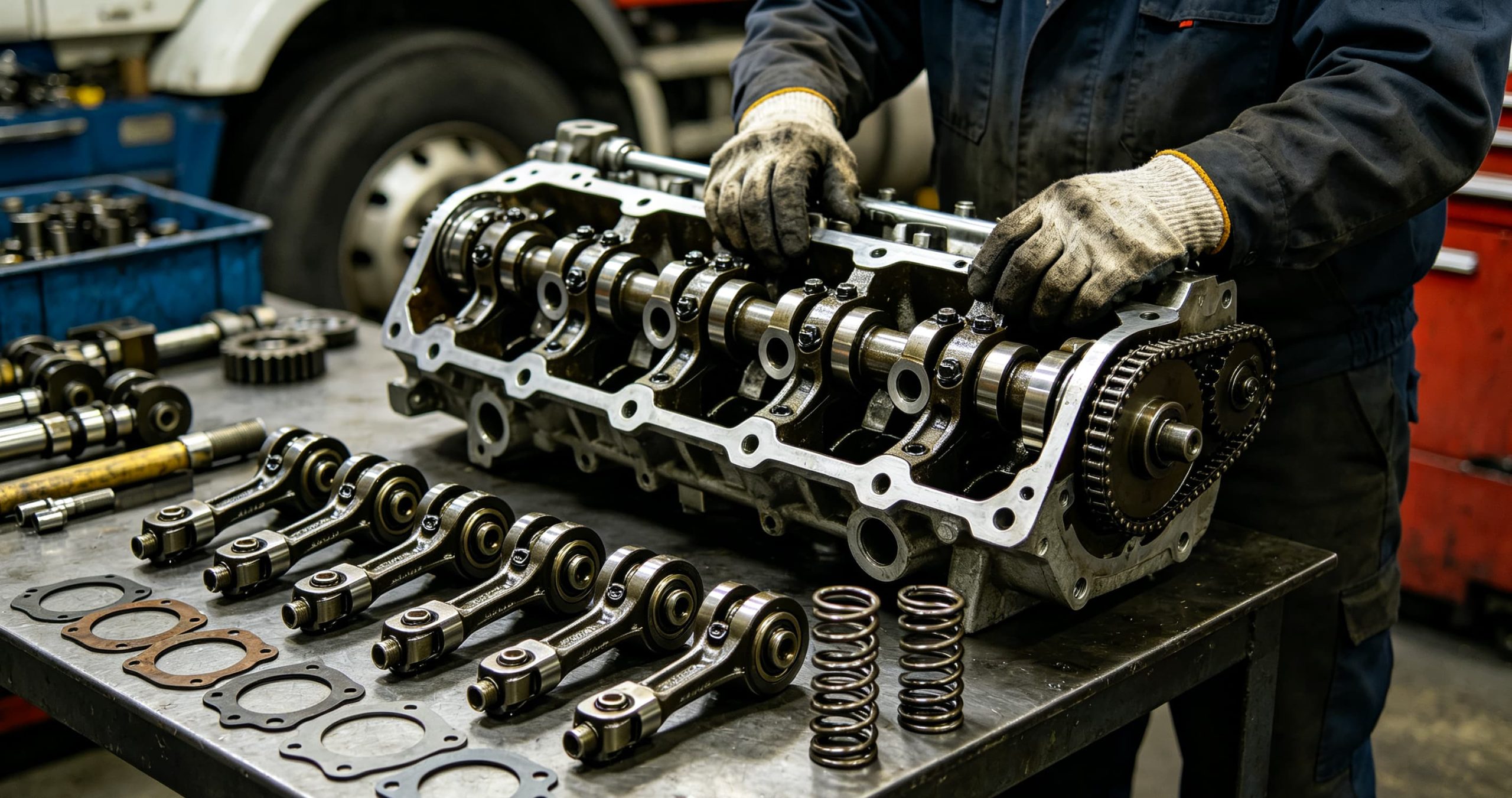
The rocker arm assembly of heavy-duty diesel trucks is a high-precision matching component group, which is completely different from the simple single rocker arm structure of light vehicles. In order to adapt to the high-load and high-frequency working environment of commercial vehicle engines, the assembly adopts integral forging technology and anti-wear optimization design, with higher structural strength and friction resistance. A complete set of rocker arm assembly includes multiple core matching parts, and each component cooperates with each other to complete the valve control work. The main components include forged rocker arm main body, wear-resistant rolling roller, roller pin shaft, fixed rocker shaft, shaft hole anti-wear bushing, reset torsion spring, limit snap ring, sealing gasket and anti-loose bolt assembly. Any abnormal state of a single part will affect the overall operation accuracy of the valve train.
The core working principle of the rocker arm assembly is lever mechanical transmission. The engine crankshaft drives the camshaft to rotate synchronously according to fixed timing parameters. The cam protrusion pushes the roller at the bottom of the rocker arm to generate upward thrust. With the middle rocker shaft as the fixed fulcrum, the rocker arm rotates and presses down the valve stem, so that the intake and exhaust valves are opened accurately. When the cam protrusion rotates past the roller position, the torsion spring drives the rocker arm to reset quickly, and the valve is tightly closed under the action of the valve spring. This cyclic reciprocating movement is carried out continuously during engine operation, controlling the intake air volume, exhaust efficiency and cylinder sealing state of each cylinder.
The rolling roller design is the key optimization of heavy-duty truck rocker arms. The traditional sliding friction structure is easy to wear and heat up under high load, while the rolling contact structure can greatly reduce friction resistance, avoid dry grinding of parts, and effectively extend the service life of the assembly. Since the entire rocker arm assembly is sealed inside the cylinder head valve cover, there is no external air cooling condition, and all heat dissipation and friction reduction depend entirely on engine oil splash lubrication. Therefore, the cleanliness, viscosity and high-temperature stability of engine oil are the key factors affecting the service life of the rocker arm assembly. Users who need to replace original matching engine accessories can select factory-standard parts through truck chassis system parts to ensure assembly accuracy and operation stability.
In actual engine operation, the rocker arm assembly needs to bear thousands of high-frequency impact loads every minute. Long-term continuous operation will inevitably produce subtle metal fatigue and wear. When the wear accumulates to a certain extent, the matching gap of the assembly exceeds the factory standard, and various failure symptoms will appear gradually. Understanding the working principle and structural characteristics is the premise of accurately distinguishing early faults and avoiding blind maintenance.
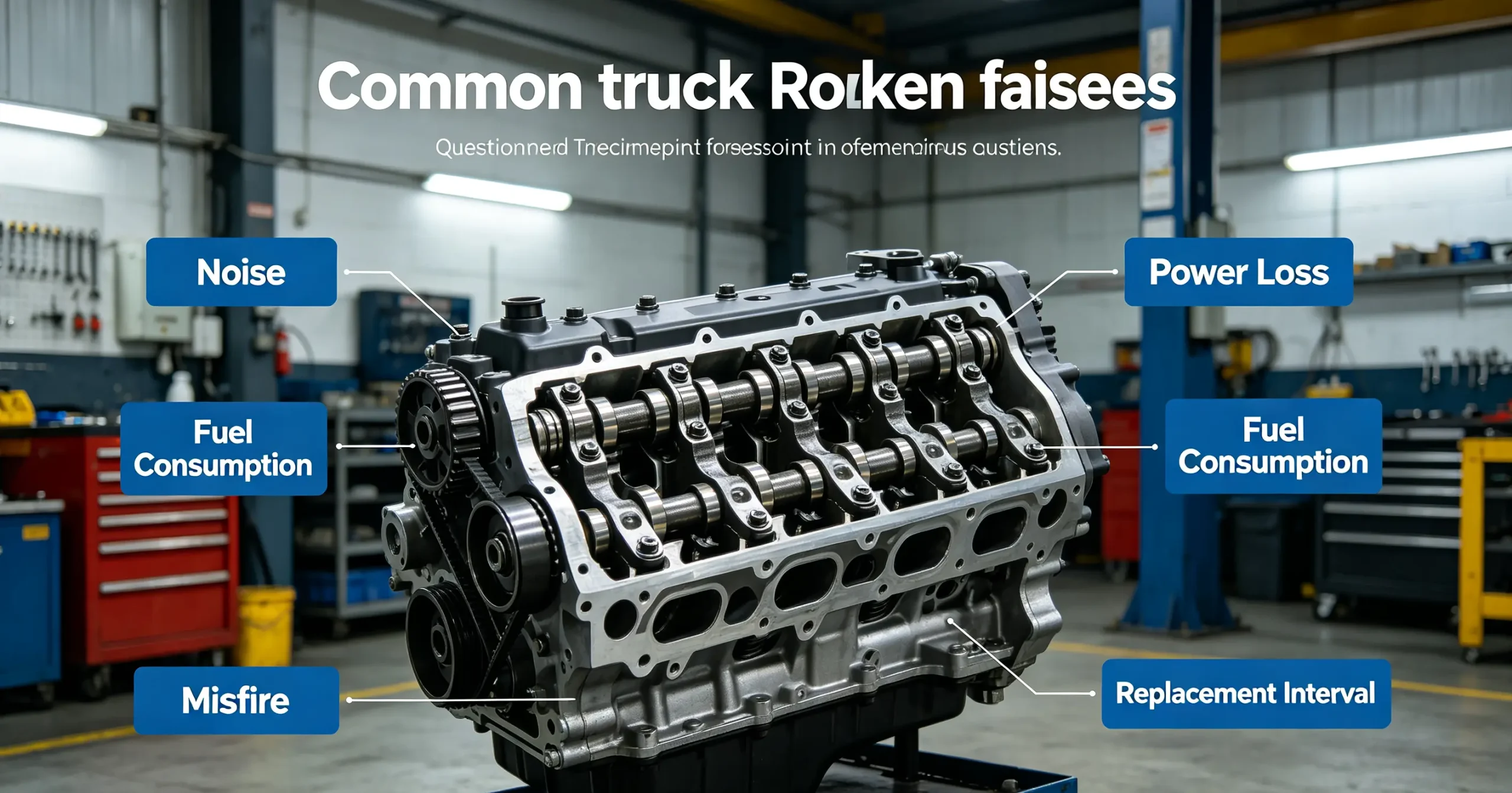
Full-Stage Failure Symptoms of Rocker Arm Assembly (Early/Middle/Late)
Rocker arm assembly failure is a typical progressive deterioration fault, which can be clearly divided into three stages: early latent wear stage, middle performance abnormality stage and late destructive damage stage. Each stage has obvious and distinguishable vehicle operation characteristics. Mastering these symptoms can help users quickly locate faults, eliminate hidden dangers at low cost, and avoid major engine overhaul losses caused by delayed maintenance.
1. Early Stage: Cold Start Ticking Noise & Subtle Idling Instability
The earliest warning signal of rocker arm wear is regular subtle ticking noise from the cylinder head valve cover, which is most obvious during cold start and low-temperature idling. In a low-temperature environment, the viscosity of engine oil increases, the fluidity becomes poor, and the lubricating oil cannot quickly circulate to the valve train parts. The wear gap formed by the rocker arm roller and shaft hole cannot be filled with the oil film, resulting in slight collision and friction during operation, forming a uniform ticking sound.
A typical feature of early faults is that the abnormal noise will gradually weaken or even disappear after the engine is warmed up. After the oil temperature rises, the oil fluidity is improved, a stable protective oil film is formed on the friction surface, and the metal thermal expansion reduces the wear gap, so the abnormal noise disappears temporarily. Most drivers will misjudge this phenomenon as normal cold start noise and ignore it. In fact, this is the most obvious early warning of rocker arm wear. With the continuous accumulation of wear, the gap will continue to expand, and the fault will gradually deteriorate.
In addition to abnormal noise, the early stage is also accompanied by extremely subtle idling jitter. The deviation of valve opening and closing timing leads to slight unbalanced combustion of each cylinder, resulting in small floating of engine speed. The jitter is not obvious in daily driving, but it can be clearly perceived when the vehicle is parked and idling with no load. This kind of subtle abnormality is far easier to repair than middle and late faults, and only needs oil replacement and gap inspection to solve the hidden danger.
2. Middle Stage: Power Decline, Increased Fuel Consumption & Intermittent Misfire
If the early wear hidden danger is not dealt with in time, the rocker arm gap will continue to increase, the roller wear will be aggravated, and the spring reset speed will be delayed, resulting in obvious valve timing deviation, entering the middle failure stage. At this stage, the most intuitive vehicle performance is insufficient power and delayed acceleration response. When the vehicle is loaded heavily and climbs uphill, the power is obviously weak, the accelerator sensitivity is reduced, and the speed rises slowly. There is no power burst during overtaking and emergency acceleration, which seriously affects transportation efficiency.
Disordered valve operation will lead to insufficient intake air and incomplete exhaust gas discharge in the cylinder. The diesel injected by the fuel injector cannot be fully mixed with air for full combustion, resulting in a large amount of unburned fuel forming carbon deposits. This not only causes obvious black smoke from the exhaust pipe during acceleration and load increase, but also directly leads to a significant increase in fuel consumption per 100 kilometers. Many fleet owners attribute the increase in fuel consumption to engine aging or emulsified engine oil problems, but the actual root cause is hidden rocker arm assembly wear.
In the middle failure stage, the engine will also have intermittent cylinder misfire. During high-speed driving and heavy-load operation, the engine will jitter obviously, and the exhaust sound is irregular. After cleaning the fuel injector and replacing the diesel filter, the fault still exists, which can confirm that the valve train mechanical wear is the core cause. At this stage, professional disassembly and inspection of the rocker arm assembly, replacement of worn parts and adjustment of valve clearance are required to restore engine performance.
3. Late Stage: Continuous Abnormal Noise, High Temperature Alarm & Destructive Engine Damage
When the rocker arm wear is serious and the spring is fatigued and failed, the fault will enter the late destructive stage. At this time, the ticking noise evolves into continuous loud metal knocking noise, which will not disappear after the engine is warmed up, and the noise increases synchronously with the increase of engine speed. The valve opening and closing timing is completely disordered, the cylinder combustion is seriously unbalanced, and the engine idling jitter is violent, even accompanied by automatic flameout during idling.
Long-term incomplete combustion and abnormal friction of parts will generate a large amount of heat, resulting in abnormal rise of engine water temperature and frequent high-temperature alarms. Continuous high-temperature operation will further aggravate metal deformation and fatigue of rocker arm parts, forming a vicious cycle. In the most serious case, the severely worn rocker arm will break, the stuck roller will fail to reset, and the valve will collide with the piston, resulting in valve bending, piston top damage and cylinder head deformation. Similar to heavy-duty truck cylinder head failure, this kind of destructive fault requires full engine overhaul, with extremely high maintenance costs and long vehicle downtime.
In addition, the abnormal combustion data generated by late rocker arm failure will be captured by the engine electronic control system, and fault codes such as cylinder misfire and valve train abnormality will be reported continuously, which cannot be eliminated by simple code clearing, and can only be solved by replacing the faulty assembly.
Core Root Causes of Rocker Arm Assembly Premature Failure
According to the statistical data of truck engine maintenance cases, the service life of genuine qualified rocker arm assemblies can reach 180,000-220,000 kilometers under standard working conditions and standardized maintenance. More than 90% of premature failures within 100,000 kilometers are caused by human operation errors, non-standard maintenance and inferior accessories, rather than natural aging of parts. The following is a detailed analysis of all core failure inducements to help users avoid maintenance misunderstandings.
1. Unqualified Lubricating Oil & Overdue Oil Replacement
Lubrication failure is the primary cause of rocker arm wear. Many individual truck drivers and small fleets choose low-cost inferior engine oil to save costs. Inferior oil has poor high-temperature stability, insufficient anti-wear additives, and is easy to thin and deteriorate after high-temperature operation, unable to form a stable protective oil film on the surface of rocker arm rollers and shaft holes, resulting in direct dry friction of precision parts and rapid wear.
In addition, overdue oil replacement and long-term non-replacement of oil filters will lead to a large amount of metal wear debris, carbon deposits and hard impurities accumulated in the oil circuit. These impurities circulate to the valve train working area with the engine oil, forming abrasive wear, continuously scratching the rocker arm friction pair, and accelerating component failure. Even if genuine rocker arm assemblies are installed, long-term use of unqualified lubricating oil will also lead to premature scrapping of parts.
2. Long-Term Overload Operation & Irregular Driving Habits
Most commercial trucks are in long-term overload operation state to pursue transportation benefits. Overload will sharply increase engine cylinder combustion pressure, making the rocker arm bear far higher impact load than the design standard. Long-term high-load impact will cause metal fatigue of the rocker arm main body and elastic fatigue of the reset spring, resulting in increased wear gap and insufficient reset capacity.
Frequent harsh driving behaviors such as rapid acceleration, sudden deceleration and slope rushing will generate instantaneous sharp load changes on the valve train system. The instantaneous impact force is directly transmitted to the rocker arm assembly, causing repeated stretching and impact of parts, aggravating fatigue damage, and greatly shortening the service life of the assembly. Long-term idle parking is also an easily overlooked inducement: idle operation reduces oil pump pressure, resulting in insufficient lubrication of cylinder head parts and hidden wear faults.
3. Non-Standard Assembly & Inaccurate Valve Clearance Adjustment
Rocker arm replacement and valve clearance adjustment are high-precision professional operations, which need to be completed with special tools and in strict accordance with factory parameters. Many grassroots maintenance shops have irregular operation processes: uneven bolt tightening torque, offset spring installation position, and inaccurate valve clearance debugging will lead to abnormal operating gaps of the rocker arm.
Excessively small valve clearance will make the rocker arm in a long-term compression state without reset margin, resulting in continuous fatigue load; excessively large clearance will cause violent collision of parts and abnormal noise. These non-standard installation behaviors are the main reasons for the re-failure of newly replaced rocker arm assemblies, leading to repeated faults that are difficult to solve.
4. Use of Inferior Imitation & Refurbished Accessories
In order to reduce short-term maintenance costs, many users choose ultra-low-price imitation rocker arm assemblies and second-hand refurbished parts. These unqualified products have serious defects in material forging, heat treatment process and dimensional precision. The alloy material has low hardness and poor fatigue resistance, unable to adapt to the high-frequency impact working environment of heavy-duty diesel engines.
Inferior rocker arm rollers are easy to jam and wear rapidly, the reset spring has insufficient elasticity and is easy to fatigue and break, and the assembly matching gap is out of tolerance. The failure recurrence rate of such accessories is extremely high, and it is easy to induce secondary faults such as valve collision and cylinder head damage. It is recommended that users cooperate with formal Sinotruk spare parts suppliers to purchase genuine matching assemblies to ensure maintenance quality.
5. Engine High-Temperature Fault & Supporting Component Aging
Cooling system faults such as radiator blockage, thermostat failure and insufficient coolant will cause long-term engine high-temperature operation. High temperature will cause thermal deformation of rocker arm metal parts, aging and failure of spring elasticity, and attenuation of oil lubrication performance, accelerating part wear and jamming.
In addition, the aging and failure of supporting valve train components will also indirectly cause rocker arm damage. Severe camshaft wear, fatigued valve springs and deformed valve stems will break the coordinated operation of the system, increase rocker arm operating resistance and impact force. Only replacing the rocker arm without checking supporting parts will lead to repeated faults in a short time.
Scientific Daily Maintenance & Fault Prevention Scheme
More than 90% of rocker arm assembly failures are preventable through standardized daily maintenance and scientific vehicle use habits. Formulating targeted maintenance plans can effectively extend the service life of valve train parts, eliminate early hidden dangers, and avoid costly engine overhaul losses. The following systematic maintenance schemes are suitable for all mainstream heavy-duty truck models and various harsh transportation scenarios.
First, strictly control lubrication quality and standardize oil replacement cycles. Always use brand-qualified engine oil and genuine filter elements that meet engine factory standards, and completely abandon inferior lubricating oil. Formulate differentiated replacement cycles according to working environments: 50,000 kilometers for standard highway transportation; shorten the cycle to 30,000-40,000 kilometers for harsh working conditions such as mining areas and construction sites to ensure clean oil circuits and sufficient lubrication of valve train parts.
Second, standardize driving habits and avoid overload and harsh operation. Strictly abide by the vehicle rated load standard, refuse long-term overload and over-speed driving, reduce frequent rapid acceleration and emergency braking, and avoid long-term idle parking. Timely turn off the engine when waiting for loading and unloading to prevent insufficient lubrication wear of rocker arm parts caused by low oil pressure during idling.
Third, establish daily valve train inspection mechanism. Take cold start abnormal noise, idle jitter, exhaust state and acceleration response as daily key inspection items. Carefully observe the engine operation state every day during cold start, and arrange professional disassembly and inspection in time once subtle abnormalities are found, so as to avoid minor faults deteriorating into destructive failures.
Fourth, adhere to full-set matching replacement. When the rocker arm assembly is worn and failed, replace the full set of rocker arms, rollers, springs, pin shafts and sealing gaskets uniformly, instead of replacing single parts. At the same time, comprehensively inspect the wear state of camshaft, valve spring and other supporting components, replace aging parts synchronously, and ensure the overall coordination of the valve train system.
Fifth, choose professional teams for standardized debugging. Rocker arm replacement and valve clearance adjustment must be completed by professional technicians with special tools. Strictly follow factory standard parameters to adjust clearance and control bolt tightening torque. After maintenance, conduct idle operation test and road test to verify stable valve train operation and no abnormal noise.
Sixth, maintain a healthy engine cooling system. Regularly clean radiator carbon deposits and dust, check coolant capacity and cleanliness, replace aging thermostats and water pipes in time, eliminate engine high-temperature hidden dangers, and provide a stable low-temperature working environment for rocker arm assemblies.
FAQ: Common Rocker Arm Assembly Fault Questions
Q1: Can I continue driving with rocker arm cold start ticking noise?
It is strictly prohibited to drive long-distance, high-speed and heavy-load with abnormal rocker arm noise. Mild cold start noise indicates early wear and poor lubrication. Continuous driving will accelerate part wear, lead to valve timing disorder, and eventually cause rocker arm fracture and valve collision damage. It is only allowed to drive at low speed for a short distance to the maintenance point for troubleshooting.
Q2: What is the replacement cycle of genuine truck rocker arm assembly?
Under standard maintenance and normal load conditions, the service life of genuine rocker arm assemblies is 180,000-220,000 kilometers. For vehicles with long-term overload, harsh working environments and irregular oil replacement, it is recommended to replace the assembly at 120,000-150,000 kilometers to eliminate hidden dangers in advance.
Q3: Why does rocker arm failure recur after replacement?
The main reasons for repeated faults are single-part replacement, unadjusted valve clearance, continued use of inferior lubricating oil, and failure to replace aging supporting components. Full-set genuine parts replacement and standardized parameter debugging are the fundamental solutions to avoid secondary failures.
Q4: How to distinguish rocker arm noise from timing chain noise?
Rocker arm abnormal noise is concentrated in the cylinder head valve cover position, obvious during cold start and weakened after warming up, and synchronized with engine speed. Timing chain noise comes from the engine front timing cover, presenting continuous rattling noise, which is less affected by temperature and has no obvious cold and hot difference.
Q5: Will rocker arm failure cause engine scrapping?
Early and middle-stage wear will only cause performance abnormalities without permanent engine damage. Late-stage rocker arm fracture and valve collision will cause irreversible damage such as valve bending, piston damage and cylinder head deformation. If not overhauled in time, it will lead to complete engine scrapping in severe cases.
Conclusion
As the core precision transmission component of heavy-duty truck diesel engine valve train system, the rocker arm assembly undertakes the key task of controlling valve opening and closing timing and stroke, and directly determines engine combustion efficiency, power stability and operational safety. Most premature failures of rocker arm assemblies are caused by non-standard maintenance, inferior lubricating oil, improper driving habits and unqualified accessories, rather than natural aging of genuine parts.
For fleet managers and individual truck drivers, establishing scientific valve train maintenance awareness is crucial to reducing vehicle failure rates and operating costs. Abandoning the neglect of hidden internal engine parts, standardizing daily lubrication and inspection, and choosing genuine matching parts and professional maintenance services can effectively avoid various rocker arm faults and costly engine overhaul. For full-series heavy-duty truck engine accessories and professional technical support, you can visit Mettlead to obtain one-stop matching solutions to protect the stable operation of logistics vehicles.


