
Why Truck Breakdowns Cost 5x More Than the Repair Bill
The Hidden Financial Impact of Unplanned Vehicle Failures
When a heavy-duty truck stops moving on the highway, the meter starts running — and it doesn’t stop at the tow bill. Most fleet operators and owner-operators drastically underestimate the true cost of truck breakdowns because they only see the repair invoice. The reality is far more complex, involving cascading losses that multiply with every hour of inactivity.
After more than a decade covering logistics technology and fleet management, I’ve seen companies lose tens of thousands of dollars from a single roadside failure. This article breaks down exactly where that money goes, why prevention is cheaper than reaction, and how to evaluate suppliers who claim to save you from these scenarios.
Direct Costs: What Shows Up on the Invoice
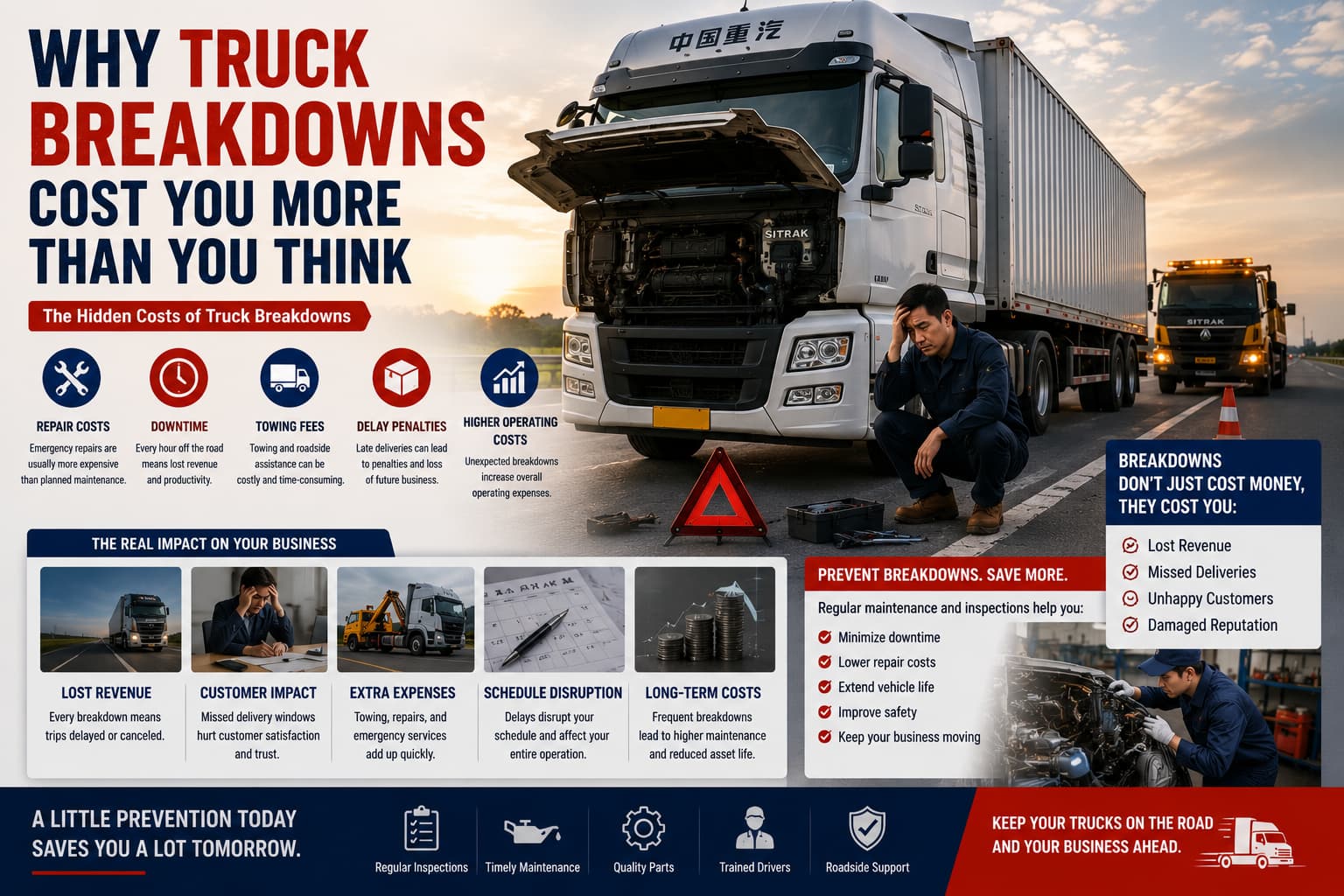
The most visible expense is the repair itself — parts, labor, and towing. But even these “obvious” costs are often higher than expected. Emergency roadside repair expenses typically carry a 40–60% premium over scheduled shop work due to urgency surcharges, after-hours labor rates, and limited parts availability.
| Cost Category | Scheduled Maintenance | Emergency Roadside Repair |
|---|---|---|
| Labor Rate (per hour) | $85–$120 | $150–$250+ |
| Towing (per mile) | N/A | $8–$15 (heavy-duty) |
| Parts Markup | 10–20% | 30–80% |
| Average Total Bill | $400–$1,200 | $2,500–$8,000+ |
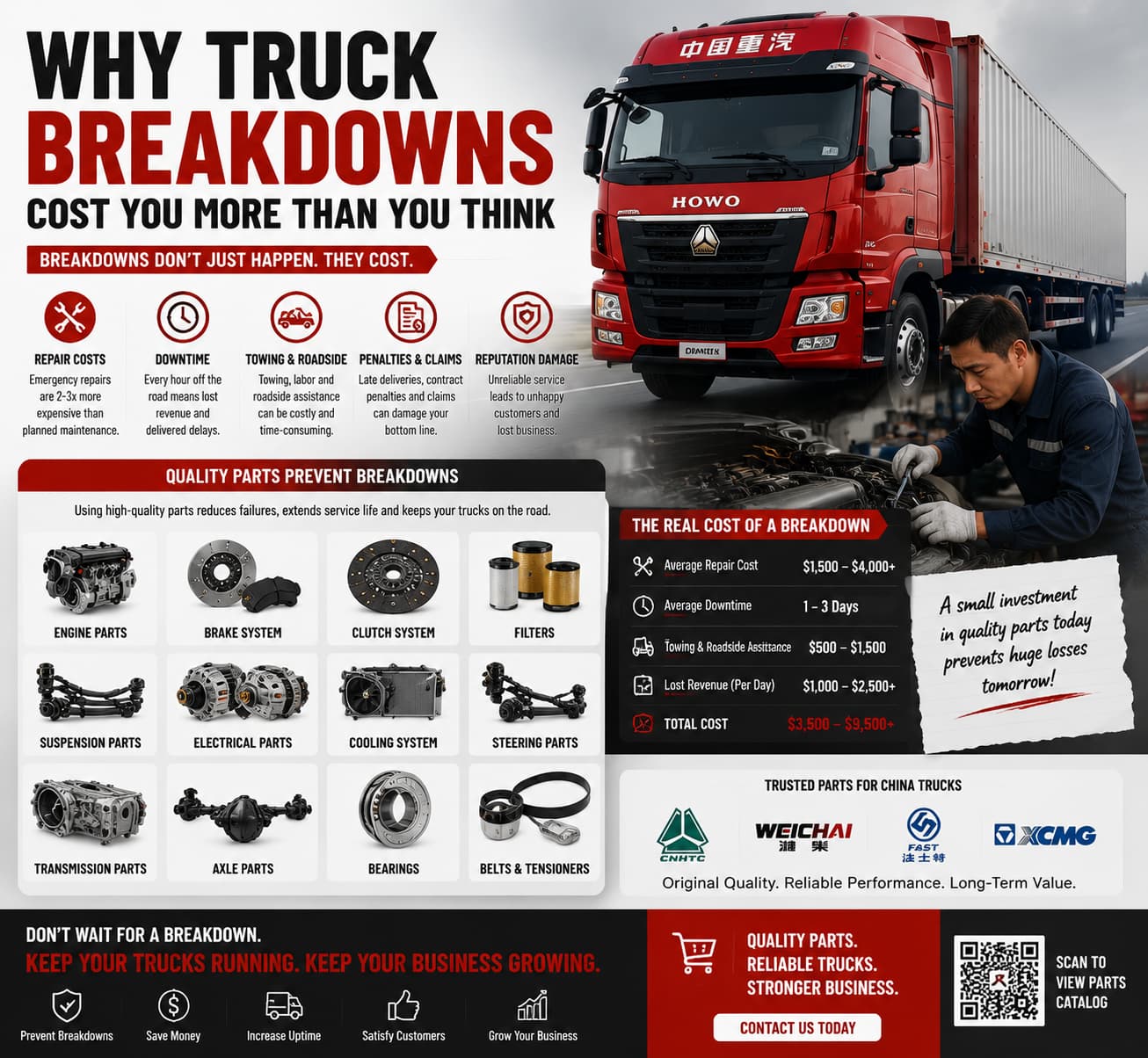
According to the American Transportation Research Institute’s 2025 operational cost analysis, the average unplanned repair event costs $4,200 in direct expenses alone. For fleets operating older equipment without reliable truck parts sourcing, that figure climbs significantly.
Indirect Costs: The Invisible Drain on Profitability
Lost Revenue and Contractual Penalties
A Class 8 truck generates approximately $600–$900 per day in revenue. Every day it sits idle represents pure income loss. For time-sensitive freight — refrigerated goods, just-in-time manufacturing components, or retail inventory — late delivery penalties can reach 5–15% of the load value.
Fleet downtime costs extend beyond the single vehicle. Dispatchers scramble to reroute loads, drivers sit idle on the clock, and customer relationships erode. One logistics manager I interviewed for a cooperative case study reported losing a $1.2 million annual contract after three late deliveries caused by mechanical failures in a single quarter.
Driver Retention and Morale
Drivers stranded on the shoulder waiting for emergency truck breakdown service 24/7 aren’t just losing hours — they’re losing patience. The driver shortage crisis means every frustrated operator who quits costs $8,000–$12,000 in recruitment and training expenses. Unreliable equipment is consistently ranked among the top three reasons drivers leave a carrier.
Insurance and Compliance Consequences
Repeated mechanical failures trigger higher insurance premiums. Carriers with above-average out-of-service rates during DOT inspections face increased audit frequency and potential CSA score degradation. A poor safety rating doesn’t just cost money — it can cost you the authority to operate.
Common Causes of Highway Failures and Their True Price Tags
Understanding common causes of truck breakdowns on highway helps quantify prevention value. The data consistently points to a handful of repeat offenders that account for the majority of unplanned stops.
| Failure Type | Frequency (%) | Average Total Cost (Direct + Indirect) | Preventable? |
|---|---|---|---|
| Tire blowouts | 28% | $3,800 | Largely yes |
| Electrical/battery | 18% | $2,900 | Yes |
| Cooling system failure | 15% | $6,500 | Yes |
| Brake system issues | 14% | $5,200 | Yes |
| Engine/fuel system | 12% | $9,400 | Partially |
| Transmission/drivetrain | 8% | $12,000+ | Partially |
| Other | 5% | Varies | Varies |
The critical insight: over 75% of these failures are preventable through proper inspection routines and quality replacement components. Cooling system failures spike dramatically in warm months, which is why understanding how to prevent truck breakdowns in summer — through coolant system inspections, belt replacements, and radiator maintenance — delivers outsized ROI between May and September.
The Low-Price Parts Trap: A Cautionary Analysis
Here’s where experience matters. In my years covering this industry, I’ve documented a consistent pattern: operators who chase the cheapest replacement components end up paying 3–5x more in total cost of ownership. The initial savings evaporate when a $40 water pump fails at 15,000 miles instead of the expected 80,000.
Red Flags When Evaluating Parts Suppliers
- Pricing 50%+ below OEM equivalents — legitimate cost savings exist, but extreme discounts signal substandard materials or counterfeit products
- No warranty or vague return policies — reputable suppliers stand behind their products
- Missing certifications — look for ISO compliance, material test reports, and proper packaging
- No technical documentation — quality manufacturers provide installation specs and torque values
- Reluctance to provide references — established suppliers have verifiable track records
When comparing vendors, prioritize those offering comprehensive technical support alongside their products. A supplier who helps you select the correct part and provides installation guidance is investing in your success — not just making a sale.
How to Vet a Supplier Properly
Request material certifications and cross-reference part numbers against OEM specifications. Examine their product category brand portfolio — do they carry recognized names with established quality records? Check whether they organize inventory by product category system (engine, braking, cooling, electrical), which indicates technical expertise rather than generic reselling.
A trustworthy partner will also be transparent about their company history and capabilities. Review their about us page for manufacturing partnerships, warehouse locations, and industry experience. These details separate serious operations from fly-by-night traders.
Prevention Economics: The Numbers That Matter
Preventive maintenance savings are not theoretical — they’re measurable. The Technology & Maintenance Council reports that every $1 spent on scheduled maintenance prevents $4–$8 in emergency repair costs. For a 50-truck fleet, this translates to $180,000–$400,000 in annual savings.
“The most expensive part on any truck is the one that fails unexpectedly. Commercial vehicle reliability isn’t built on luck — it’s built on discipline, data, and quality components.” — Fleet Maintenance Professional Association, 2025 Annual Report
Truck breakdown assistance for commercial vehicles has improved dramatically with telematics and predictive diagnostics. Modern systems can flag failing components weeks before catastrophic failure. But technology only works when paired with action — and action requires having the right parts available when needed.

Building a Resilient Maintenance Strategy
Step 1: Audit Your Current Failure Patterns
Pull 12 months of repair orders and categorize by system, cause, and whether the failure was scheduled or unplanned. Most fleets discover that 60–70% of their emergency events trace back to 2–3 recurring system weaknesses.
Step 2: Establish Critical Parts Inventory
Based on your failure analysis, stock the components most likely to cause roadside events. Belts, hoses, filters, brake components, and electrical parts should never be on backorder. Partner with a supplier who maintains deep inventory and can ship within 24–48 hours.
Step 3: Implement Interval-Based Replacement
Don’t wait for failure. Replace wear items at manufacturer-recommended intervals — or earlier if your operating conditions are severe. Desert heat, mountain grades, and stop-and-go urban delivery all accelerate component degradation.
Step 4: Train Drivers as First-Line Inspectors
A thorough pre-trip inspection catches 80% of impending failures. Invest in driver training that goes beyond checkbox compliance. Teach them what a failing U-joint sounds like, how to spot a glazed belt, and when coolant color indicates contamination.
Real-World Cost Comparison: Reactive vs. Proactive
| Metric | Reactive Fleet (20 trucks) | Proactive Fleet (20 trucks) |
|---|---|---|
| Annual unplanned events | 38 | 8 |
| Average downtime per event | 2.4 days | 0.8 days |
| Total annual downtime days | 91.2 | 6.4 |
| Revenue lost to downtime | $68,400 | $4,800 |
| Emergency repair costs | $159,600 | $33,600 |
| Preventive maintenance budget | $24,000 | $72,000 |
| Total maintenance + downtime cost | $252,000 | $110,400 |
| Annual savings | — | $141,600 |
The proactive fleet spends three times more on scheduled maintenance yet saves $141,600 annually. That’s the math trucking operational losses create when left unmanaged. The numbers scale linearly — a 100-truck fleet following reactive practices hemorrhages over $700,000 per year in preventable costs.
When a Failure Happens: Minimizing the Damage
Even the best-maintained fleet will experience occasional mechanical failures. When searching for truck breakdown recovery near me in a crisis, response time determines whether you lose hours or days. Have these resources pre-arranged:
- Contracted roadside service providers along your primary routes
- Pre-negotiated towing rates (avoid surge pricing during emergencies)
- A parts supplier with expedited shipping capabilities — contact us options that include phone and WhatsApp for immediate response
- Backup driver and vehicle deployment protocols
Frequently Asked Questions
What is the average cost of an unplanned heavy-duty vehicle failure?
When combining direct repair expenses with indirect losses (revenue, penalties, driver downtime), the average unplanned failure costs between $4,200 and $12,000 depending on severity and duration. Engine and transmission failures sit at the high end, while tire and electrical issues are typically less expensive but more frequent.
How often should commercial trucks receive preventive maintenance?
Most manufacturers recommend comprehensive inspections every 10,000–15,000 miles, with oil and filter changes at shorter intervals. However, severe-duty applications (construction, mountain routes, extreme temperatures) should shorten these intervals by 20–30%. Daily pre-trip inspections remain the single most effective prevention tool.
Are aftermarket parts safe to use for critical truck systems?
Quality aftermarket components that meet or exceed OEM specifications are both safe and cost-effective. The key is sourcing from reputable suppliers who provide material certifications, proper fitment data, and warranty coverage. Avoid unbranded parts with no documentation — the savings aren’t worth the risk of catastrophic failure.
How can I identify a reliable parts supplier versus a low-quality trader?
Look for suppliers with verifiable industry history, organized product catalogs by vehicle system, technical support staff who understand applications, transparent pricing without hidden fees, and documented partnerships with recognized manufacturers. Request references from existing customers operating similar equipment to yours.
What are the most effective ways to reduce fleet downtime?
The highest-impact strategies are: implementing strict interval-based component replacement, maintaining critical parts inventory, using telematics for predictive diagnostics, training drivers on thorough pre-trip inspections, and establishing pre-contracted emergency service relationships along primary routes. Combined, these practices typically reduce unplanned events by 70–80%.


