
Understanding How a Turbocharger Works (And Why It Fails)
The Basic Mechanics
A turbocharger uses exhaust gas energy to spin a turbine wheel, which is connected via a shaft to a compressor wheel on the opposite side. The compressor draws in ambient air, pressurizes it, and forces it into the engine’s intake manifold. More air means more fuel can be burned, which means more power — simple physics, elegant engineering.
The shaft connecting both wheels rides on bearings lubricated by engine oil. These bearings are the turbo’s Achilles’ heel. Any interruption in oil supply, contamination, or excessive heat can destroy them in minutes. According to turbocharger manufacturer data published in 2025, approximately 90% of premature turbo failures trace back to oil-related issues rather than manufacturing defects.
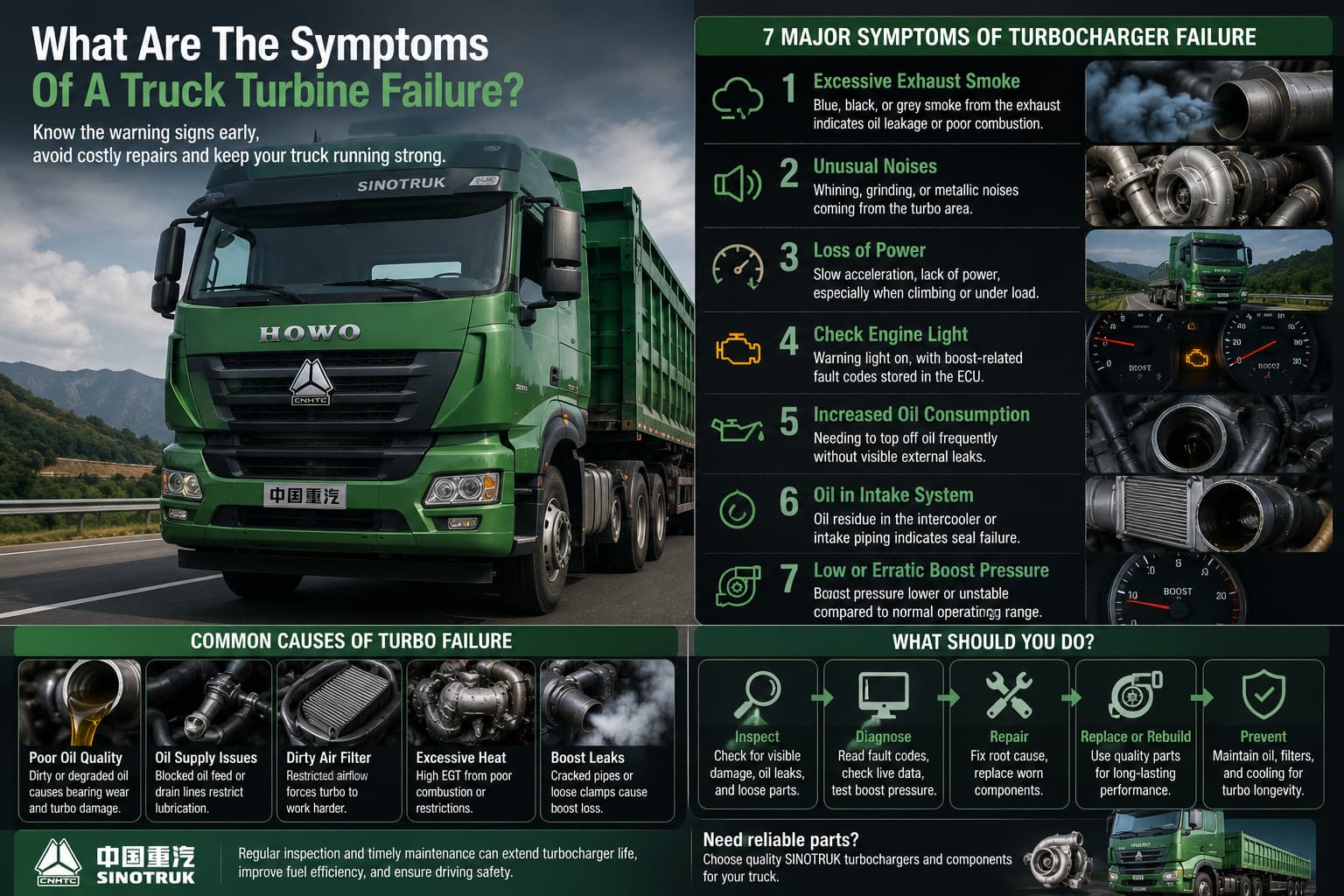
Common Root Causes of Failure
- Oil starvation: Blocked oil feed lines, low oil levels, or degraded oil that can’t lubricate properly
- Foreign object damage: Debris entering through the intake or exhaust side
- Excessive exhaust temperatures: Often caused by fueling issues or restricted airflow
- Worn seals: Age and thermal cycling eventually degrade internal seals
- Boost leak: Cracked intercooler pipes or loose clamps that allow pressurized air to escape
The Major Warning Signs of Turbocharger Failure
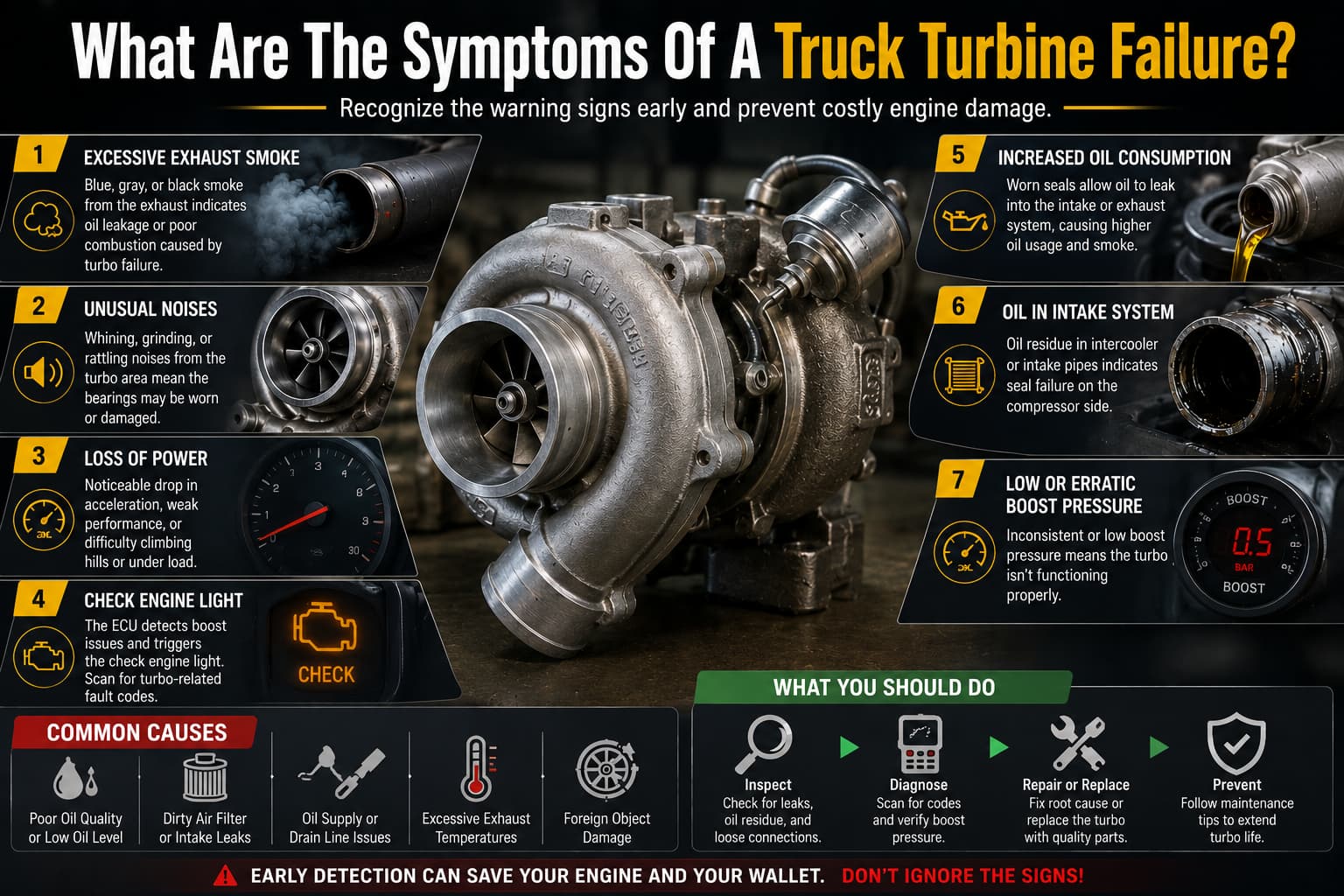
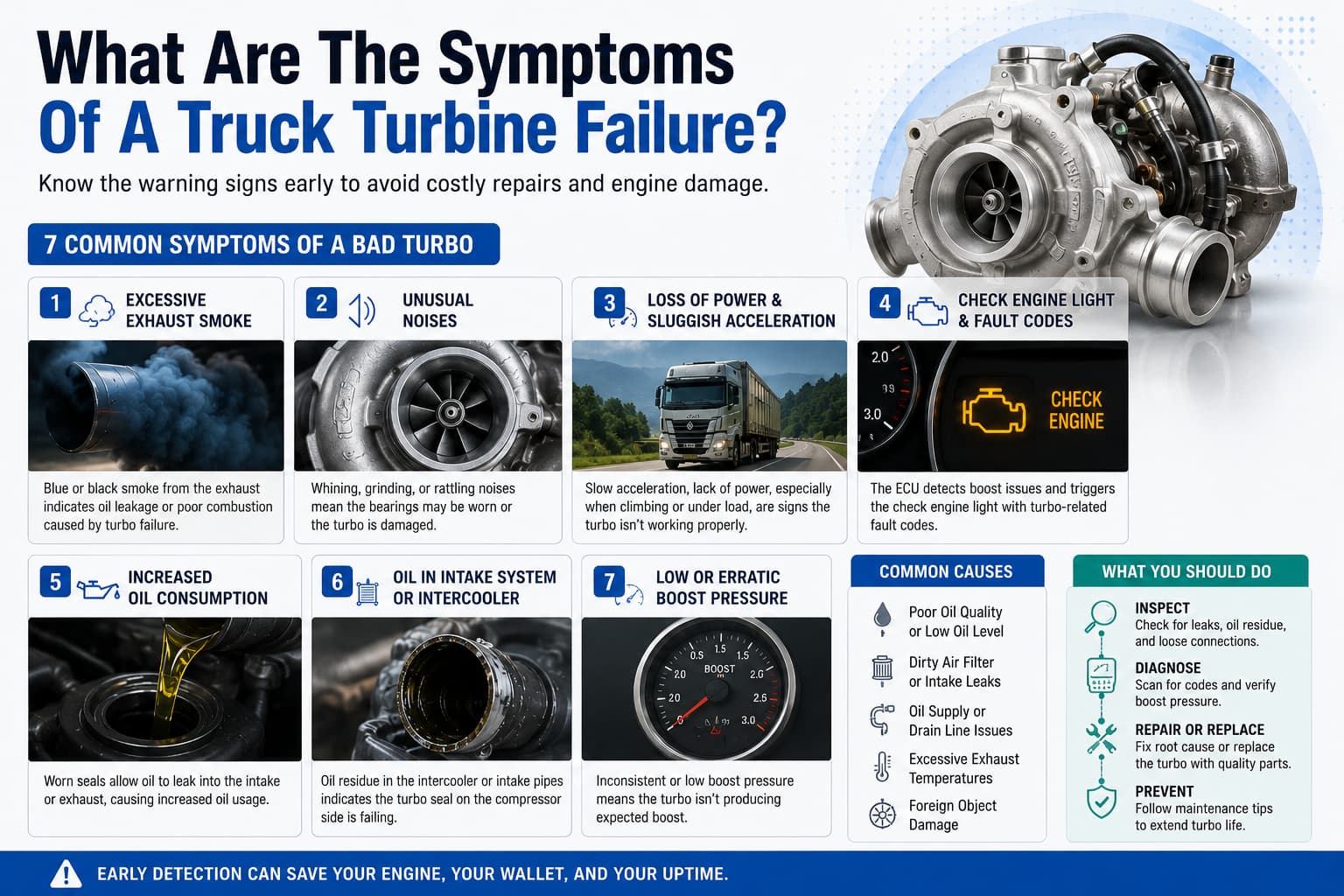
1. Excessive Exhaust Smoke
One of the most visible indicators is a change in your exhaust output. Blue or grey smoke typically indicates that oil is leaking past worn turbo seals and being burned in the combustion chamber. Black smoke, on the other hand, suggests the engine is running rich — possibly because the turbo isn’t delivering adequate boost pressure and the ECU is compensating incorrectly.
Don’t ignore colored smoke at startup or under load. While a brief puff on a cold morning might be normal, persistent smoke signals internal seal degradation that will only worsen over time. Left unchecked, oil consumption increases dramatically, and you risk fouling your diesel particulate filter or catalytic converter.
2. Unusual Noises — The Whining and Grinding
A healthy turbocharger produces a smooth, almost musical whistle under boost. When bearings wear or the compressor wheel contacts its housing, that pleasant sound transforms into something far less reassuring. A whining turbo noise that changes pitch with engine speed is a classic early warning sign.
Grinding, scraping, or metallic rattling sounds are more severe. These indicate the shaft has enough play that the wheels are physically contacting the housings. At this stage, failure is imminent. If you hear these sounds, reduce load immediately and get the unit inspected before fragments enter your engine.
3. Loss of Power and Sluggish Acceleration
When your truck feels like it’s hauling twice its actual load, the turbocharger is a prime suspect. A failing unit cannot generate adequate boost pressure, resulting in noticeable loss of power acceleration — particularly when climbing grades or attempting to overtake. The engine management system may also trigger limp mode to protect against further damage.
This symptom is particularly dangerous for heavy-duty trucks operating at gross vehicle weight. Reduced power on an incline doesn’t just affect your schedule; it creates a genuine safety hazard for you and other road users.
4. Check Engine Light and Boost-Related Fault Codes
Modern trucks are equipped with sophisticated sensors that monitor boost pressure, exhaust gas temperature, and turbo shaft speed. When readings fall outside expected parameters, the ECU stores diagnostic trouble codes (DTCs) and illuminates the check engine light. Common codes include P0299 (underboost), P0234 (overboost), and manufacturer-specific turbo performance codes.
Don’t simply clear these codes and hope for the best. They exist to protect your engine from secondary damage. A proper diagnosis requires reading live data, not just snapshot codes.
5. Increased Oil Consumption
If you’re topping off your oil more frequently without any visible external leaks, the turbo’s internal seals may be allowing oil to pass into either the intake or exhaust tract. This oil is being burned — contributing to that smoke we discussed earlier — and starving the turbo of the very lubrication it needs to survive.
A healthy turbocharger should consume virtually no oil. Any measurable increase in consumption warrants inspection of the turbo’s compressor and turbine sides for oil residue.
6. Oil in the Intercooler or Intake Piping
During routine maintenance, check your intercooler and intake pipes for oil accumulation. A small film is sometimes acceptable on high-mileage units, but pooling oil indicates significant seal failure on the compressor side. This oil can also reduce intercooler efficiency, raising intake temperatures and further stressing the engine.
Diagnostic Comparison: Turbo Failure vs. Other Engine Problems
One of the trickiest aspects of diagnosing turbocharger issues is that many symptoms overlap with other engine problems. Understanding how to tell if your turbo is going bad — versus dealing with a different issue entirely — requires systematic troubleshooting. The comparison between bad turbo symptoms vs blown head gasket is particularly common, as both can produce smoke and power loss.
| Symptom | Turbocharger Failure | Blown Head Gasket | Injector Problems |
|---|---|---|---|
| Blue/grey exhaust smoke | Yes — oil past seals | White/sweet-smelling (coolant) | Black smoke (excess fuel) |
| Power loss | Gradual, worse under load | Sudden or progressive | Misfires, rough running |
| Coolant loss | No | Yes — often into combustion | No |
| Oil in intake system | Yes | No (coolant may appear) | No |
| Unusual noise | Whining, grinding | Possible ticking | Knocking, ticking |
| Overheating | Rare | Common | Possible |
| Boost pressure | Low or erratic | May be normal initially | Normal |
A compression test, coolant pressure test, and boost leak test can help differentiate between these conditions. When in doubt, consult experienced technical support professionals who specialize in heavy-duty diesel systems.
The Troubleshooting Process: A Step-by-Step Approach
Step 1: Visual Inspection
Start with the basics. Remove the intake pipe from the turbo’s compressor inlet and inspect the wheel. Look for blade damage, oil residue, and shaft play. Grab the shaft and check for radial (side-to-side) and axial (in-and-out) movement. Minimal play is normal; anything you can feel with your fingers is excessive.
Step 2: Check the Air Intake Path
Inspect the entire intake system from the air filter to the turbo inlet. A collapsed hose, clogged filter, or debris in the airbox can cause the turbo to work harder than designed, accelerating wear. Ensure all clamps are tight and there are no cracks in the piping.
Step 3: Inspect the Exhaust Side
Look for signs of excessive heat (discoloration), cracks in the exhaust manifold, or restrictions in the exhaust system. A blocked DPF or catalytic converter creates backpressure that forces exhaust gases past the turbo’s seals.
Step 4: Oil System Evaluation
Verify oil level, condition, and pressure. Check the oil feed line to the turbo for restrictions or carbon buildup. Inspect the oil drain line — if it’s kinked or blocked, oil backs up inside the turbo and forces past the seals. This is one of the most overlooked causes of apparent turbo failure.
Step 5: Electronic Diagnostics
Connect a diagnostic scanner capable of reading live boost pressure data. Compare actual boost to target boost across the RPM range. A significant deviation confirms the turbo isn’t performing to specification. Variable geometry turbochargers (VGTs) should also have their vane position tested for proper actuation.
Diesel Engines: Special Considerations
Heavy-duty diesel trucks place extraordinary demands on their turbochargers. The combination of high compression ratios, sustained heavy loads, and extended operating hours means that bad turbo symptoms diesel engine applications tend to manifest differently than in lighter vehicles. Diesel turbos often fail gradually over tens of thousands of kilometers rather than suddenly.
Fleet operators should implement proactive monitoring programs. Tracking boost pressure trends, oil consumption rates, and exhaust gas temperatures over time reveals degradation patterns long before a driver notices performance changes. According to fleet maintenance data, early intervention reduces total repair costs by 40-60% compared to running a turbo to complete failure.
For those managing multiple vehicles, understanding the signs of a failing turbo in a car versus a heavy truck is important. Passenger vehicles typically show symptoms more dramatically due to their lighter mass and more responsive power delivery. Trucks may mask early degradation simply because drivers attribute sluggishness to load weight.
Solutions: Repair, Rebuild, or Replace?
When Repair Makes Sense
Minor issues like a boost leak from a cracked intercooler pipe or a sticking VGT actuator can often be repaired without replacing the entire turbocharger. These fixes are relatively inexpensive and can restore full performance. Always address the root cause — simply fixing the symptom guarantees a repeat failure.
Rebuilding: The Middle Ground
A turbo rebuild involves disassembling the unit, replacing worn bearings, seals, and sometimes wheels, then rebalancing the rotating assembly. This is a viable option when the housings are undamaged and the shaft isn’t scored. Quality rebuilds can deliver near-new performance at a fraction of replacement cost.
Full Replacement: When It’s Time
If the compressor or turbine wheels are damaged, the housings are cracked, or the shaft is worn beyond tolerance, replacement is the only safe option. When sourcing a new turbocharger, quality matters enormously. Cheap aftermarket units with poor metallurgy or inadequate balancing will fail prematurely, costing you more in the long run.
This is where choosing the right parts supplier becomes critical. Reliable Truck Parts from established suppliers ensure you’re getting components manufactured to OEM specifications. You can explore options by product category brand or by product category system to find the exact turbocharger assembly your application requires.
Prevention: Keeping Your Turbo Healthy
The best repair is the one you never need. Follow these practices to maximize turbocharger lifespan:
- Use quality oil and change it on schedule. Turbo bearings depend on clean, properly graded oil. Extended drain intervals are the enemy.
- Allow proper cool-down. After sustained high-load operation, idle for 60-90 seconds before shutdown. This allows the turbo to slow down while oil is still circulating.
- Maintain the air filtration system. A clogged filter creates a vacuum on the compressor inlet that pulls oil past seals.
- Fix oil leaks promptly. Low oil level means reduced flow to the turbo — even briefly.
- Address fault codes immediately. Don’t drive with active boost-related DTCs.
- Inspect during routine service. A 5-minute visual check of the turbo during oil changes catches problems early.
Many fleet operators who follow these practices report turbocharger lifespans exceeding 500,000 kilometers. Those who neglect maintenance often see failures before 200,000 km. The math speaks for itself.
Real-World Impact: What Happens When You Ignore the Signs
We’ve seen cases through our cooperative case studies where fleet operators delayed turbo replacement despite clear warning signs. In one instance, a logistics company continued operating a truck with obvious turbo seal failure for three weeks. The result? Oil contamination destroyed the DPF system, fouled the EGR valve, and caused premature wear on the piston rings. What would have been a straightforward turbo replacement became a major engine overhaul.
The lesson is clear: turbo failure signs are your truck communicating a problem. Listening early saves money, prevents downtime, and keeps your drivers safe on the road.
Understanding Repair Costs: What to Expect
While specific pricing varies by application and region, understanding the relative cost structure helps with budgeting. When evaluating bad turbo symptoms and repair cost implications, consider that the turbocharger itself is only part of the equation. Labor, associated gaskets, oil lines, and potentially contaminated downstream components all factor in.
| Repair Type | Relative Cost | Typical Downtime | Longevity |
|---|---|---|---|
| Boost pipe/clamp repair | Low | 1-2 hours | Permanent fix |
| VGT actuator replacement | Low-Medium | 2-4 hours | Long-term |
| Turbo rebuild (quality shop) | Medium | 1-3 days | Near-new lifespan |
| Full turbo replacement (OEM-spec) | Medium-High | 4-8 hours | Full new lifespan |
| Turbo failure + secondary damage | High-Very High | Days to weeks | Varies |
The takeaway? Early diagnosis and quality replacement parts always cost less than delayed action. For specific part availability and sourcing assistance, don’t hesitate to contact us directly.
Why Parts Quality Matters More Than You Think
Not all replacement turbochargers are created equal. The internal components spin at speeds where even microscopic imbalances create destructive vibrations. Inferior bearings, poorly cast wheels, and inadequate heat treatment of housings all contribute to premature repeat failures.
When selecting replacement components, look for suppliers with verifiable quality control processes, proper balancing equipment, and a track record in the heavy-duty market. Learn more about us and our commitment to supplying genuine-quality turbocharger assemblies and components for commercial vehicle applications.
A quality turbocharger, properly installed with fresh oil and clean lines, should deliver years of reliable service. Cutting corners on the part itself is a false economy that experienced fleet managers learned to avoid long ago.
Frequently Asked Questions
Can I drive my truck with a failing turbocharger?
Technically, yes — but it’s strongly inadvisable. A degraded turbo that’s leaking oil can contaminate downstream emission components, damage the engine through oil starvation, or shed fragments into the exhaust or intake. Continued operation transforms a moderate repair into a major overhaul. Reduce load, limit speed, and get it inspected as soon as possible.
How long does a truck turbocharger typically last?
With proper maintenance — quality oil, regular changes, clean air filtration, and appropriate cool-down procedures — a heavy-duty turbocharger can last 400,000 to 700,000 kilometers. Neglected units may fail in under 150,000 km. The variable isn’t usually the turbo’s quality; it’s the care it receives throughout its service life.
What’s the difference between turbo lag and turbo failure?
Turbo lag is the brief delay between pressing the accelerator and feeling boost pressure build — it’s normal and inherent to all turbocharged engines. Turbo failure manifests as a permanent reduction in power, unusual sounds, smoke, or complete absence of boost. If your truck used to pull strongly at 1,800 RPM and now feels flat until 2,500 RPM (or never recovers), that’s not lag — that’s a problem requiring diagnosis.
Can a faulty wastegate mimic turbocharger failure?
Absolutely. A stuck-open wastegate allows exhaust to bypass the turbine, resulting in low boost and sluggish performance that feels identical to internal turbo damage. Conversely, a stuck-closed wastegate causes overboosting, which can damage the engine. Wastegate function should always be verified before condemning the turbocharger itself. This is a common misdiagnosis that leads to unnecessary replacements.
Should I replace the turbo oil feed and drain lines when installing a new unit?
Yes — this is considered best practice by every major turbocharger manufacturer. Old feed lines may contain carbon deposits that restrict flow, and drain lines can be partially blocked or kinked. Installing a new turbo on contaminated lines is like giving a patient a heart transplant without cleaning the arteries. Fresh lines, fresh oil, and a new oil filter at installation give your replacement turbo the best possible start.


