
For heavy-duty operators, the honest answer is that truck brake pads should not be replaced by mileage alone. A long-haul tractor running mostly flat highways may travel far longer between brake services than a dump truck, mixer, or mountain-route vehicle that stops under heavy loads dozens of times per shift. The better rule is to inspect, measure, record, and replace truck brake pads before they reach a risk zone: many fleets schedule replacement when pad friction material approaches 4–5 mm, well before the common U.S. federal minimum of 3.2 mm for air disc brake pads and far before a roadside out-of-service problem can stop the vehicle unexpectedly.
The practical replacement rule is simple: inspect truck brake pads at every preventive maintenance interval, measure the thinnest friction material on both inboard and outboard pads, and replace them early enough that the truck will not drop below legal or fleet safety limits before its next scheduled service.
The reason this matters is not just compliance. A loaded truck carries enormous kinetic energy, and brake pads convert that energy into heat. When pads become thin, glazed, cracked, contaminated, or separated from the backing plate, they lose their ability to manage heat and friction consistently. Stopping distance increases, rotor damage accelerates, and the vehicle may begin to pull, vibrate, smoke, grind, or lose braking response. In fleet operations, delaying a low-cost brake pad replacement can become a roadside violation, a damaged rotor and caliper set, or a catastrophic crash.
| Operating Condition | Suggested Inspection Focus | Practical Replacement Trigger |
|---|---|---|
| Long-haul highway freight | Measure pad thickness during scheduled PM and tire service | Replace before the next PM if pads are near 4–5 mm or unevenly worn |
| Urban delivery and refuse work | Inspect more frequently because of repeated stops | Replace at early wear signs, heat checking, glazing, or rapid wear trend |
| Mountain routes and heavy payloads | Inspect after severe downhill routes or overheating events | Replace immediately if pads show cracks, smoke damage, glazing, or loss of response |
| Construction, mining, and dump trucks | Inspect for contamination, debris scoring, and heat damage | Replace in axle sets when pads are contaminated, tapered, or structurally damaged |
| Mixed fleets | Track wear by vehicle, axle, route, and driver behavior | Use recorded wear rate to forecast replacement before legal limits |
Why There Is No Single Mileage Interval for Truck Brake Pads
Some general maintenance guides suggest that semi-truck brakes may last around 100,000 miles or several years in favorable service, while other heavy-duty or stop-and-go applications can require replacement far sooner. The problem with a fixed mileage number is that it ignores the variables that actually wear truck brake pads: payload, terrain, trailer weight, brake balance, driver technique, retarder use, caliper condition, rotor surface, pad compound, and environmental contamination. A truck descending grades at high gross weight can consume brake capacity much faster than a lightly loaded highway tractor using engine braking and predictive driving.
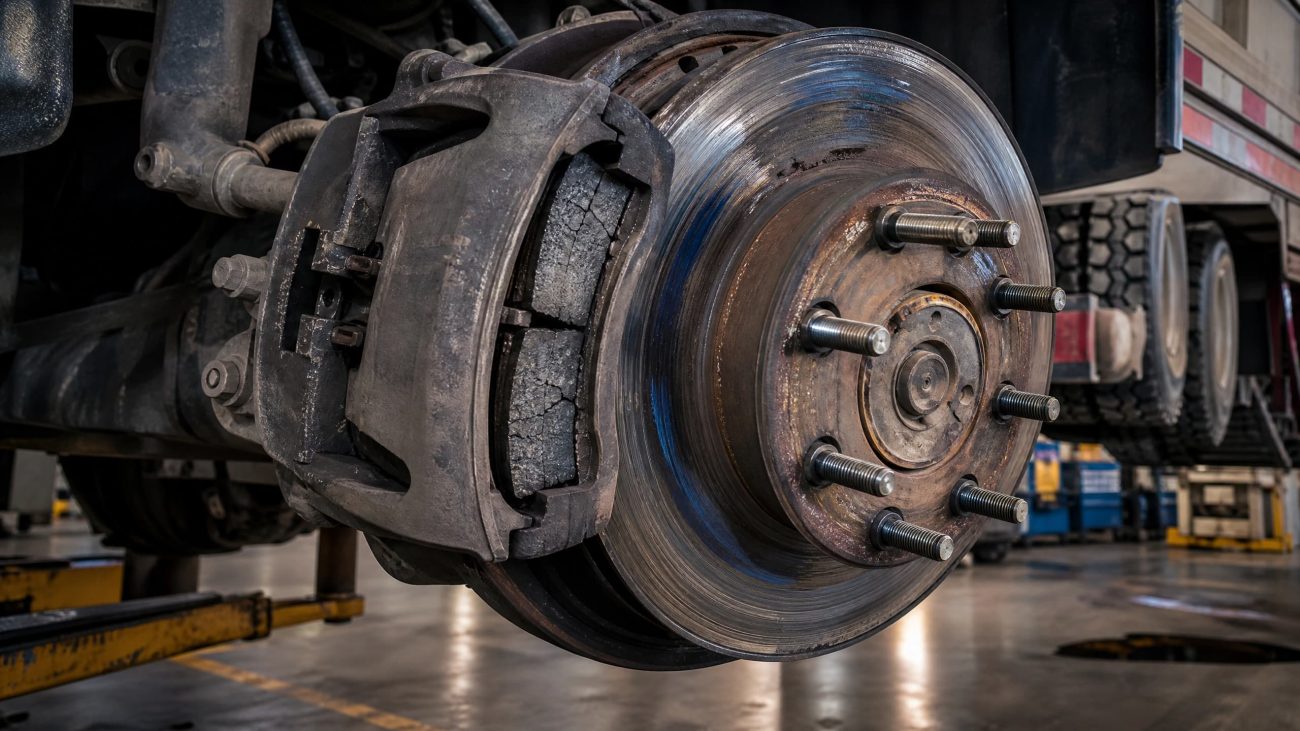
The most defensible approach is therefore not “replace every X miles,” but “replace when measurement, condition, or performance says the pads are approaching end of service.” Under 49 CFR §393.47, brake components must be constructed, installed, and maintained so they provide safe and reliable stopping and prevent excessive fading and grabbing. For air disc brakes, steering axle pad thickness must not be less than 3.2 mm, and non-steering axle disc brake pads must also not be operated below 3.2 mm. For air drum configurations with shoes, the rules differ by axle and lining type, including 4.8 mm or 6.4 mm limits in specified steering-axle cases and 6.4 mm for non-steering air-braked drum linings.
| Measurement or Symptom | What It Means | Recommended Action |
|---|---|---|
| Pad material near 4–5 mm | Approaching fleet planning limit | Schedule replacement before the next service gap |
| Pad material at 3.2 mm on air disc brakes | At or near legal minimum in U.S. federal rule | Replace; do not continue dispatching the vehicle |
| Inboard pad much thinner than outboard pad | Caliper slide, guide pin, or alignment issue | Replace pads and repair the cause of uneven wear |
| Grinding or metal scraping | Friction material may be gone | Stop operation and inspect pad, rotor, and caliper damage |
| Burning odor or smoke | Overheating, dragging brake, contamination, or severe duty | Inspect immediately and replace affected pads if heat damaged |
| Cracked, glazed, oily, or separating pads | Friction performance is compromised | Replace pads and correct leak, heat, or hardware cause |
The Serious Consequences of Ignoring Worn Truck Brake Pads
Brake failures are rarely mysterious when investigators look closely. They often involve a chain of small decisions: a visual inspection instead of a measurement, a brake problem “adjusted” rather than diagnosed, a truck released with uneven braking, or a fleet running parts until the last millimeter to save money. The following cases show how brake maintenance failures can become tragedies.
Case 1: Mountainburg, Arkansas — Three Children Killed After a Truck Could Not Stop
In 2001, a tractor-trailer left Interstate 540 near Mountainburg, Arkansas, reached the bottom of an exit ramp, and failed to stop before colliding with a school bus. Three children were killed. According to reporting on the National Transportation Safety Board’s findings, the crash was attributed to brakes that were poorly maintained and inadequately inspected. Investigators found that eight of the truck’s ten brakes were either out of adjustment or nonfunctional, and four could provide no braking force even before accounting for heat buildup and drum expansion on hilly terrain.
The most chilling lesson is that the driver had visually inspected the brakes that morning, yet the problem remained hidden because the inspection did not include the necessary measurement of pushrod stroke. In other words, the truck looked ready, but the braking system was already compromised. For fleet managers, this is the difference between a checklist culture and a measurement culture. Truck brake pads and brake linings must be measured, documented, and trended, not merely glanced at.
Case 2: Glen Rock, Pennsylvania — A Runaway Dump Truck Hits Cars and Children on a Sidewalk
In 2003, a dump truck descended a steep grade in Glen Rock, Pennsylvania. The driver could not stop. The truck struck four passenger cars, and one of those cars struck three children on the sidewalk. A driver and an 11-year-old child were killed, while other occupants and pedestrians suffered injuries. The NTSB found that the owner’s lack of oversight allowed an untrained driver to operate an overloaded air-brake-equipped vehicle with inadequately maintained brakes. Mechanics had also misdiagnosed the truck’s underlying brake problems, particularly around automatic slack adjusters and brake system maintenance.
This case is especially important for operators who assume that “adjusting the brakes” is the same as fixing the brakes. It is not. When pads, linings, slack adjusters, calipers, rotors, drums, chambers, or air systems are not working together, the safe response is a full diagnosis. A new set of truck brake pads installed on seized hardware or damaged rotors may wear quickly and still leave the truck unsafe.
Case 3: North American Brake Safety Week — Thousands of Trucks Stopped for Brake Violations
The Commercial Vehicle Safety Alliance’s 2025 Brake Safety Week gives a broad view of how common brake problems remain. Inspectors in 52 North American jurisdictions conducted 15,175 commercial motor vehicle inspections, and 2,296 vehicles were placed out of service for brake-related violations, a 15.1% out-of-service rate. The most cited reason was that 20% or more of the vehicle’s service brakes were out of service, with 1,199 such violations.
These numbers are not abstract. Each out-of-service vehicle represents a delivery interrupted, a driver delayed, a customer disappointed, and a safety risk that should have been resolved before the vehicle reached the road. For fleets, proactive brake pad management is therefore both a safety system and a business continuity system.
| Source or Case | What Happened | Lesson for Fleets |
|---|---|---|
| Mountainburg, Arkansas crash | Three children died after a tractor-trailer with many ineffective brakes hit a school bus | Visual checks are not enough; measure brake condition and adjustment |
| Glen Rock, Pennsylvania crash | Runaway dump truck killed two people after brake maintenance and training failures | Brake repair must diagnose root causes, not just symptoms |
| CVSA Brake Safety Week 2025 | 2,296 vehicles placed out of service for brake-related violations | Brake pad and brake system programs prevent downtime and enforcement risk |
How Fleet Operators Should Manage Truck Brake Pads
A professional fleet should treat truck brake pads as a controlled safety inventory, not as emergency consumables ordered only when a driver hears grinding. The strongest programs combine inspection discipline, data tracking, technician training, stock planning, and supplier reliability.
First, fleets should define brake pad inspection intervals based on duty cycle. A highway tractor may be inspected at every preventive maintenance interval, while refuse trucks, concrete mixers, mining trucks, port tractors, and mountain-route vehicles may require shorter intervals. Inspection should include pad thickness at the thinnest point, inboard and outboard comparison, rotor condition, caliper movement, guide pins, wear sensors, cracks, glazing, contamination, and signs of overheating.
Second, fleets should record pad thickness by vehicle, axle, and wheel end. When readings are stored over time, the fleet can calculate wear rate and predict replacement dates. A vehicle that loses 1 mm every 15,000 km should not be managed the same way as one losing 1 mm every 50,000 km. This data also identifies hidden problems, such as a route that consumes brakes quickly, a driver who brakes aggressively, or a caliper that causes one side to wear faster.
Third, fleets should replace pads in matched axle sets and inspect the surrounding brake hardware. Replacing only one wheel end can create imbalance, while installing new pads on damaged rotors or sticking calipers can shorten pad life. The best practice is to inspect rotors or drums, calipers, slides, guide pins, chambers, slack adjusters, hoses, air dryers, valves, and sensors during the same service event.
| Fleet Management Item | Best Practice | Business Value |
|---|---|---|
| Inspection records | Track pad thickness by wheel position | Predict replacements and reduce roadside failures |
| Minimum fleet threshold | Replace near 4–5 mm instead of waiting for the legal minimum | Prevent violations and protect rotors |
| Matched replacement | Replace pads by axle set | Maintain balanced braking torque |
| Root-cause repair | Inspect calipers, rotors, guide pins, valves, and air system | Avoid repeat failures and uneven wear |
| Stock planning | Keep fast-moving brake pads and hardware in reserve | Reduce vehicle downtime during peak work |
| Supplier qualification | Verify OEM numbers, materials, packaging, and batch consistency | Protect safety and avoid wrong-fit parts |
Spare Truck Brake Pads: What a Fleet Should Keep in Stock
The right spare-parts policy depends on fleet size, route distance, service network, and truck model diversity. A small owner-operator may keep one emergency axle set and rely on a supplier for replenishment. A regional fleet should keep a rolling stock of high-turn brake pads, wear sensors, retaining kits, caliper hardware, and common air brake components. A large fleet should build minimum and maximum inventory levels based on actual consumption.
A practical reserve model is to keep enough truck brake pads to cover the next planned service window plus emergency failures. If a fleet operates many Sinotruk HOWO or Sitrak units, standardizing pad references by VIN, axle model, and OEM number reduces wrong-part risk. The reserve should include related components that often determine whether a brake job is completed in one visit: pad fitting kits, wear sensors, rotor or drum options, guide-pin kits, seals, air dryer cartridges, valves, and hoses.
The inventory policy should also distinguish between safety stock and dead stock. Safety stock supports predictable maintenance and emergency replacement. Dead stock is the result of ordering unclear part numbers, mixing incompatible brands, or buying low-quality pads that drivers and technicians refuse to use. Brake parts are safety-critical; price matters, but consistency, fitment, friction stability, and supplier support matter more.
How to Source Sinotruk Truck Brake Pads from China
For buyers operating Sinotruk HOWO, Sitrak, and related Chinese heavy-duty trucks, sourcing brake system parts from China can be cost-effective when the supplier can verify model compatibility, OEM part numbers, material options, packaging, and export documentation. This is where a specialized truck-parts exporter can reduce risk.
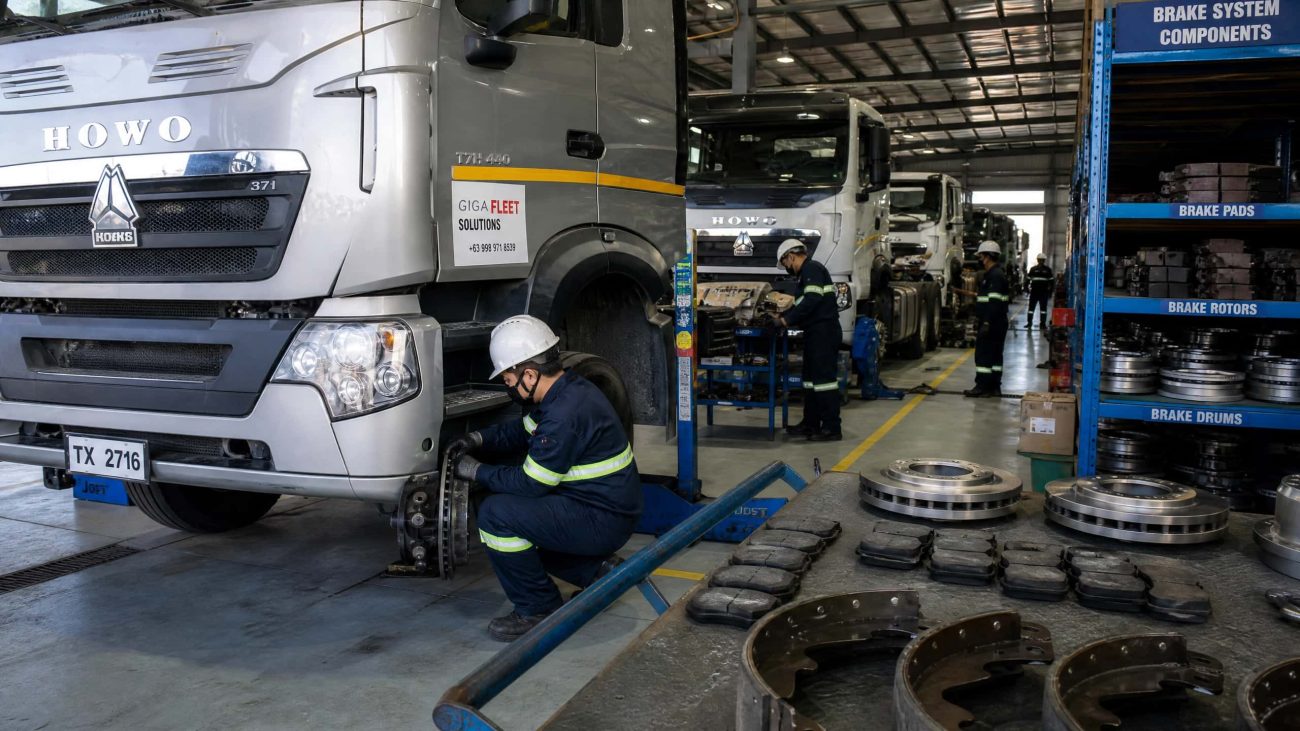
Mettlead positions itself as a China-based supplier of heavy-duty truck and machinery spare parts, with a dedicated braking category covering brake pads, shoes, and air brake components. Its site describes long-term experience in truck and after-sales parts export, 24/7 procurement support, a large warehouse, integrated procurement, and support for brands including Sinotruk, Sitrak, Shacman, Foton, FAW, DFM, Beiben, XCMG, Shantui, LiuGong, SDLG, Weichai, Cummins, Yuchai, and Shangchai.
A natural procurement approach is to send the supplier your truck model, VIN if available, axle model, current brake pad photos, OEM number, target quantity, and destination country. For fleets, it is also useful to provide your operating environment, such as mountain roads, city delivery, construction sites, hot climate, or high dust exposure. That information helps match the pad type and supporting brake components to the actual duty cycle.
| Step | What the Buyer Prepares | What the Supplier Should Confirm |
|---|---|---|
| 1. Identify the Part | Truck model, VIN, axle, OEM number, pad photos | Co (Content truncated due to size limit. Use line ranges to read remaining content) |
2. Confirm specification
Quantity, duty cycle, quality level, packaging needs
Material, fitment, MOQ, lead time, and warranty policy
3. Quote and PI
Destination port/city and preferred Incoterm
Unit price, freight option, payment terms, and delivery schedule
4. Pre-shipment check
Label requirements and documents needed
Photos, packing list, invoice, certificates, and batch information
5. Export and import
Broker contact and local compliance requirements
China export declaration and logistics coordination
6. After-sales replenishment
Wear data and feedback after installation
Future stock plan and cross-reference sup
Import Method: From China Supplier to Your Country
Importing truck brake pads is usually straightforward when classification and documentation are handled early. The exact HS code varies by country and product description. Brake linings and pads not containing asbestos may fall under HS 6813.81 in many tariff systems, while brake systems, servo-brakes, and many brake parts are commonly handled under HS 8708.30 or national subcodes. Because customs classification affects duty, admissibility, and inspection requirements, importers should confirm the final code with a local customs broker before shipment.
The typical trade flow begins with product confirmation and quotation. After the buyer approves the proforma invoice, the supplier prepares stock or production, confirms packaging, and arranges pre-shipment inspection photos. Logistics can move by courier for urgent samples, by air for high-value emergency replenishment, by LCL sea freight for moderate orders, or by FCL sea freight for fleet-scale stock. The supplier then prepares commercial invoice, packing list, export declaration, and any documents required by the destination country. At arrival, the buyer or broker completes customs clearance, pays duty and VAT if applicable, and arranges final delivery.
For buyers who are not sure which route is suitable, the safest approach is to contact the supplier first with destination details. After you contact Mettlead, the team can guide you through the import method that fits your country, including part confirmation, documentation, shipping mode, customs coordination, and replenishment planning. This guidance is especially useful for fleet buyers who want repeated shipments rather than one-time emergency purchases.
Final Answer: When Should Truck Brake Pads Be Replaced?
Replace truck brake pads when measurement, condition, or performance shows they will not safely last until the next service interval. In a practical fleet program, that usually means replacing them before they fall below 4–5 mm, immediately replacing pads that are cracked, glazed, contaminated, separating, unevenly worn, or causing grinding and overheating, and never operating below applicable legal limits such as 3.2 mm for air disc brake pads under U.S. federal rules.
The safest fleets do not wait for noise, smoke, or an inspection violation. They measure every wheel end, record wear trends, replace pads in balanced sets, inspect the entire brake system, and keep reliable spare stock on hand. Brake pads are small compared with the size and value of a heavy truck, but when they are ignored, the consequences can be measured in lost vehicles, stopped freight, legal exposure, and lives.


