
Definition in plain words
“Truck gear boxes” is the everyday way many drivers and buyers refer to the gearbox (transmission) that turns engine power into usable wheel torque and road speed.
If the engine speaks “high-rpm horsepower” and the wheels speak “low-speed pulling,” the gearbox is the translator in the middle—sometimes a bit grumpy, but always essential.
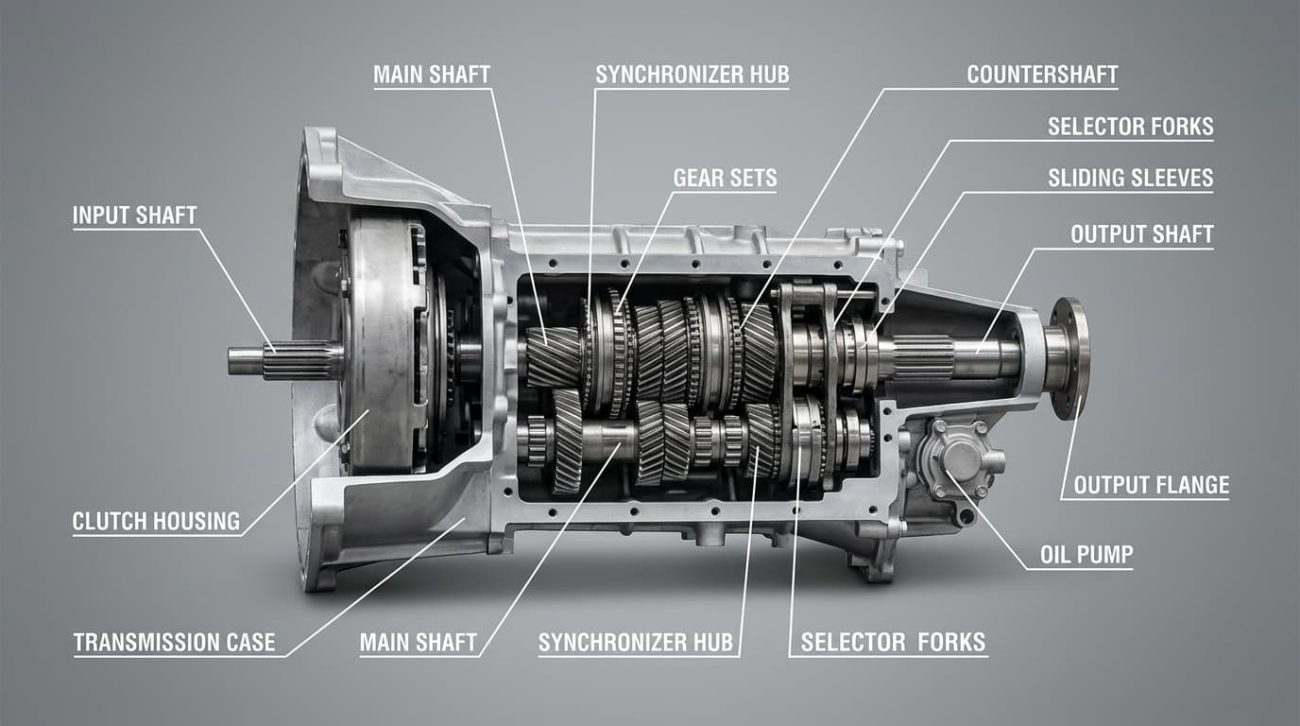
Where it sits in the drivetrain
In most heavy-duty layouts, power flows like this: engine → clutch (or torque converter) → gearbox → driveshaft → axle.
On tractors and rigid trucks, the commercial vehicle gearbox usually sits right behind the engine, with PTO options for vocational equipment when required.
Common types you’ll see on heavy-duty trucks
- Manual truck gearbox (fully manual or AMT-ready): simple, durable, driver-skill dependent.
- AMT (automated manual): manual hardware with automated shifting/clutch actuation—popular for fleets chasing consistency.
- Allison-style automatic: often used in specific vocational segments; smooth in stop-start work but can be costlier and heavier.
Truck Gear Boxes in Heavy-Duty Operations (Middle East-focused context)
Why heavy-duty trucks need “strong personalities” in gearboxes
Heavy-duty truck transmission systems live under high torque, long pulls, and frequent load spikes—exactly the kind of moments that separate “works fine” from “why is it whining now?”
Add hot weather, long highway stretches, and occasional overload scenarios, and your gearbox quickly learns the meaning of overtime.
Middle East reality check (useful operational context)
Across the Middle East, fleets often run long highway corridors between ports, industrial zones, and inland cities—high sustained speeds, high ambient temperatures, and heavy gross weights.
In Gulf summers, ambient temperatures commonly reach 40–50°C in many areas, raising thermal stress on oils, seals, and bearings—especially if maintenance intervals drift or oil spec is off.
Example anchor: SINOTRUK (中国重汽) typical scenarios in the Middle East
Take a SINOTRUK tractor: on a Dubai-to-Riyadh style long-haul pattern, the gearbox spends hours in top gears managing heat and rpm efficiency.
Move that same SINOTRUK into construction or quarry hauling, and the commercial vehicle gearbox suddenly faces low-speed shock loads, frequent starts, and higher risk of overheating—like asking the same person to do office work in the morning and a CrossFit session at noon.
Key Specs That Actually Matter When Choosing Truck Gear Boxes
Torque rating (Nm) and why it’s the “don’t lie to me” number
Input torque rating is the gearbox’s truth serum: it must cover engine peak torque plus a realistic safety margin for load spikes.
In hot climates and heavy start-stop duty, that margin matters more than brochure optimism.
Gear count & ratio spread (climb vs cruise)
More gears (or smarter spacing) helps keep the engine in its efficient band, especially when loads and gradients change.
A wider ratio spread with a low crawler gear improves startability and reduces clutch heat—your clutch will thank you by not smelling like burnt toast.
Overdrive/direct top gear and fuel economy
Overdrive top gears reduce cruise rpm at highway speed, which can reduce fuel use and noise—if the truck still has enough torque to hold speed without lugging.
In Middle East heat, lower rpm can also reduce some thermal load, but only if the engine isn’t being forced into inefficient low-rpm, high-load operation.
Synchronizers, bearings, and shaft design
The truck transmission parts that often “complain” first are synchronizers (hard shifting), bearings (whine), and seals (leaks).
Heavy loads, wrong oil viscosity, and prolonged heat accelerate wear—bearings don’t enjoy sauna season.
Power take-off (PTO) capability for vocational trucks
If you run mixers, dump bodies, tankers, or recovery equipment, PTO readiness isn’t a nice-to-have—it’s a spec decision.
Confirm PTO torque capacity, mounting type, and duty rating before signing anything.
Real-World Data: Typical Heavy-Duty Truck Gearbox Spec Ranges (Reference Table)
The ranges below reflect common heavy-duty applications as general benchmarks. Exact figures depend on the specific model, calibration, cooling, and duty cycle.
| Item | Typical Range (Heavy-Duty) | Why it matters in the real world |
|---|---|---|
| Input torque rating | 1,500–3,000+ Nm | Must cover peak torque + load spikes (starts, grades, sand, construction access roads) |
| Gear count | 8–16 (sometimes more) | Balances drivability, fuel efficiency, and complexity (especially with varied driver skill) |
| Ratio spread (1st to top) | ~8:1 to 14:1 | Bigger spread = better startability + comfortable highway cruise without lugging |
| Top gear | Direct (1.00) or Overdrive (e.g., 0.78–0.85) | Lower rpm at cruise can improve fuel consumption, reduce noise, and manage heat |
| Oil capacity | ~8–16 L | Heat management & durability; higher thermal load in hot climates punishes marginal oil volume |
| Service interval (oil) | ~60,000–200,000 km (duty dependent) | Harsh duty and high ambient temperatures can shorten intervals significantly |
Important: For any specific SINOTRUK configuration used in the Middle East, cite the exact manufacturer manual for the gearbox model, oil spec, and service interval—because “same truck, different job” changes everything.
How Truck Gear Boxes Affect Fuel, Speed, and Driver Fatigue (with numbers that feel real)
Fuel economy impact: rpm management at cruise
At highway speed, an overdrive gear can reduce engine rpm by roughly 10–20%, depending on axle ratio and tire size.
Example (illustrative, not a universal promise): a SINOTRUK long-haul tractor cruising near 90 km/h might drop from ~1,500 rpm in direct top gear to ~1,250–1,350 rpm in overdrive, potentially improving fuel consumption by a few percent if the engine remains in an efficient load band.
Gradeability and startability: fewer burnt clutches, fewer bad moods
Low gearing is about controlling clutch slip and heat during heavy starts—especially with fully loaded trailers on construction approaches or uneven yards.
When first gear is too tall, the clutch becomes the “gear reducer,” and it will eventually resign in the form of glazing, odor, and downtime.
Driver experience: manual vs AMT
In traffic or frequent slow-down zones, AMT can reduce fatigue and shifting errors—helpful for mixed-experience driver pools.
Manual truck gearbox setups offer direct control and can be very durable, but they demand consistent technique to protect synchronizers and clutch.
SINOTRUK Example Expansion: Matching Gearbox to Use Case (Scenario Table)
One SINOTRUK badge can live very different lives in the Middle East. The gearbox spec should match the job, not the paint color.
| SINOTRUK Use Case (Example) | Typical Operating Pattern | Gearbox Preference | Why |
|---|---|---|---|
| Long-haul logistics tractor (expressway) | Stable cruise, long distances, high ambient heat | AMT or efficient manual with overdrive | Fuel economy + reduced fatigue + consistent shifting under long thermal exposure |
| Mountain route / heavy gross weight | Frequent climbs/descents, variable speeds | Wider ratio spread, robust cooling and correct oil spec | Keeps engine in torque band, reduces overheating, better speed control on grades |
| Engineering/mining transport | Low-speed, high-load, start-stop, rough access roads | Heavy-duty commercial vehicle gearbox, strong low gears + PTO readiness | Handles shock loads, frequent starts, and vocational needs with fewer failures |
Day-in-the-life note #1: On a hot desert highway, the gearbox is basically sipping oil and humming in top gear—happy, quiet, and pretending it doesn’t work hard.
Day-in-the-life note #2: Put that same truck on a steep site ramp, force it to lug in a too-high gear, and the gearbox starts “clearing its throat” with a whine that says, politely, “I’d like to file a complaint.”
Truck Transmission Parts: What Wears, What Fails, and What It Looks Like
High-wear parts inside truck gear boxes
- Synchronizer rings & hubs (grinding, hard shifting)
- Bearings (input/main/countershaft) (whine, vibration, heat)
- Gear teeth pitting/spalling (noise under load, debris in oil)
- Seals (oil leaks; low oil leads to bigger problems)
- Shift forks & rails (poor engagement, jumping out of gear)
External but related components
- Clutch system (manual/AMT): misadjustment or wear can imitate gearbox problems
- Driveline U-joints: vibration and shock loads can accelerate gearbox wear
- Mounts & linkages: misalignment can cause engagement issues and premature wear
Symptom → likely cause quick mapping (Troubleshooting Table)
| Symptom | Likely Causes | What to check first |
|---|---|---|
| Hard shifting / grinding | Worn synchronizers, wrong oil, clutch drag | Clutch adjustment, oil spec/level |
| Whining in specific gears | Bearing wear, gear tooth wear | Oil metal debris, noise changes with load |
| Jumping out of gear | Worn detents, fork wear, gear engagement damage | Linkage, detent springs, fork inspection |
| Overheating / burnt smell | Low oil, wrong viscosity, overload, cooling issues | Oil level/condition, load habits |
| Oil leak | Seal wear, breather clog | Breather first, then seal points |
Truck Gearbox Repair: Practical Maintenance That Prevents Expensive Drama
Maintenance schedule logic (not just “change oil sometimes”)
Gearbox life is mostly a math problem: load + heat + time. If you run heavy in high temperatures, your “normal” interval isn’t normal anymore.
Best practice for fleets is duty-based intervals plus periodic oil sampling, and inspection of magnets/strainers (when equipped) during service.
Correct lubricant selection and why wrong oil is “silent sabotage”
Use the viscosity grade and performance level specified by the gearbox manufacturer (for example, OEM-approved specs for a given SINOTRUK gearbox model used in your fleet).
In Middle East heat, oil choice and level are critical: wrong viscosity can raise temperatures, reduce film strength, and accelerate bearing and gear wear—quietly, until it becomes very loud.
Driver habits that extend gearbox life (gentle but firm)
- Don’t lug the engine in high gear; downshift early on grades.
- Pause shifts and respect synchronizers—forcing it is just paying interest on future repairs.
- Avoid shock loads on starts; smooth engagement reduces heat and tooth stress.
Your gearbox is strong, not immortal. Treat it like a professional, not a superhero.
Repair vs replace decision factors
For truck gearbox repair decisions, compare downtime cost, parts availability, and whether a reman unit can return the truck to service faster with a warranty.
Severe metal contamination, repeated overheating, or gear tooth damage often pushes the economics toward replacement or reman—especially for fleets that value uptime.
Buying/Spec’ing Checklist for Fleet Owners (Decision Table)
| Decision Factor | What to confirm | Why it saves money |
|---|---|---|
| Engine torque & duty | Peak torque + operating weight + route + ambient temperature | Prevents under-rating failures and overheating |
| Ratio needs | Startability + cruise rpm target (tire + axle ratio included) | Balances fuel economy vs drivability; reduces clutch wear |
| Control type | Manual vs AMT vs automatic; driver pool and training | Improves consistency and reduces shifting damage |
| PTO requirement | PTO torque capacity + mounting + duty cycle | Avoids costly retrofits and PTO-related failures |
| Service network | Parts supply + local rebuild capability + diagnostic support | Reduces downtime and improves repair quality |
| Oil/maintenance plan | Correct oil spec + duty-based intervals + oil analysis option | Extends gearbox life; fewer rebuild surprises |
SEO-Driven Section: Truck Gear Boxes vs Heavy-Duty Truck Transmission (Keyword Integration)
Terminology map for buyers and mechanics
In everyday buying language, truck gear boxes usually refers to the same core unit as a heavy-duty truck transmission.
In parts catalogs, you’ll often see the phrase commercial vehicle gearbox, while workshops talk about truck transmission parts like synchronizers, bearings, seals, and shafts when planning a rebuild.
If you’re comparing options for a SINOTRUK fleet in the Middle East, you’ll also hear “manual truck gearbox” vs AMT, and when symptoms show up (whine, hard shifting, overheating), it quickly turns into a discussion about truck gearbox repair and downtime planning.
FAQ
What’s the difference between truck gear boxes and a heavy-duty truck transmission?
In most heavy-truck contexts, they refer to the same core component. “Gearbox” emphasizes the gear set and housing, while “transmission” may also include controls, actuation (especially AMT), and integration details.
Manual truck gearbox or AMT for a SINOTRUK fleet—what’s better?
AMT often wins for mixed driver skill levels, long-haul consistency, and reduced fatigue in traffic. A manual truck gearbox can be cost-effective and durable when drivers are well-trained and routes don’t punish shifting technique.
How often should I change gearbox oil on a heavy-duty commercial vehicle gearbox?
Typical intervals range roughly from 60,000 to 200,000 km depending on duty cycle, load, and heat. In Middle East high-temperature or construction duty, many fleets shorten intervals and use oil analysis, but you should follow the OEM manual for the exact gearbox model.
What are the early warning signs that I need truck gearbox repair?
Common early signs include persistent gear whine, hard shifting or grinding, metal particles in drained oil, overheating/burnt smell, and repeated leaks. Addressing these early often prevents expensive internal damage.
Can I mix gearbox oil brands or viscosities in an emergency?
An emergency top-up is sometimes unavoidable, but mixing oils with different specifications can reduce performance and protection. Treat it as temporary, then return to the OEM-approved spec and correct viscosity as soon as possible.
Why does my gearbox “whine” only in one gear?
A whine in one gear often points to localized wear on that gear pair or a bearing loaded differently in that ratio. Check oil condition and metal debris first, then plan an inspection before the wear spreads.
Is a rebuilt/reman gearbox reliable for heavy-duty trucks?
It can be, if the reman process replaces the correct wear components, controls tolerances, and includes test bench verification plus a meaningful warranty. Reliability depends on rebuild standards, parts quality, and whether the gearbox is matched to the actual duty cycle.


