How to Maintain the Engine of a Truck: The Complete Guide to Keeping Your Diesel Heart Healthy
Think of the engine of a truck as the heart of a long-haul athlete. It beats thousands of times every single day, hauls loads that would make a bodybuilder weep, and never once asks for a vacation. Quite the overachiever, right? But here’s the thing — ignore that hardworking heart long enough, and it won’t just complain. It’ll stage a full revolt, preferably on a remote highway at 2 AM when the nearest shop is 200 kilometers away.
Here’s a stat that should grab your attention: according to the American Transportation Research Institute (ATRI), truck and engine maintenance consistently ranks among the top three operating costs for commercial fleets. Yet the majority of catastrophic engine failures trace back to skipped maintenance intervals — problems that were entirely preventable with consistent, informed care.
So whether you’re an owner-operator nursing a single rig or a fleet manager overseeing dozens of trucks powered by brands like Weichai, Yuchai, or FAW, this guide is your friendly, no-nonsense roadmap. Consider it advice from a seasoned mechanic friend who happens to know a lot about diesel engine care — and who genuinely wants your engine to outlive your loan payments.
Why the Engine of a Truck Deserves Your Full Attention
The True Cost of Neglect (Real-World Data)
Let’s talk numbers without talking prices. Fleet studies consistently show that every dollar spent on preventive maintenance saves between four and eight dollars in unplanned repairs. That ratio alone should make scheduled maintenance feel less like a chore and more like a strategic investment.
Moreover, unplanned downtime doesn’t just cost repair money — it costs revenue. A truck sitting in a shop isn’t earning. Diesel engine care isn’t optional; it’s genuinely the cheapest insurance policy your business will ever carry. Consequently, fleets that follow a strict preventive maintenance schedule report up to 25% fewer roadside breakdowns annually.
Signs Your Engine Is Quietly Crying for Help
Your engine actually tries to communicate before it throws a full tantrum. The problem? Most drivers either don’t notice or choose to “deal with it later.” Here are the distress signals you should never ignore:
- Black or white exhaust smoke — incomplete combustion or coolant leaks into cylinders
- Sluggish acceleration — fuel delivery or turbo issues developing
- Rising coolant temperatures — the cooling system begging for attention
- Oil pressure fluctuations — potential bearing wear or oil pump degradation
- Unusual vibrations or knocking — internal components losing their harmony
- Increased fuel consumption — the engine working harder than it should
Think of these as your engine whispering, “Hey, I need some help here.” Ignore the whisper, and eventually it becomes a scream — followed by silence. That silence is expensive. If you’re noticing multiple symptoms simultaneously, it’s time to visit our troubleshooting support page for guided diagnostics.
The Complete Preventive Maintenance Schedule for Truck Engines
Daily and Weekly Checks (The Quick Health Scan)
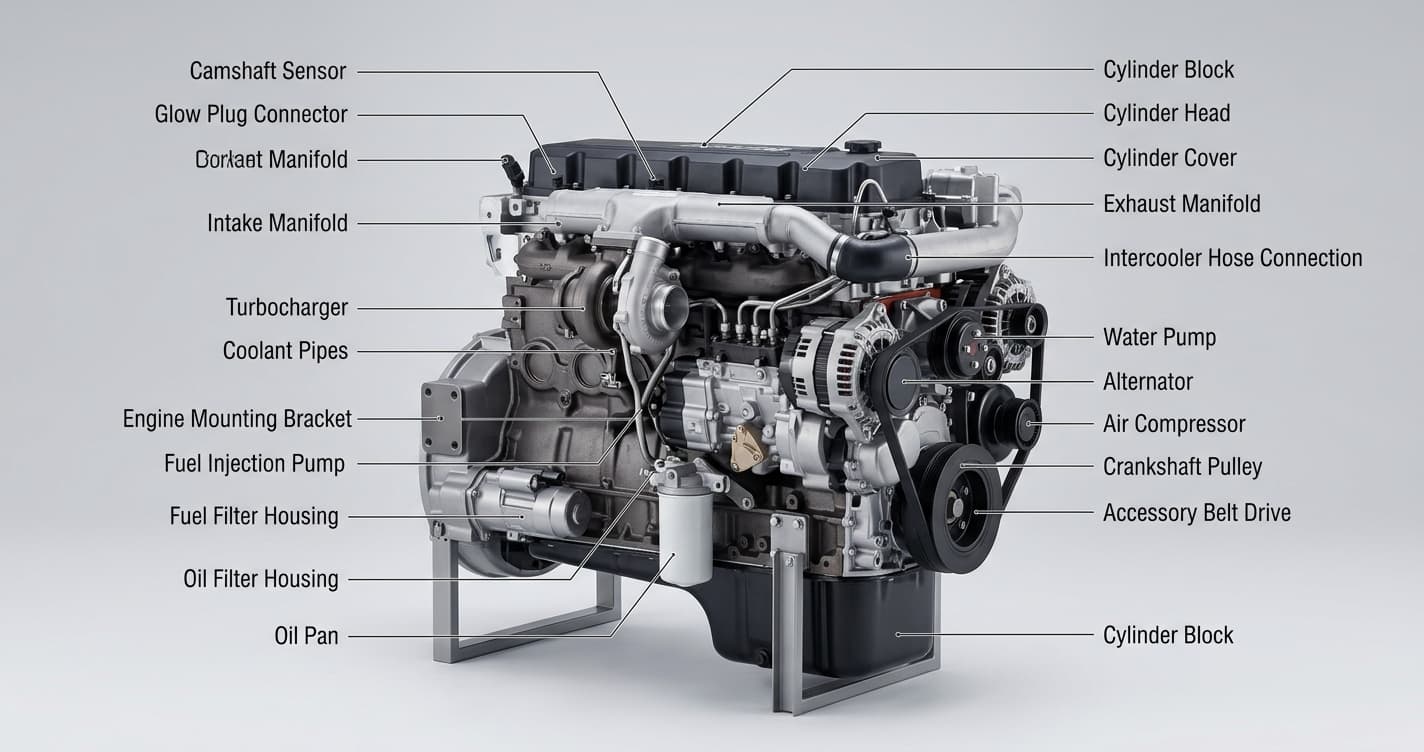
This is your five-minute morning routine — no tools required, just your eyes and hands. Before firing up that Dongfeng or Sinotruk engine, take a quick walk around and pop the hood. Check engine oil level, coolant reservoir, and power steering fluid. Look for fresh puddles underneath that weren’t there yesterday.
Additionally, give your belts a visual once-over for fraying or glazing. Inspect air filter housing seals and listen for unusual sounds during startup. These daily habits cost you nothing but minutes, yet they catch problems while they’re still small, quiet, and cheap to fix.
Monthly and Quarterly Tasks (The Deeper Checkup)
Now we move beyond the visual scan into hands-on territory. Engine oil change frequency sits at the center of this tier — and it varies more than most people realize. Load weight, ambient temperature, terrain, and fuel quality all influence how quickly your oil degrades.
During monthly checks, inspect fuel filters for contamination, test coolant concentration with a refractometer, and clean battery terminals to prevent voltage drops. Quarterly, you should also examine exhaust system connections, check turbo boost pressure readings, and inspect engine mounts for cracking or sagging. These tasks form the backbone of any serious truck engine maintenance tips list.
Annual and Major Milestone Services (The Full Physical)
Once a year — or at major mileage milestones — your engine deserves the equivalent of a comprehensive physical exam. This includes professional injector flow testing, turbocharger inspection for shaft play and housing cracks, valve lash adjustments, and full electronic diagnostics.
This is precisely where heavy duty engine repair costs are avoided. A turbo showing early signs of bearing wear costs a fraction to address now versus replacing the entire unit (plus cleaning metal shavings from your intake) six months later. For engines from brands like Yuchai or Weichai, following OEM-recommended milestone services is non-negotiable for warranty preservation and longevity.
Maintenance Interval Table
| Task | Frequency | Why It Matters | Consequence of Skipping |
|---|---|---|---|
| Engine Oil & Filter Change | Every 15,000–30,000 km (varies by duty) | Removes contaminants, maintains lubrication | Accelerated bearing wear, sludge buildup |
| Fuel Filter Replacement | Every 20,000–40,000 km | Protects injectors from particulates | Injector damage, power loss, poor fuel economy |
| Coolant System Inspection | Monthly visual / Annual flush | Prevents overheating and liner cavitation | Head gasket failure, warped cylinder heads |
| Serpentine Belt Inspection | Monthly visual / Replace every 80,000–120,000 km | Drives alternator, water pump, AC compressor | Complete accessory drive failure at speed |
| Air Filter Replacement | Per restriction gauge or every 50,000 km | Ensures proper air-fuel ratio | Reduced power, increased fuel consumption |
| Hose Inspection & Replacement | Quarterly inspection / Replace as needed | Prevents coolant and boost leaks | Sudden coolant loss, turbo underperformance |
| Injector Testing & Service | Annually or every 150,000 km | Maintains spray pattern and fuel atomization | Rough running, excessive smoke, cylinder damage |
| Turbocharger Inspection | Annually | Detects shaft play and seal leaks early | Catastrophic turbo failure, engine oil starvation |
| EGR System Cleaning | Every 100,000–150,000 km | Maintains emissions compliance and airflow | Carbon buildup, reduced performance, fault codes |
| Valve Adjustment | Per OEM schedule (typically 200,000–300,000 km) | Ensures proper sealing and timing | Burned valves, compression loss, hard starting |
Engine Oil — The Lifeblood Your Truck Can’t Fake
Choosing the Right Oil (And Why It’s Not All the Same)
Not all engine oils are created equal, and your diesel engine knows the difference even if you don’t. Viscosity grades like 15W-40 or 10W-30 aren’t arbitrary numbers — they define how your oil behaves across temperature extremes. For most Chinese-brand truck engines operating in varied climates, 15W-40 remains the workhorse choice, while 10W-30 offers better cold-start protection in frigid regions.
Beyond viscosity, pay attention to API ratings (CK-4 is the current standard for diesel) and always cross-reference with your OEM specifications. Weichai, Yuchai, and FAW engines each have specific approval lists. Furthermore, the synthetic versus conventional debate has a practical answer: synthetic oils genuinely last longer and protect better under extreme heat, but they only deliver value if you’re actually monitoring oil condition rather than just running longer between changes.
How Often Should You Really Change It?
The “change every X kilometers” rule is an oversimplification that either wastes good oil or leaves degraded oil in your engine too long. In reality, engine oil change frequency depends heavily on your operating profile. Oil analysis — sending a sample to a lab every few changes — tells you exactly what’s happening inside your engine and whether your intervals are appropriate.
| Operating Profile | Typical Oil Change Interval | Key Factors |
|---|---|---|
| Light Duty / Urban Delivery | 15,000–20,000 km | Frequent stops, more idle time, higher soot loading |
| Regional Haul | 20,000–30,000 km | Mixed conditions, moderate loads |
| Long Haul / Highway | 30,000–50,000 km (with oil analysis) | Steady RPM, lower soot, consistent temperatures |
Regardless of your profile, never extend intervals without data to support the decision. Your engine’s longevity depends on this discipline. Browse our product brands page to find OEM-approved filters and lubricants for your specific engine model.
Cooling System Care — Keeping Your Engine’s Temper in Check
Coolant Flush and Replacement
Coolant doesn’t last forever. Over time, its additives deplete, pH levels shift, and its ability to prevent corrosion and cavitation diminishes. Cavitation liner damage — where collapsing vapor bubbles literally eat through cylinder liner walls — is one of the most expensive failures in diesel engines. And it’s entirely preventable with proper coolant maintenance.
Use the correct coolant type specified by your engine manufacturer. Extended Life Coolant (ELC) and conventional coolants require different supplemental additive strategies. Mixing them is a recipe for gel formation and plugged passages. In other words, your engine “loses its cool” in more ways than one when coolant chemistry goes wrong.
Inspecting Hoses, Thermostats, and Water Pumps
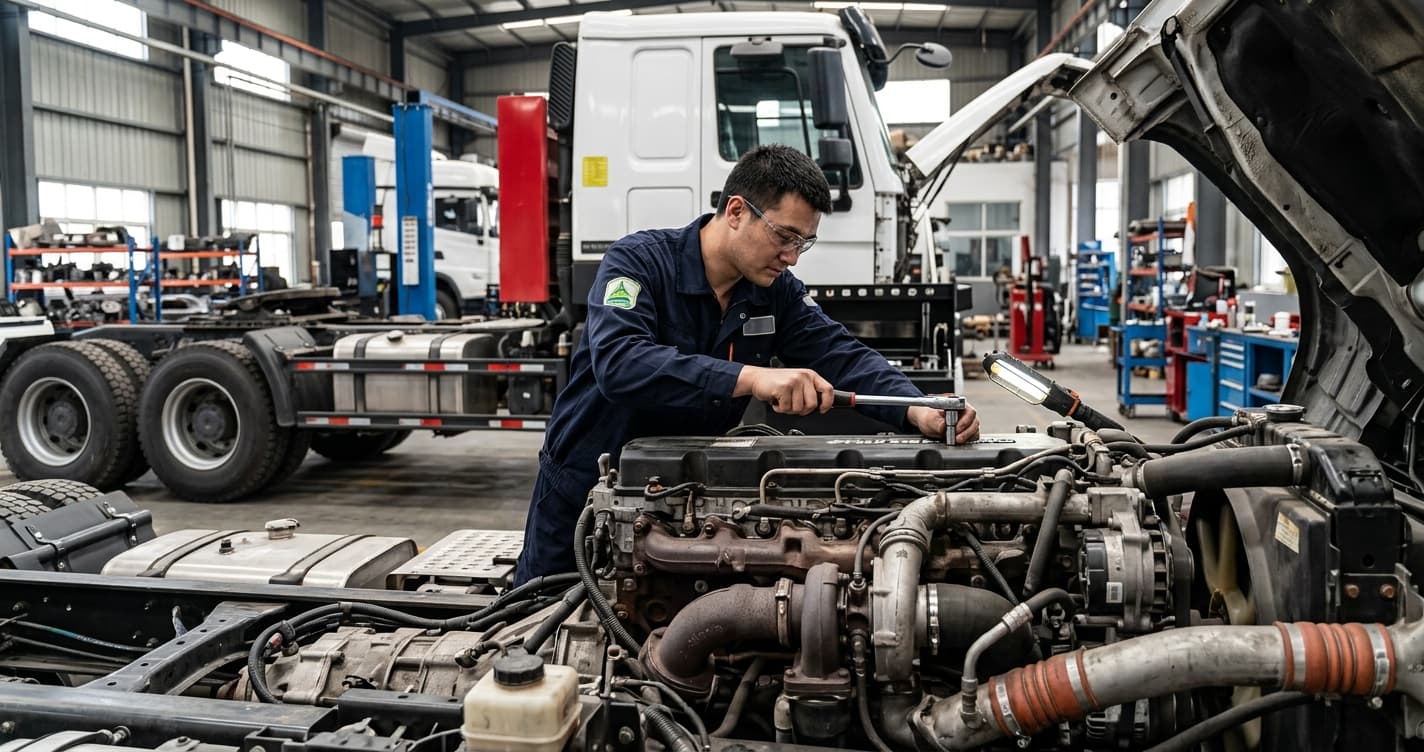
A cooling system is only as strong as its weakest hose. Rubber degrades from the inside out, meaning a hose can look fine externally while its inner lining is flaking apart, sending debris into your radiator and heater core. Squeeze hoses during inspections — they should feel firm and uniform, never mushy or crunchy.
Thermostats that stick open cause overcooling (poor fuel economy, excessive carbon buildup), while those stuck closed cause overheating. Water pump weep holes dripping coolant signal seal failure — address it before the bearing seizes. For a deeper dive into these systems, check our product systems page for cooling components compatible with Sinotruk, Shacman, and other Chinese truck brands.
Air and Fuel Systems — Letting Your Engine Breathe and Eat Right
Air Filtration: The Lungs of Your Diesel
Your diesel engine consumes thousands of cubic meters of air for every tank of fuel burned. Every particle of dust that slips past the air filter acts like sandpaper on cylinder walls, piston rings, and valve guides. Consequently, a compromised air filtration system silently destroys your engine while simultaneously tanking fuel economy by up to 8%.
Use restriction gauges rather than calendar-based replacement. Operating in dusty environments like construction sites or unpaved roads may require filter changes at triple the normal frequency. Meanwhile, highway-only trucks in clean air regions can safely extend intervals. Let the data guide you, not assumptions.
Fuel System Integrity (Injectors, Filters, Water Separators)
Modern common-rail diesel injectors operate at extraordinary pressures and microscopic tolerances. Even tiny amounts of water or particulate contamination can score injector internals, causing poor spray patterns, cylinder wash-down, and eventual failure. Draining your water separator daily — yes, daily — takes thirty seconds and protects components that are extremely costly to replace.
Fuel quality varies significantly across regions. If you’re operating in areas with inconsistent fuel standards, consider adding a secondary fuel filtration stage. Additionally, never let your tank run below a quarter full — the sediment sitting at the bottom of aging fuel tanks gets stirred up and sucked into your system during low-fuel operation. Visit our support page for fuel system troubleshooting guides specific to Chinese truck engine platforms.
Belts, Hoses, and Electrical — The Unsung Support Crew
Serpentine Belts and Tensioners
A serpentine belt failure at highway speed creates an immediate cascade: no alternator charging, no water pump circulation, no power steering assist. Within minutes, your engine overheats and your electrical system dies. The belt itself is inexpensive — the collateral damage from its failure is not.
Inspect belts for cracking, glazing, and chunk loss. Equally important, check the automatic tensioner — a weak tensioner allows belt slip that generates heat and accelerates wear. Most manufacturers recommend replacement between 80,000 and 120,000 kilometers, but harsh conditions warrant earlier attention.
Electrical System and Sensors
Modern truck engines from manufacturers like FAW, Dongfeng, and Foton rely heavily on electronic control modules (ECMs) and sensor networks. A single faulty sensor can trigger derating, limp mode, or phantom fault codes that send you chasing problems that don’t exist. Regular diagnostic scans catch sensor drift before it causes operational headaches.
Keep electrical connections clean and properly sealed against moisture intrusion. Corroded grounds cause erratic gauge readings and intermittent faults that are notoriously difficult to diagnose. For comprehensive electrical diagnostics and sensor replacement guidance, explore our truck electrical system resources.
Common Mistakes That Shorten Engine Life
Even well-intentioned operators sometimes develop habits that quietly shorten their engine’s lifespan. Here are the most frequent offenders — and what to do instead:
| Common Mistake | What Happens | Better Practice |
|---|---|---|
| Skipping warm-up period | Oil hasn’t reached bearings; metal-on-metal wear | Idle 3–5 minutes before loading the engine |
| Ignoring cool-down after hard runs | Turbo oil coking, heat soak damage | Idle 2–3 minutes before shutdown |
| Using incorrect fluids | Seal degradation, additive conflicts | Always match OEM specifications exactly |
| Ignoring check engine lights | Minor issue escalates to major failure | Diagnose within 48 hours of illumination |
| Excessive idling | Carbon buildup, fuel dilution of oil, wet stacking | Shut down if idling exceeds 5 minutes |
| Using cheap, unverified aftermarket parts | Premature failure, potential engine damage | Source quality parts from reputable suppliers |
| Overfilling engine oil | Aeration, seal blowout, crankcase pressure | Fill to the upper mark only — never above |
Each of these mistakes is entirely avoidable. The common thread? Impatience and cutting corners. Your engine rewards patience with longevity. See real examples of how proper maintenance transformed fleet operations on our customer success stories page.
Building Your Own Preventive Maintenance Schedule
No two trucks operate identically, which means no single maintenance schedule fits everyone perfectly. Owner-operators and small fleets benefit enormously from building a customized preventive maintenance schedule based on their actual operating conditions rather than generic guidelines.
Start by documenting your typical duty cycle: average daily kilometers, load weights, terrain type, climate conditions, and idle time percentage. Then map your OEM-recommended intervals against these factors, adjusting conservatively for harsh conditions. Digital logbook apps and telematics platforms make tracking effortless — many even send automated reminders based on real-time mileage and engine hours.
For fleets running multiple Chinese-brand trucks, standardizing maintenance windows across similar units reduces scheduling complexity and allows bulk parts ordering. Our company information page details how we support fleet customers with consolidated parts sourcing across Sinotruk, Shacman, FAW, Dongfeng, and other major Chinese truck brands — all at globally competitive pricing.
FAQ — Truck Engine Maintenance
How often should I service the engine of a truck?
Service intervals depend on your operating profile. Light-duty urban trucks need attention every 15,000–20,000 km, while long-haul highway trucks can extend to 30,000–50,000 km with oil analysis confirmation. Always follow your specific engine manufacturer’s recommendations as the baseline, then adjust based on real-world conditions like dust exposure, load weight, and fuel quality.
What is the most overlooked diesel engine care task?
Draining the fuel-water separator ranks as the single most neglected task. It takes less than a minute, yet skipping it allows water to reach your injectors — causing corrosion, poor atomization, and eventual failure. Coolant additive maintenance comes in as a close second, since depleted additives lead to invisible internal corrosion long before symptoms appear externally.
Can I extend oil change intervals with synthetic oil?
Synthetic oil does offer superior thermal stability and longer additive life, which can support extended intervals. However, extension should only happen with supporting oil analysis data. Running synthetic oil without monitoring is like having health insurance but never visiting a doctor — the protection exists, but you’re flying blind on actual condition.
What are the signs of injector failure in a truck engine?
Watch for rough idle, white or black smoke at startup, increased fuel consumption, engine misfires, and a distinctive knocking sound from affected cylinders. In advanced stages, you may notice diesel fuel diluting your engine oil (check the dipstick for fuel smell and thin consistency). Early detection through regular diagnostic scans prevents single-injector issues from damaging pistons and liners.
How does excessive idling affect engine longevity?
Extended idling causes incomplete combustion, leading to carbon deposits on valves, rings, and turbo components. It also promotes fuel dilution of engine oil, reducing lubrication effectiveness. Furthermore, “wet stacking” — unburned fuel accumulating in the exhaust system — can damage aftertreatment components. Limiting idle time to under five minutes protects both your engine and your fuel budget.


