Picture this: a fleet manager in Lagos gets a call at 2 AM. One of his HOWO A7 tippers — the one hauling granite for a government contract — just died on the expressway. The culprit? A counterfeit water pump that lasted exactly 11 days. Now he’s staring at a towing bill, a missed delivery deadline, and a driver who’s stranded in the dark. All because someone saved $18 on a part that was “close enough.”
Sound familiar? If you’ve been in the heavy truck business long enough, you’ve lived some version of this nightmare. And here’s the painful truth: counterfeit and substandard parts don’t just cost you money — they cost you time, trust, and sometimes safety.
So the question isn’t whether you need genuine China Sinotruk truck parts. The question is: where do you actually find them without getting burned? That’s exactly what this guide is built to answer. Whether you’re a distributor in Addis Ababa, a workshop owner in Hanoi, or a procurement officer in Lima, consider this your no-nonsense roadmap to sourcing authentic Sinotruk components online — confidently and cost-effectively.
Understanding the China Sinotruk Truck Parts Ecosystem
Before we dive into where to buy, let’s understand what we’re buying into. Sinotruk isn’t just another truck brand — it’s a global infrastructure backbone. And the parts ecosystem around it is massive, complex, and occasionally confusing.
Who Is Sinotruk and Why Parts Availability Matters
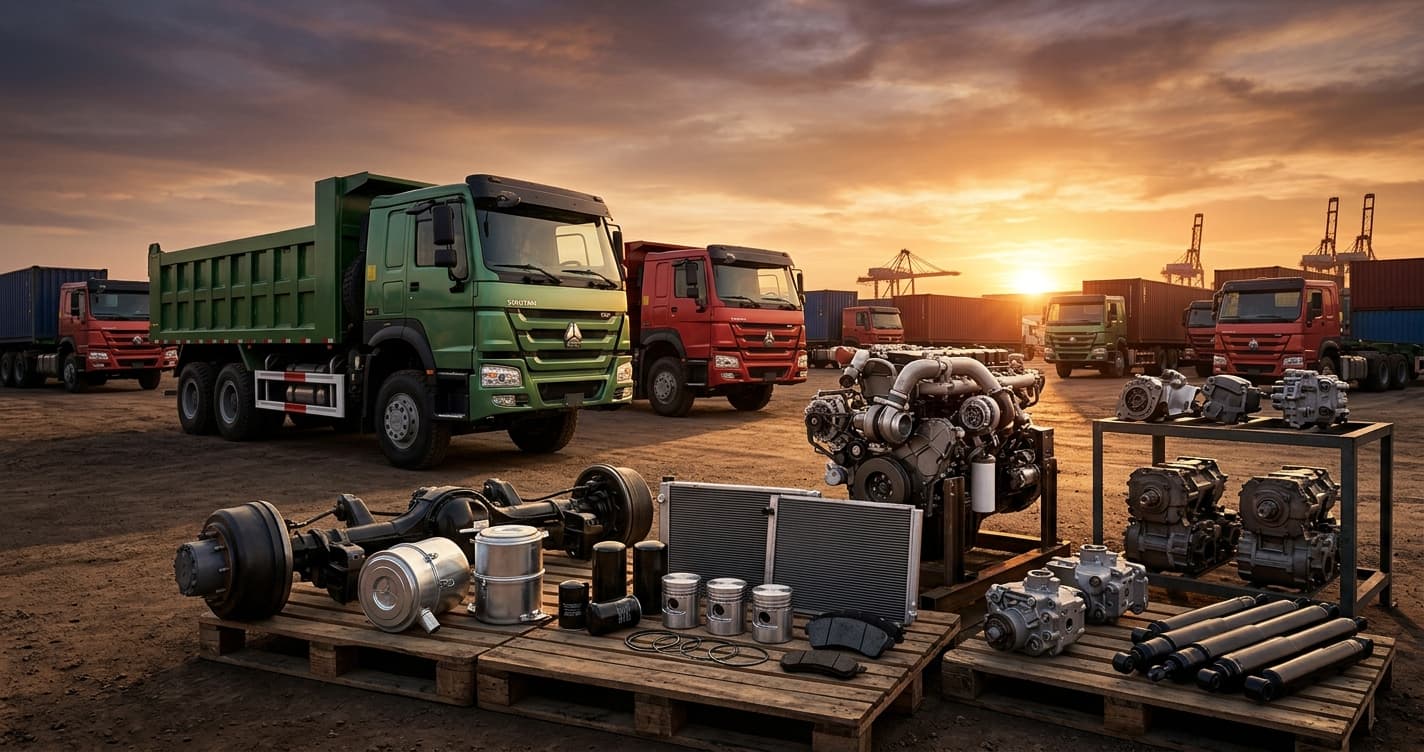
China National Heavy Duty Truck Group (Sinotruk) has been manufacturing heavy trucks since 1956. Today, it exports to over 110 countries, with particularly dominant market share across Africa, Southeast Asia, the Middle East, and South America. In 2023 alone, Sinotruk exported over 130,000 units — making it one of the largest heavy truck exporters on the planet.
With that many trucks on roads worldwide, the demand for genuine Sinotruk components online has exploded. Moreover, because many of these trucks operate in harsh conditions — mining sites, unpaved highways, tropical humidity — parts wear out faster than they would in gentler environments. Consequently, reliable sourcing isn’t a luxury; it’s a survival skill.
Sinotruk’s product lines span several major series, each with its own parts characteristics:
| Export Market | Estimated Annual Unit Sales (2023) | Top Models in Use |
|---|---|---|
| Nigeria | 12,000+ | HOWO A7, HOWO 371 |
| Ethiopia | 9,500+ | HOWO 371, HOWO A7 |
| Vietnam | 8,000+ | HOWO T5G, Sitrak C7H |
| Philippines | 6,500+ | HOWO A7, HOWO 375 |
| Tanzania | 5,800+ | HOWO 371, HOWO 336 |
| Algeria | 5,200+ | HOWO A7, Steyr King |
| Mozambique | 4,500+ | HOWO 371 |
| Saudi Arabia | 4,200+ | Sitrak C7H, HOWO T7H |
| Peru | 3,800+ | HOWO A7, HOWO 375 |
| Myanmar | 3,500+ | HOWO 336, HOWO 371 |
As you can see, the HOWO series dominates across nearly every region. Additionally, there’s significant parts overlap between the HOWO, Steyr, and Sitrak lines — particularly in drivetrain and braking components. Understanding this overlap can actually save you money and simplify inventory management.
OEM vs Aftermarket vs Counterfeit — Know the Difference
This is where many buyers get tripped up. Not all “Sinotruk parts” are created equal, and the differences can be dramatic. Let’s break it down honestly:
| Factor | OEM (Original) | Quality Aftermarket | Counterfeit / Fake |
|---|---|---|---|
| Source | Sinotruk-authorized factories | Certified third-party manufacturers | Unknown / unregistered workshops |
| Price Range | Standard baseline | 15–40% lower | 50–70% lower |
| Expected Lifespan | 100% of design life | 70–90% of design life | 10–30% of design life |
| Warranty | Full manufacturer warranty | Supplier warranty (varies) | None or fake warranty cards |
| Risk Level | Very Low | Low to Moderate | Extremely High |
| Packaging | Hologram, QR code, official branding | Clean but different branding | Mimics OEM packaging poorly |
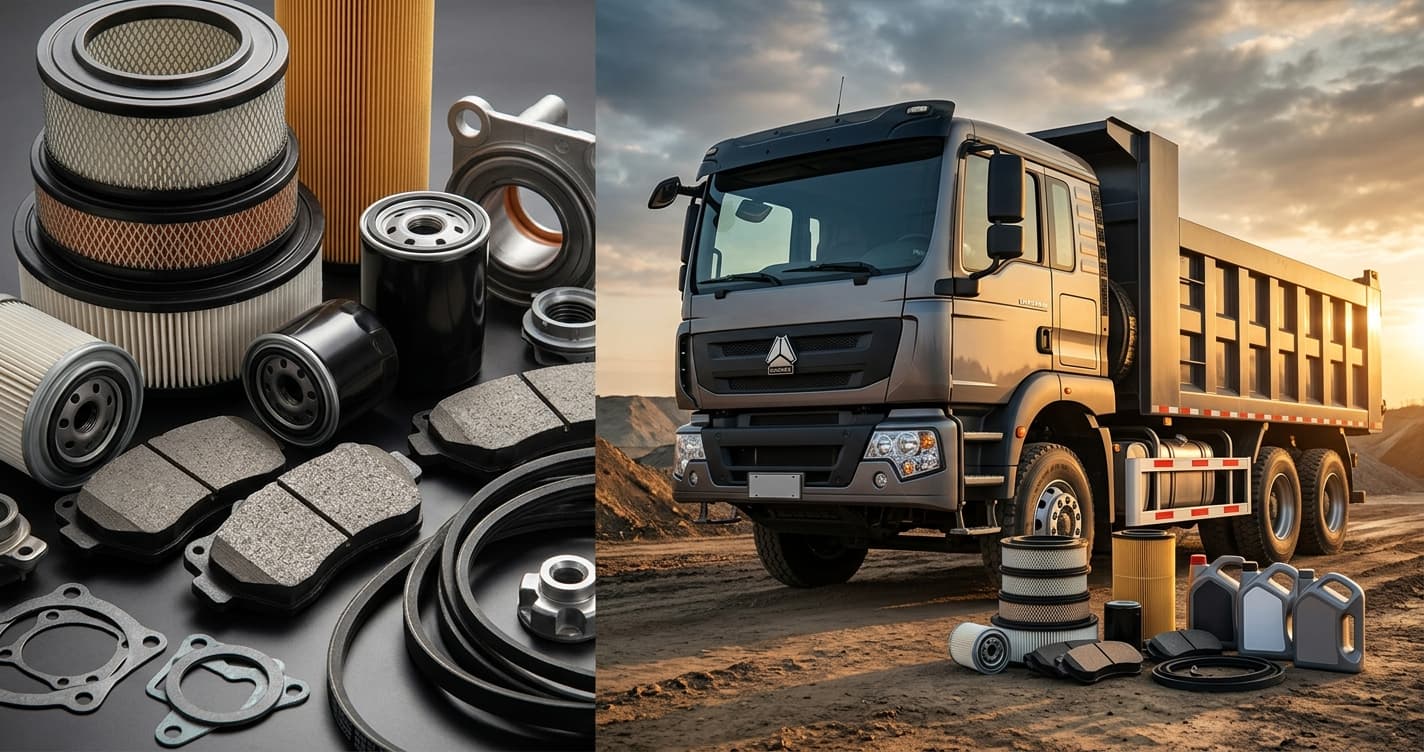
How to spot fakes: Genuine Sinotruk parts carry specific part number formats (typically starting with “WG” or “AZ” followed by a numeric sequence). The packaging includes holographic stickers, scannable QR codes linking to Sinotruk’s verification database, and consistent print quality. Counterfeits often have blurry logos, misspelled words, or QR codes that lead nowhere.
Furthermore, always cross-reference the part number with the official HOWO truck replacement parts catalog for your specific model year. A single digit off can mean a completely different component.
Browse Our Sinotruk Brand Page →
Where to Actually Buy Authentic China Sinotruk Truck Parts
Now for the part you’ve been waiting for. There are essentially four channels for sourcing China Sinotruk truck parts, and each comes with its own trade-offs. Let’s walk through them honestly.
Option 1 — Direct from Sinotruk Authorized Parts Dealers
Going straight to the source sounds ideal, right? In theory, yes. A Sinotruk authorized parts dealer guarantees authenticity, offers manufacturer warranties, and provides technical documentation.
However, there are practical challenges. Minimum order quantities (MOQs) tend to be high — often requiring full-container volumes. Lead times can stretch to 45–60 days. And for overseas buyers, communication barriers and limited after-sales support can make the process frustrating.
Additionally, not every region has a local authorized dealer. If you’re in a smaller African or South American market, you might find that “authorized” is more of a concept than an accessible reality.
Best for: Large fleet operators or national distributors who can commit to volume orders and have existing relationships with Sinotruk’s sales network.
Option 2 — China Heavy Truck Parts Wholesale Suppliers
The wholesale market in China for heavy truck parts is enormous — centered primarily in Jinan (Sinotruk’s headquarters), Weifang (Weichai engine territory), and Shiyan (Dongfeng country, but with significant Sinotruk parts crossover).
When evaluating a China truck parts wholesale supplier, look for these green flags:
- ISO 9001 certification or equivalent quality management systems
- Documented factory audit reports
- At least 5 years of export experience with verifiable shipping records
- Willingness to provide part samples before bulk orders
- Clear return and defect policies in writing
On the flip side, here are red flags that should make you run:
- Prices that seem impossibly low (because they probably are)
- No physical address or factory photos
- Refusal to provide references from existing overseas clients
- Pressure to pay 100% upfront via non-traceable methods
- Vague or evasive answers about part origins
Option 3 — Specialized Export Partners (The Sweet Spot)
Here’s where things get interesting. Between the rigidity of authorized dealers and the Wild West of open wholesale markets, there’s a middle ground: specialized export partners who focus exclusively on Chinese brand truck parts for international buyers.
This is exactly the space where Mettlead operates. With 15 years of hands-on experience as a Sinotruk HOWO spare parts supplier, we’ve built direct relationships with OEM factories, maintain rigorous truck parts quality inspection protocols, and handle the entire export chain — from part identification to consolidated shipping.
The benefits of working with a specialized partner include:
- Quality inspection before shipment — including photos, measurements, and certification verification
- Consolidated shipping that lets you mix parts across systems in a single order
- Technical support to help you identify the right part number for your specific chassis
- Flexible MOQs that work for both small workshops and large distributors
- After-sales support that doesn’t vanish after payment clears
Learn About Our Company & Experience →
Option 4 — Online Marketplaces (Alibaba, Made-in-China)
Let’s be honest: platforms like Alibaba and Made-in-China are where many buyers start their search. And they’re not inherently bad — but they require a level of due diligence that many first-time importers underestimate.
Pros: Huge selection, easy price comparison, built-in trade assurance programs, and convenient communication tools.
Cons: Supplier quality varies wildly. Product photos can be misleading. “Gold Supplier” badges are paid memberships, not quality certifications. And after-sales support is often nonexistent once the platform’s dispute window closes.
Here’s how all four channels compare side by side:
| Channel | Price Level | Authenticity Reliability | Typical MOQ | After-Sales Support | Risk Level |
|---|---|---|---|---|---|
| Sinotruk Authorized Dealer | Highest | Excellent | High (container+) | Good but slow | Very Low |
| Wholesale Suppliers | Low–Medium | Variable | Medium | Inconsistent | Medium–High |
| Specialized Export Partner (e.g., Mettlead) | Competitive | High | Flexible | Strong | Low |
| Online Marketplaces | Lowest–Medium | Unpredictable | Low | Minimal | Medium–High |
Complete HOWO Truck Replacement Parts Catalog Breakdown
Knowing where to buy is only half the battle. You also need to know what to buy. Let’s walk through the major systems of a HOWO truck so you can build smarter, more complete orders.
Engine System Parts
The heart of any HOWO truck is its engine — typically a Weichai WD615, WP10, WP12, or the newer MC series. These engines are workhorses, but they have well-known wear items that need regular replacement.
Common failure points include water pumps, fuel injection pumps, turbochargers, cylinder liners, piston kits, and oil filters. Interestingly, many buyers underestimate how quickly fuel system components degrade when running on lower-quality diesel — which is common in many developing markets.
| # | Part Name | Part Number Format Example | Replacement Frequency |
|---|---|---|---|
| 1 | Piston Kit | 612600030017 | Every 200,000 km |
| 2 | Cylinder Liner | 612630010015 | Every 200,000 km |
| 3 | Water Pump Assembly | 612600060307 | Every 100,000 km |
| 4 | Fuel Injection Pump | 612601080376 | Every 150,000 km |
| 5 | Turbocharger | 612601110925 | Every 250,000 km |
| 6 | Oil Filter Element | 612630010239 | Every 10,000 km |
| 7 | Fuel Filter Element | 612600081335 | Every 15,000 km |
| 8 | Air Filter Element | 612600114993 | Every 20,000 km |
| 9 | Starter Motor | 612600090293 | As needed |
| 10 | Alternator | 612600090506 | As needed |
| 11 | Fan Belt | 612600020066 | Every 50,000 km |
| 12 | Thermostat | 612600040022 | Every 80,000 km |
| 13 | Engine Gasket Kit | 612600040355 | During overhaul |
| 14 | Connecting Rod Bearing | 612600030020 | During overhaul |
| 15 | Crankshaft Main Bearing | 612600030033 | During overhaul |
Note: Part numbers shown are representative formats. Always confirm the exact number against your engine nameplate data.
Transmission & Drivetrain Parts
HOWO trucks predominantly use the HW series gearbox (HW15710, HW19710, etc.), which is robust but not indestructible. Synchronizer rings, gear shift forks, and output shaft bearings are the most common replacement items.
Beyond the gearbox, drivetrain components like drive shafts, universal joints, differential assemblies, and half-shaft gears see heavy wear — especially in mining and construction applications where torque loads are extreme. Consequently, keeping these parts in stock can prevent the kind of extended downtime that kills profitability.
Brake & Steering System Parts
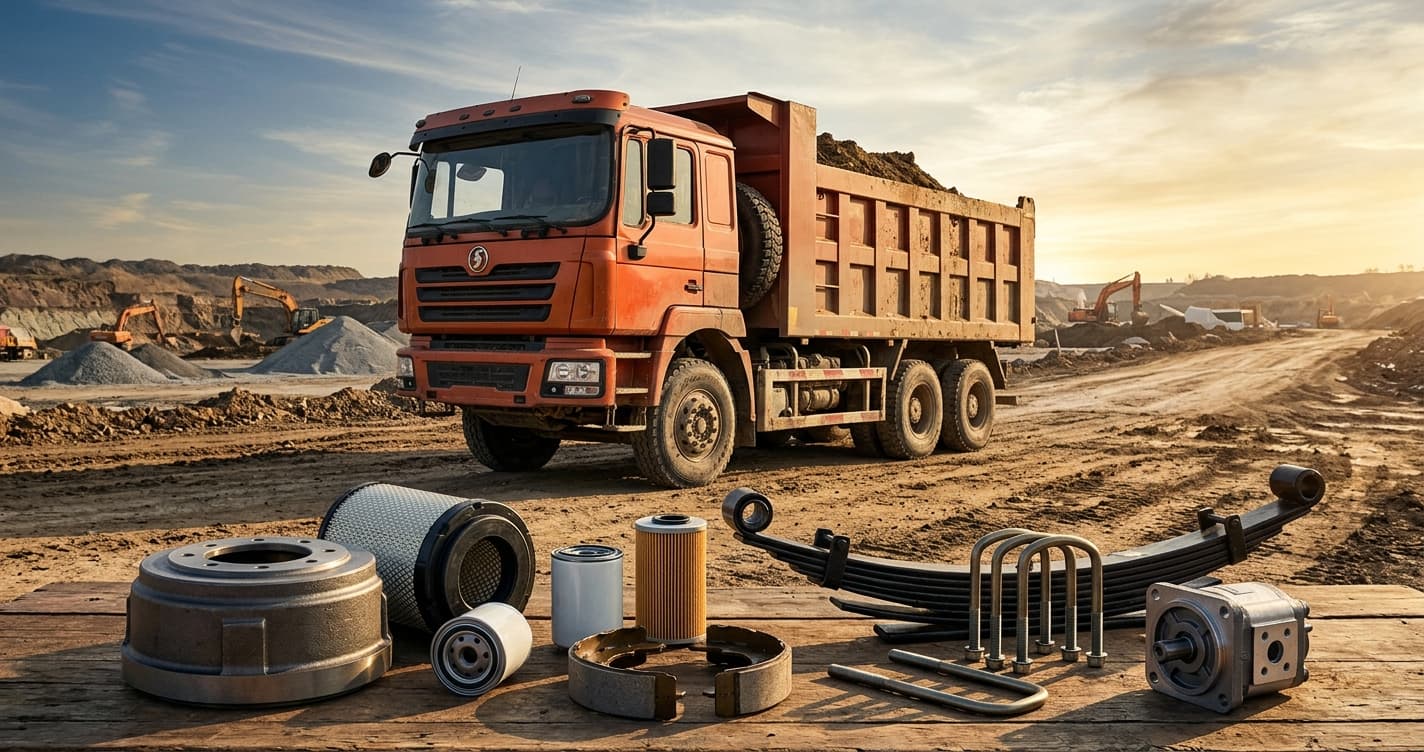
Safety-critical components deserve special attention. HOWO trucks use WABCO-compatible air brake systems, and the most frequently replaced items include brake drums, brake shoe assemblies, slack adjusters, air dryers, and relay valves.
For steering, the recirculating ball steering gearbox (typically ZF8098 type) requires periodic maintenance. Power steering pumps and drag links also wear out, particularly on trucks operating on rough terrain. Never compromise on quality for these parts — the consequences of brake or steering failure speak for themselves.
Cab & Body Parts
While not as mechanically critical, cab and body parts matter for driver comfort, visibility, and resale value. The most commonly ordered items include side mirrors, front bumpers, headlamp assemblies, dashboard panels, door handles, and electrical wiring harnesses.
Interestingly, cab parts are also among the most frequently counterfeited — particularly mirrors and lighting components. Consequently, sourcing these from a verified heavy duty truck spare parts supplier is just as important as it is for engine components.
Suspension & Chassis Parts
HOWO trucks use a traditional leaf spring suspension setup in most configurations. High-wear items include leaf spring assemblies, U-bolts, center bolts, king pins, wheel hub assemblies, and shock absorbers.
For trucks operating in overloaded conditions (which, let’s be honest, is common in many markets), these components wear out significantly faster than the manufacturer’s recommended intervals. Stocking spares proactively can save you from costly roadside breakdowns.
Explore Our Full Product System Categories →
How to Import Truck Parts from China Without Headaches
Sourcing the right parts is one thing. Getting them from a Chinese warehouse to your doorstep — intact, on time, and through customs — is another challenge entirely. Here’s how to navigate it smoothly.
Step-by-Step Ordering Process
- Submit your inquiry — Include part numbers, quantities, truck model, and chassis/VIN number. Photos of the old part help enormously.
- Receive quotation and part confirmation — Your supplier should confirm part compatibility, provide photos of actual stock, and clarify lead times.
- Place order and arrange payment — Use secure methods (T/T with deposit + balance before shipping, or trade assurance if using a platform).
- Quality inspection — Request pre-shipment inspection photos, packaging verification, and certification documents.
- Shipping and documentation — Confirm shipping method, receive bill of lading, commercial invoice, and packing list.
- Customs clearance and delivery — Ensure HS codes are correct and all documentation matches the shipment contents.
Shipping & Logistics Tips
Choosing between Full Container Load (FCL) and Less-than-Container Load (LCL) depends on your order volume. Here’s a quick reference:
| Destination Region | FCL (20ft) Transit Time | LCL Transit Time | Recommended For |
|---|---|---|---|
| West Africa (Lagos) | 35–45 days | 45–60 days | FCL for distributors; LCL for workshops |
| East Africa (Dar es Salaam) | 25–35 days | 35–50 days | FCL preferred due to port delays |
| Southeast Asia (Ho Chi Minh) | 10–15 days | 15–25 days | Either; fast transit both ways |
| Middle East (Jeddah) | 20–25 days | 25–35 days | FCL for bulk; LCL for urgent orders |
| South America (Callao) | 35–45 days | 50–65 days | FCL strongly recommended |
Packaging matters. Insist on wooden crate packing for heavy items (engine blocks, gearbox assemblies) and proper cushioning for fragile components (mirrors, sensors). A good supplier knows this instinctively — if yours doesn’t, that’s a warning sign.
Truck Parts Quality Inspection — What to Demand
Never skip inspection. At minimum, demand the following before any shipment leaves China:
- Clear photographs of each part with part number visible
- OEM certification documents or factory test reports
- Packaging integrity photos showing holographic seals and branding
- For large orders: third-party inspection (SGS, TÜV, or equivalent)
- Batch sampling at a ratio of at least 10% for high-volume items
Visit Our Support Page for Import Guidance →


