
In the intricate ecosystem of a heavy-duty truck, the starter solenoid plays a pivotal, yet often overlooked, role. It acts as the crucial bridge between the ignition system and the powerful starter motor, ensuring that your engine cranks reliably every time you turn the key. For operators and maintenance professionals managing fleets of robust Chinese trucks like Sinotruk HOWO, Shacman,FAW, Foton, and Dongfeng , understanding the nuances of starter solenoid function, common problems, and effective repair strategies is paramount. A faulty solenoid can lead to frustrating no-start conditions, impacting uptime and operational efficiency. This comprehensive guide will delve into the mechanics of the starter solenoid, illuminate its common failure modes, provide detailed diagnostic procedures, and offer step-by-step repair and replacement instructions, empowering you to maintain your heavy-duty vehicles with confidence and expertise.
Understanding the Truck Starter Solenoid: The Unsung Hero of Ignition
The starter solenoid is an electromagnetic switch designed to perform two critical functions simultaneously: to complete the high-current circuit between the battery and the starter motor, and to engage the starter motor’s pinion gear with the engine’s flywheel. Without a properly functioning solenoid, the starter motor, no matter how powerful, cannot effectively crank the engine.
Function and Importance
The primary functions of a truck starter solenoid include:
- High-Current Switching: The starter motor requires a very high amperage draw (hundreds of amps) to crank a heavy-duty diesel engine. The ignition switch, designed for low-current circuits, cannot handle this load directly. The solenoid acts as a relay, using a small current from the ignition switch to activate a powerful internal switch that completes the high-current circuit from the battery to the starter motor.
- Pinion Gear Engagement: Simultaneously, the solenoid’s plunger (or armature) pushes the starter motor’s pinion gear forward to mesh with the teeth on the engine’s flywheel. This mechanical engagement ensures that the starter motor’s rotational force is transferred to the engine, initiating the cranking process.
- Disengagement: Once the engine starts and the ignition key is released, the solenoid disengages the pinion gear from the flywheel and breaks the high-current circuit, preventing damage to both the starter and the flywheel.
For heavy-duty trucks, which often operate in challenging conditions and require robust starting power, the starter solenoid is engineered for durability and high performance. Its reliable operation is essential for minimizing downtime and ensuring that trucks are ready to work when needed. A failure in this component can render an otherwise healthy engine unable to start, leading to significant operational disruptions.
💡 Pro-Tip: Integrated vs. Remote Solenoids
Heavy-duty trucks typically use one of two solenoid configurations: an **integrated solenoid** mounted directly on the starter motor (most common), or a remote solenoid mounted elsewhere on the chassis. Understanding your truck’s specific setup (e.g., for HOWO or Shacman models) is crucial for accurate diagnosis and repair. Integrated solenoids are often replaced as part of the starter motor assembly, while remote solenoids can be serviced independently.
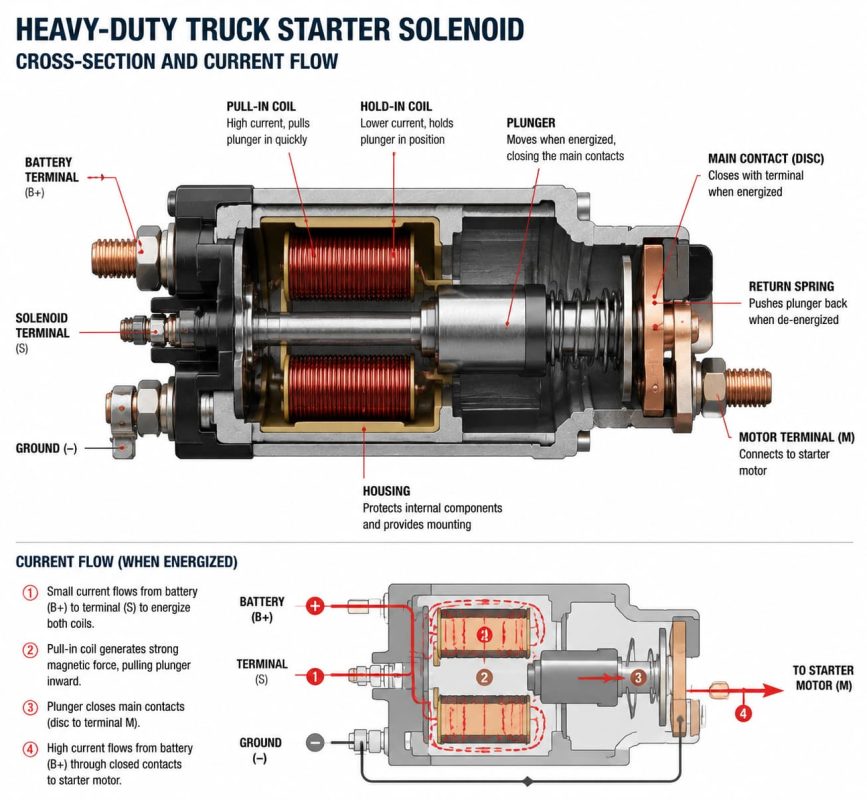
Key Components of a Starter Solenoid
A typical starter solenoid consists of several interconnected parts:
- Electromagnetic Coil (Pull-in and Hold-in Coils): These coils create a magnetic field when energized by the ignition switch, pulling the plunger inward.
- Plunger (Armature): A movable iron core that is pulled by the magnetic field. It mechanically engages the pinion gear and simultaneously closes the main contacts.
- Main Contacts (Disc/Bridge and Terminals): These heavy-duty contacts complete the high-current circuit from the battery to the starter motor. They are designed to handle hundreds of amps.
- Return Spring: Pushes the plunger back to its original position when the magnetic field dissipates, disengaging the pinion gear and opening the main contacts.
- Housing: Protects the internal components and provides mounting points.
Common Starter Solenoid Problems and Their Symptoms
Recognizing the signs of a failing starter solenoid is the first step towards a timely and effective repair. The symptoms can often be confused with other starting system issues, so careful diagnosis is key. The table below summarizes common starter solenoid problems and their associated symptoms, helping you quickly pinpoint the issue in your heavy-duty truck, be it a FAW, Foton, or Dongfeng.
| Problem Area | Key Symptoms | Underlying Cause (Component) |
|---|---|---|
| No-Crank, No-Click | Turning the key produces no sound or action from the starter. | Open circuit in solenoid coil, faulty ignition switch, wiring issue, dead battery. |
| Single Click, No-Crank | A single audible click from the starter area, but engine does not crank. | Weak battery, corroded battery cables, faulty main contacts in solenoid, seized starter motor. |
| Rapid Clicking, No-Crank | Multiple rapid clicks from the starter area, but engine does not crank. | Severely discharged battery, loose/corroded battery terminals, high resistance in battery cables. |
| Starter Stays Engaged After Engine Starts | Grinding noise after engine starts, starter motor continues to run. | Stuck solenoid plunger, faulty return spring, welded main contacts, faulty ignition switch. |
| Intermittent Starting | Truck starts sometimes, but not always, with no clear pattern. | Loose wiring connections, corroded terminals, worn solenoid contacts, intermittent ignition switch fault. |
| Starter Motor Spins, Engine Doesn’t Crank | Hear the starter motor spinning, but the engine does not turn over. | Faulty solenoid plunger (not engaging pinion), worn pinion gear, damaged flywheel teeth. |
1. No-Crank, No-Click Condition
This is perhaps the most frustrating symptom. You turn the ignition key, and absolutely nothing happens – no sound, no click, no attempt from the starter motor to engage. This indicates a complete failure in the circuit that activates the solenoid. While it could point to a dead battery or a faulty ignition switch, a common culprit is an open circuit within the solenoid’s electromagnetic coil, preventing it from being energized. For HOWO trucks, this often warrants a thorough check of the control circuit leading to the solenoid.
2. Single Click, No-Crank Condition
You turn the key, hear a distinct single click from the starter area, but the engine does not crank. This
symptom is a classic indicator that the solenoid is receiving power and attempting to engage, but it cannot complete the high-current circuit to the starter motor, or the starter motor itself is seized. The click you hear is the solenoid plunger moving and the main contacts attempting to close. However, if the battery is weak, the battery cables are corroded, or the solenoid’s internal main contacts are heavily pitted or worn, the high current required by the starter motor cannot flow effectively. This often happens in Shacman and FAW trucks, where heavy use can lead to accelerated wear on these components.
3. Rapid Clicking, No-Crank Condition
When you turn the key, you hear a rapid series of clicks, almost like a machine gun, but the engine still doesn’t crank. This usually points to a severely discharged battery or extremely poor connections in the battery cables. The solenoid is attempting to engage, but the voltage drops so rapidly due to the high current draw and low battery charge that it immediately disengages, only to re-engage as the voltage momentarily recovers. This cycle repeats rapidly. Always check battery voltage and cable connections first when encountering this symptom in any heavy-duty truck, including Foton and Dongfeng models.
4. Starter Stays Engaged After Engine Starts
This is a dangerous symptom. After the engine starts, you hear a loud grinding or whining noise, and the starter motor continues to run, often at a very high RPM. This indicates that the solenoid’s plunger is stuck in the engaged position, or its main contacts are welded shut, preventing the pinion gear from disengaging from the flywheel. Prolonged engagement will rapidly destroy the starter motor, the flywheel teeth, or both. Immediate action is required: turn off the engine and disconnect the battery. This issue can be caused by a faulty solenoid return spring, welded contacts due to excessive arcing, or a sticky plunger. It’s a critical failure that demands immediate attention to prevent catastrophic damage.
5. Intermittent Starting
The truck starts sometimes, but not always, with no clear pattern. This can be one of the most frustrating problems to diagnose. Intermittent starting often suggests loose or corroded wiring connections to the solenoid, worn internal contacts within the solenoid that make contact inconsistently, or an intermittent fault in the ignition switch circuit that supplies power to the solenoid. This symptom requires a systematic approach to check all connections and components for reliability. For Sinotruk vehicles, environmental factors like moisture or extreme temperatures can sometimes exacerbate intermittent electrical issues.
6. Starter Motor Spins, Engine Doesn’t Crank
In this scenario, you hear the starter motor spinning rapidly when you turn the key, but the engine itself does not turn over. This indicates that the starter motor is receiving power and operating, but its rotational force is not being transferred to the engine. The most common cause is a faulty solenoid plunger that is not extending the pinion gear to mesh with the flywheel. Alternatively, the pinion gear itself might be worn, or the flywheel teeth could be damaged. This problem isolates the issue specifically to the engagement mechanism of the starter system.
⚠️ Caution: Safety First!
Before attempting any diagnostic or repair work on the starter system, always disconnect the negative battery terminal. This prevents accidental short circuits, electrical shocks, and potential damage to sensitive electronic components. Wear appropriate personal protective equipment (PPE), including safety glasses and gloves. When testing, be aware of rotating parts and high current. Never bypass safety features or attempt to jump-start a starter directly without understanding the risks.
Diagnosing Truck Starter Solenoid Problems: A Step-by-Step Guide
Accurate diagnosis is paramount to avoid unnecessary part replacement and ensure efficient repairs. A systematic approach will help pinpoint whether the starter solenoid itself is faulty, or if the problem lies elsewhere in the starting circuit (e.g., battery, cables, ignition switch, starter motor). For heavy-duty trucks, especially those from Sinotruk HOWO, Shacman,FAW, Foton, and Dongfeng , a robust diagnostic process is essential.
1. Initial Visual Inspection
Begin with a thorough visual inspection of the entire starting circuit:
- Battery Terminals and Cables: Check for corrosion, looseness, or damage. Corroded terminals can significantly impede current flow. Ensure cables are securely fastened to the battery, starter, and chassis ground.
- Starter Motor and Solenoid Wiring: Inspect all wires connected to the starter motor and solenoid for fraying, cuts, burns, or loose connections. Pay close attention to the small gauge wire from the ignition switch (S-terminal) and the large gauge battery and motor cables.
- Ground Connections: Ensure the battery ground cable is securely attached to the chassis and engine block, and that these connections are clean and free of rust or paint. Poor grounds are a frequent cause of electrical issues.
- Physical Damage: Look for any signs of physical damage to the starter motor or solenoid housing, such as cracks, dents, or signs of overheating.
2. Battery Load Test
A weak battery is the most common cause of starting problems. Even if the battery shows good voltage (12.6V for a 12V system) with no load, it might not be able to deliver the high current required by the starter. Use a professional battery load tester to assess its capacity. If the battery fails the load test, recharge it fully and retest. If it still fails, replace the battery before proceeding with further starter system diagnostics.
3. Voltage Drop Test (High-Current Circuit)
This test helps identify excessive resistance in the high-current battery cables and connections, which can prevent sufficient current from reaching the starter motor and solenoid. Perform this test with a multimeter:
- Positive Cable Voltage Drop: Connect the multimeter’s positive lead to the battery positive post and the negative lead to the starter motor’s battery terminal (B+ terminal on the solenoid). Have an assistant attempt to crank the engine. The voltage drop should be less than 0.5 volts (for 12V systems) or 1.0 volts (for 24V systems). Higher readings indicate excessive resistance in the positive cable or its connections.
- Negative Cable Voltage Drop: Connect the multimeter’s positive lead to the engine block (or starter motor housing) and the negative lead to the battery negative post. Have an assistant attempt to crank the engine. The voltage drop should be less than 0.5 volts (for 12V systems) or 1.0 volts (for 24V systems). Higher readings indicate excessive resistance in the negative cable or its ground connections.
💡 Pro-Tip: Clean Connections are Critical
Corrosion and loose connections are silent killers of electrical systems. Regularly clean battery terminals, cable ends, and ground points with a wire brush and battery terminal cleaner. Apply a thin layer of dielectric grease or battery terminal protector to prevent future corrosion. This simple maintenance step can prevent numerous starting issues in your HOWO or Shacman trucks.
4. Solenoid Activation Test (Small-Current Circuit)
This test verifies if the solenoid is receiving the activation signal from the ignition switch. You will need a multimeter or a test light:
- Locate S-Terminal: Identify the small gauge wire connected to the solenoid (often labeled
as ‘S’ or ‘Start’). This wire carries the low-current signal from the ignition switch to activate the solenoid. - Test for Voltage: With the multimeter set to DC voltage, connect the negative lead to a good chassis ground. Connect the positive lead to the S-terminal of the solenoid. Have an assistant turn the ignition key to the ‘Start’ position. You should observe battery voltage (12V or 24V) at this terminal while the key is held in ‘Start’.
- Interpretation:
- If voltage is present: The ignition switch and its wiring to the solenoid are likely good. The problem is either the solenoid itself or the high-current circuit.
- If no voltage is present: The issue lies upstream in the ignition circuit, possibly the ignition switch, a neutral safety switch, or wiring.
5. Solenoid Main Contact Test (Bench Test or In-Vehicle)
This test determines if the solenoid’s internal main contacts are capable of passing high current to the starter motor. This can be done in-vehicle or, more accurately, on a workbench after removing the starter motor.
In-Vehicle Test (for single-click, no-crank symptom):
- Safety First: Ensure the transmission is in neutral (manual) or park (automatic) and the parking brake is engaged. Disconnect the negative battery terminal.
- Bypass Solenoid Activation: Using a heavy-gauge jumper wire, momentarily connect the battery positive terminal (B+) on the solenoid directly to the S-terminal (small wire from ignition switch). This bypasses the ignition switch. If the starter motor cranks the engine vigorously, the solenoid’s main contacts are likely good, and the issue is upstream (ignition switch, neutral safety switch, wiring).
- Bypass Solenoid Main Contacts: If the above test only produces a click or no action, you can try to bypass the solenoid’s main contacts. Using a heavy-gauge jumper cable, momentarily connect the battery positive terminal (B+) on the solenoid directly to the starter motor’s main power terminal (M terminal). This completely bypasses the solenoid. If the starter motor now cranks the engine, the solenoid’s main contacts are faulty. **⚠️ Caution:** This test sends full battery power directly to the starter motor. Ensure the truck is out of gear and stationary. Sparks will occur.
Bench Test (more precise):
After removing the starter motor from the truck:
- Connect Battery: Connect a fully charged battery to the starter motor. Connect the battery’s negative terminal to the starter motor housing (ground).
- Activate Solenoid: Connect a jumper wire from the battery’s positive terminal to the solenoid’s B+ terminal. Then, momentarily touch another jumper wire from the battery’s positive terminal to the solenoid’s S-terminal.
- Observe: The solenoid should click loudly, and the pinion gear should extend and the starter motor should spin powerfully. If it clicks but doesn’t spin, or spins weakly, the solenoid’s main contacts or the starter motor itself is faulty. If it doesn’t click, the solenoid’s electromagnetic coil is faulty.
⚠️ Caution: High Current Hazard
Starter systems involve extremely high electrical currents. Improper testing or bypassing can cause severe sparks, electrical burns, battery explosions, or damage to vehicle electronics. Always use insulated tools, wear safety glasses, and ensure proper ventilation. If unsure, consult a qualified heavy-duty truck mechanic, especially for complex **FAW** or **Foton** electrical systems.
Repairing and Replacing Truck Starter Solenoids
Once the diagnostic process has confirmed a faulty starter solenoid, the next step is repair or replacement. The approach depends on the type of solenoid (integrated or remote) and the specific nature of the failure. For many heavy-duty truck applications, particularly those from Sinotruk (HOWO), Shacman, and Dongfeng, the solenoid is often integrated into the starter motor assembly, making replacement of the entire starter motor a common solution. However, in some cases, or for remote solenoids, component-level repair is feasible and cost-effective.
1. Starter Solenoid Replacement (Integrated Type)
For most modern heavy-duty trucks, the starter solenoid is an integral part of the starter motor. If the solenoid is deemed faulty, the most common repair involves replacing the entire starter motor assembly. This ensures that all components (solenoid, motor, Bendix drive) are new and functioning optimally.
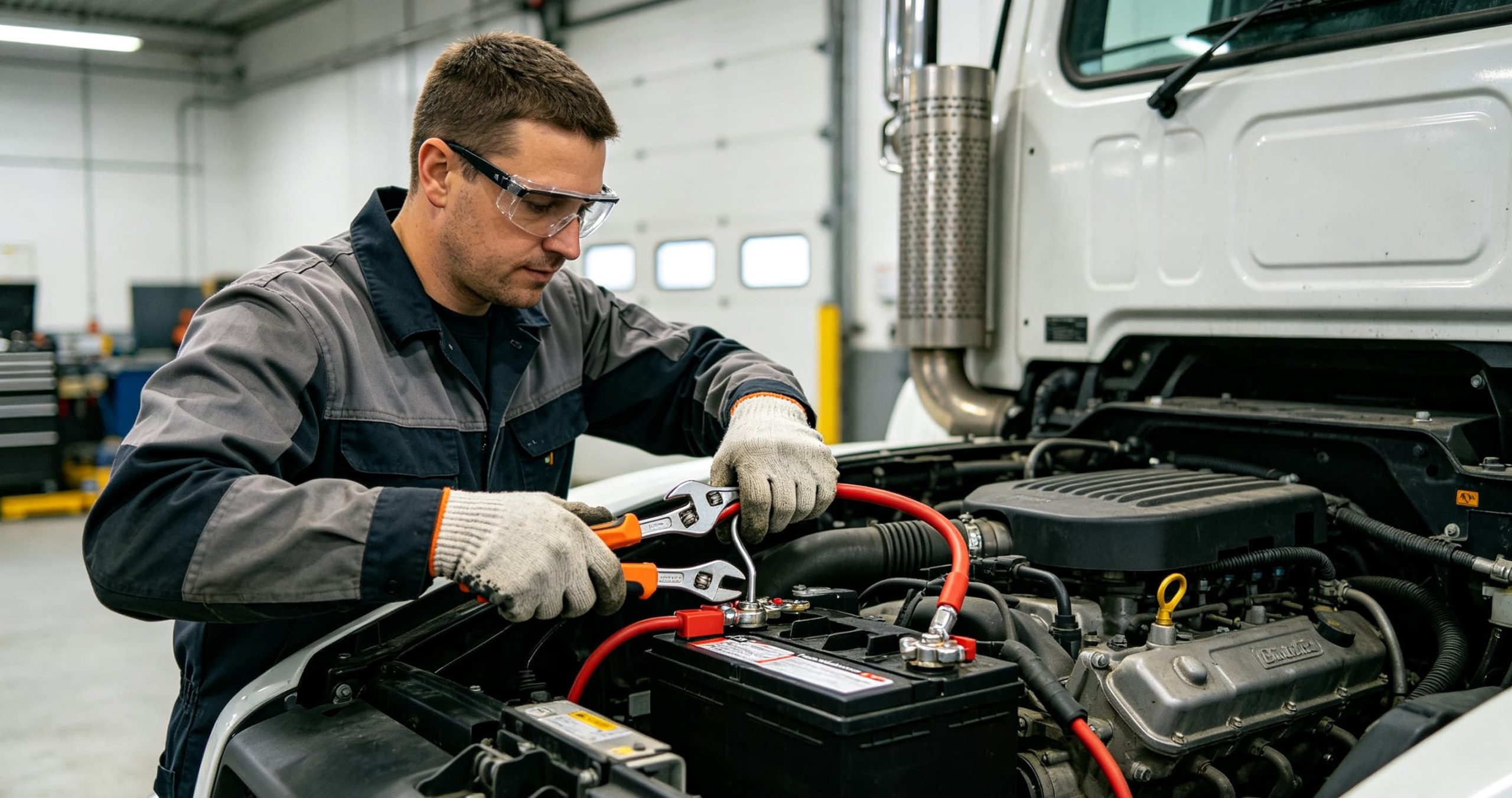
- Disconnect Battery: Always start by disconnecting the negative battery terminal to prevent accidental shorts.
- Locate and Access Starter Motor: The starter motor is typically mounted on the engine block, near the flywheel housing. Access may require removing other components (e.g., exhaust pipes, transmission crossmember) depending on the truck model (e.g., FAW Jiefang or Foton Auman).
- Disconnect Wiring: Carefully disconnect all electrical connections from the starter motor: the large battery cable (B+), the small ignition switch wire (S-terminal), and sometimes a ground wire. Note their positions or take photos.
- Remove Mounting Bolts: Support the starter motor, then remove the mounting bolts that secure it to the engine block. Heavy-duty starters can be very heavy, so ensure you have proper support to prevent injury or damage.
- Remove Old Starter Motor: Carefully maneuver the old starter motor out of its mounting location.
- Install New Starter Motor: Position the new starter motor in place and loosely install the mounting bolts. Ensure proper alignment.
- Reconnect Wiring: Reconnect all electrical wires to the new starter motor, ensuring connections are clean and tight.
- Tighten Mounting Bolts: Torque the mounting bolts to the manufacturer’s specifications.
- Reconnect Battery and Test: Reconnect the negative battery terminal. Attempt to start the engine. Listen for proper cranking and engagement.
💡 Pro-Tip: Inspect Flywheel Teeth
Before installing a new starter motor, take a moment to inspect the teeth on the engine’s flywheel (or flexplate). Look for any signs of wear, chipping, or damage. Damaged flywheel teeth can quickly ruin a new starter motor’s pinion gear. If damage is present, it must be addressed to prevent recurring starter problems, especially in high-mileage Shacman or Dongfeng trucks.
2. Remote Solenoid Replacement (if applicable)
Some heavy-duty trucks, particularly older models or specific configurations, may use a remote starter solenoid mounted on the firewall or frame rail, separate from the starter motor. In such cases, only the solenoid needs to be replaced.
- Disconnect Battery: Always disconnect the negative battery terminal.
- Locate Remote Solenoid: Identify the remote solenoid, typically a small cylindrical or rectangular component with several large terminals.
- Disconnect Wiring: Carefully disconnect all wires from the old solenoid. There will usually be a large battery cable from the battery, a large cable going to the starter motor, and one or two smaller wires from the ignition switch and possibly a neutral safety switch. Label them if necessary.
- Remove Old Solenoid: Unbolt the old solenoid from its mounting location.
- Install New Solenoid: Mount the new solenoid securely.
- Reconnect Wiring: Reconnect all wires to their correct terminals on the new solenoid. Ensure all connections are clean and tight.
- Reconnect Battery and Test: Reconnect the negative battery terminal and test the starting system.
3. Solenoid Component Repair (Advanced/Specific Cases)
While often more practical to replace the entire starter or remote solenoid, in some specific cases, or for certain types of solenoids, component-level repair might be attempted. This is typically for experienced technicians or for situations where a new part is unavailable. Common component repairs include:
- Cleaning/Replacing Main Contacts: If the solenoid clicks but doesn’t crank, the main contacts inside might be pitted or burned. In some solenoids, these contacts can be accessed, cleaned with fine-grit sandpaper, or replaced. This requires careful disassembly of the solenoid.
- Replacing Plunger/Return Spring: If the plunger is sticking or the return spring is weak, these components can sometimes be replaced.
- Repairing Coil Windings: This is rarely practical and usually indicates a need for full solenoid replacement.
⚠️ Caution: Specialized Repair
Component-level repair of a starter solenoid is an advanced task and may not be possible or cost-effective for all types. Many modern solenoids are sealed units. Attempting to disassemble a sealed unit can cause irreparable damage. Always weigh the cost of repair against the cost of a new or remanufactured unit, especially for critical components in FAW or Foton heavy-duty trucks.
Preventive Maintenance for Starter Solenoid Longevity
Proactive maintenance is key to extending the life of your truck’s starter solenoid and preventing unexpected no-start conditions. Regular checks and good practices can significantly reduce the likelihood of premature failure, especially for heavy-duty trucks from Sinotruk (HOWO), Shacman, FAW, Foton, and Dongfeng that endure demanding operational cycles.
1. Regular Battery and Cable Inspection
Since the solenoid relies heavily on a strong electrical supply, maintaining the battery and its cables is paramount. Regularly:
- Check battery terminals for corrosion and cleanliness. Clean them with a wire brush and apply anti-corrosion grease.
- Ensure battery cables are securely fastened to the battery posts, starter motor, and chassis ground. Loose connections create resistance and heat, which can damage the solenoid and starter.
- Test battery voltage and perform a load test periodically to ensure it can deliver the necessary cranking amps.
2. Inspect Wiring and Connections
Periodically inspect all wiring connected to the starter solenoid and starter motor. Look for:
- Frayed, cracked, or damaged insulation.
- Loose or corroded terminals.
- Signs of overheating (discoloration or melted insulation).
Ensure the small gauge wire from the ignition switch (S-terminal) is intact and securely connected. Any damage should be repaired promptly.
3. Keep Components Clean
Dirt, grease, and moisture can contribute to corrosion and electrical issues. Keep the starter motor and solenoid area as clean as possible. While heavy-duty trucks operate in harsh environments, occasional cleaning during routine maintenance can help. Avoid direct high-pressure washing of electrical components.
4. Address Starting Issues Promptly
Do not ignore early signs of starting problems, such as slow cranking, a single click, or intermittent starts. Addressing these issues early can prevent a complete failure of the solenoid or starter motor and potentially save on more expensive repairs down the line. Early diagnosis can often lead to simpler, less costly fixes.
5. Proper Engine Maintenance
An engine that is difficult to start puts excessive strain on the entire starting system, including the starter solenoid. Ensure your engine is well-maintained, with regular tune-ups, proper fuel delivery, and good compression. An engine that starts easily requires less cranking time and reduces wear on the starter and solenoid.
💡 Pro-Tip: Quality Replacement Parts
When replacement is necessary, always opt for high-quality starter solenoids or complete starter motor assemblies from reputable suppliers. For HOWO, Shacman,FAW, Foton, and Dongfeng trucks, choosing parts that meet or exceed OEM specifications ensures durability and reliable performance, minimizing future breakdowns and maximizing uptime.
Conclusion
The starter solenoid, though a small component, is indispensable to the reliable operation of any heavy-duty truck. Understanding its function, recognizing the symptoms of failure, and knowing how to diagnose and repair it are critical skills for anyone involved in heavy-duty vehicle maintenance. By following the diagnostic steps and repair guidelines outlined in this comprehensive guide, and by adhering to a regimen of preventive maintenance, you can significantly extend the lifespan of your truck’s starting system. This proactive approach not only saves on costly repairs and downtime but also ensures that your Sinotruk (HOWO), Shacman, FAW, Foton, or Dongfeng trucks are always ready to hit the road, delivering consistent performance and reliability. Investing in quality parts and knowledgeable maintenance is an investment in the longevity and efficiency of your fleet.
Advanced Diagnostics and Troubleshooting Techniques
For persistent or intermittent starter solenoid issues, especially in modern heavy-duty trucks with complex electrical systems like those from **Foton** or **Dongfeng**, advanced diagnostic techniques can provide deeper insights beyond basic multimeter tests.
1. Oscilloscope Analysis for Solenoid Waveforms
An oscilloscope can be an invaluable tool for diagnosing subtle or intermittent solenoid problems that a multimeter might miss. By observing the voltage and current waveforms, technicians can identify issues such as:
- Voltage Drop During Engagement: A significant voltage drop across the solenoid’s main contacts during cranking indicates high resistance, often due to pitted or burned contacts.
- Slow Engagement/Disengagement: Irregularities in the current waveform to the pull-in and hold-in coils can reveal a sticky plunger or weak electromagnetic coils.
- Noise/Interference: Electrical noise or spikes in the waveform can point to poor connections or internal arcing within the solenoid.
💡 Pro-Tip: Interpreting Waveforms
Learning to interpret oscilloscope waveforms for starter circuits requires practice. Look for clean, sharp transitions in voltage and current. Any sluggishness, excessive ripple, or unexpected drops can indicate a problem. Compare your readings to known good waveforms for similar Sinotruk or FAW starter systems if available.
2. Thermal Imaging for Overheating
Infrared thermal imaging can quickly identify hotspots in the starter circuit, indicating areas of excessive resistance or current flow. This is particularly useful for:
- Corroded Connections: Hot spots at battery terminals, cable ends, or solenoid connections point to high resistance due to corrosion or looseness.
- Internal Solenoid Overheating: An excessively hot solenoid housing after a few cranking attempts can indicate internal resistance, such as welded contacts or a shorted coil.
- Starter Motor Issues: Overheating in the starter motor itself might suggest a seized motor or excessive load, which can indirectly affect solenoid performance.
3. Current Draw Test (Amperage Test)
While a voltage drop test is crucial, measuring the actual current draw of the starter motor and solenoid can provide a complete picture. This requires an inductive amp clamp. Excessive current draw can indicate a seized starter motor, shorted windings, or excessive mechanical resistance in the engine. Insufficient current draw (with good voltage) might point to high resistance in the solenoid’s main contacts or wiring.
⚠️ Caution: High Amperage Testing
Measuring high amperage in a starter circuit requires specialized equipment (inductive amp clamp) and careful handling. Never attempt to put a standard multimeter in series with the starter circuit, as it will likely damage the meter and create a dangerous short circuit. Always follow the equipment manufacturer’s instructions and maintain a safe distance from rotating parts.
Understanding the Impact of Environmental Factors and Operating Conditions
Heavy-duty trucks, especially those from Chinese manufacturers like HOWO, Shacman,FAW, Foton, and Dongfeng, often operate in diverse and challenging environments. These conditions can significantly impact the lifespan and performance of the starter solenoid and the entire starting system.
1. Extreme Temperatures
- Cold Weather: In extremely cold conditions, engine oil becomes thicker, increasing the resistance the starter motor must overcome. This leads to higher current draw and places additional strain on the battery and solenoid. Solenoid contacts can become less efficient, and internal components can become brittle.
- Hot Weather: High ambient temperatures can accelerate the degradation of electrical components, including solenoid coils and insulation. Overheating can lead to increased resistance and premature failure of the solenoid’s internal contacts.
2. Dust, Dirt, and Moisture
Trucks operating in dusty construction sites, off-road environments, or regions with high humidity are particularly susceptible to contamination. Dust and dirt can ingress into the solenoid housing, causing the plunger to stick or accelerating wear on contacts. Moisture can lead to corrosion of terminals and internal components, creating high resistance and intermittent failures. Proper sealing and protective covers are crucial for these applications.
3. Vibration and Shock
The constant vibration and occasional shock experienced by heavy-duty trucks can loosen electrical connections, fatigue wiring, and cause internal damage to the solenoid. Manufacturers design these components to be robust, but extreme conditions can still take their toll. Regular inspection of mounting points and wiring harnesses is essential.
4. Frequent Starts and Stops
Vehicles that undergo frequent start-stop cycles (e.g., delivery trucks, municipal vehicles) place more stress on the starter solenoid than those with long, continuous runs. Each start cycle involves a high-current surge and mechanical engagement, leading to accelerated wear on the solenoid’s contacts and plunger mechanism. This is a key consideration for urban fleet operations using Sinotruk or Shacman vehicles.
Choosing the Right Replacement Parts: A Focus on Quality
When it comes to repairing or replacing a starter solenoid, the quality of the replacement part is paramount, especially for heavy-duty trucks where reliability is non-negotiable. Opting for cheap, substandard components can lead to recurring failures, increased downtime, and ultimately higher operational costs.
1. OEM vs. Aftermarket
- OEM (Original Equipment Manufacturer) Parts: These are parts made by the original manufacturer of the truck or the original supplier to the truck manufacturer. They guarantee fit, form, and function, and are typically of the highest quality. For HOWO, Shacman,FAW, Foton, and Dongfeng trucks, sourcing genuine OEM parts ensures compatibility and performance matching the original specifications.
- High-Quality Aftermarket Parts: Reputable aftermarket manufacturers produce parts that meet or exceed OEM specifications. These can be a cost-effective alternative to OEM parts without compromising quality. It’s crucial to choose trusted brands with a proven track record in the heavy-duty truck industry.
- Avoid Low-Quality Parts: Cheap, unbranded aftermarket parts often use inferior materials, have poor manufacturing tolerances, and lack proper quality control. These can fail prematurely, leading to frustration and additional repair expenses.
2. Material and Construction
Pay attention to the materials used in the solenoid’s construction. High-quality solenoids will feature:
- Durable Contacts: Main contacts made from copper or copper alloys with sufficient thickness to withstand high current and arcing.
- Robust Coils: Coils wound with high-grade copper wire and properly insulated to resist heat and vibration.
- Sealed Housing: A well-sealed housing to protect internal components from moisture, dust, and contaminants, especially important for trucks operating in harsh environments.
💡 Pro-Tip: Partner with Trusted Suppliers
For heavy-duty truck parts, especially for specialized components like starter solenoids for Sinotruk, Shacman, or FAW, partnering with a trusted parts supplier is invaluable. A good supplier can provide expert advice, ensure the authenticity and quality of parts, and offer warranties, giving you peace of mind and reducing the risk of premature failures.
Conclusion
The starter solenoid, though a small component, is indispensable to the reliable operation of any heavy-duty truck. Understanding its function, recognizing the symptoms of failure, and knowing how to diagnose and repair it are critical skills for anyone involved in heavy-duty vehicle maintenance. By following the diagnostic steps and repair guidelines outlined in this comprehensive guide, and by adhering to a regimen of preventive maintenance, you can significantly extend the lifespan of your truck’s starting system. This proactive approach not only saves on costly repairs and downtime but also ensures that your Sinotruk HOWO, Shacman,FAW, Foton, and Dongfeng trucks are always ready to hit the road, delivering consistent performance and reliability. Investing in quality parts and knowledgeable maintenance is an investment in the longevity and efficiency of your fleet.
Frequently Asked Questions (FAQs) about Truck Starter Solenoids
A1: The primary function of a starter solenoid is twofold: first, it acts as a high-current relay, allowing a small current from the ignition switch to activate a powerful internal switch that completes the high-amperage circuit from the battery to the starter motor. Second, it mechanically engages the starter motor’s pinion gear with the engine’s flywheel, transferring the motor’s rotational force to crank the engine.
A2: A systematic diagnosis is key. If you hear a rapid clicking sound, it’s often a weak battery or poor battery cable connections. If you hear a single click but no crank, it could be a faulty solenoid (main contacts) or a seized starter motor. If there’s no sound at all, it might be a completely dead battery, a faulty ignition switch, or an open circuit in the solenoid’s activation coil. Performing voltage drop tests and solenoid activation tests (as described in this guide) can help pinpoint the exact culprit.
A3: In many modern heavy-duty trucks, the starter solenoid is integrated into the starter motor assembly, making replacement of the entire starter motor the most common and often most practical solution. However, for remote solenoids or some older integrated designs, component-level repair (e.g., cleaning/replacing main contacts or the plunger) might be possible for experienced technicians. It’s crucial to weigh the cost and complexity of repair against the cost of a new or remanufactured unit.
A4: A starter solenoid that stays engaged after the engine starts is a serious issue. It means the starter motor continues to spin at extremely high RPMs, leading to rapid wear and potential destruction of the starter motor, its pinion gear, and the engine’s flywheel teeth. This can also cause severe overheating and even fire. Immediate action (turning off the engine and disconnecting the battery) is required to prevent catastrophic damage.
A5: Extremely important. The starter solenoid and motor require very high current to operate. Corroded or loose battery terminals and cable connections create excessive resistance, which restricts current flow. This can lead to symptoms like rapid clicking, slow cranking, or a single click with no crank, even if the battery and solenoid are otherwise healthy. Regular cleaning and ensuring tight connections are vital for reliable starting.
A6: While the fundamental principles are the same, Chinese heavy-duty trucks like HOWO, Shacman,FAW, Foton, and Dongfeng often operate in diverse and sometimes challenging environments. This can lead to accelerated wear on components like starter solenoids. It’s particularly important to use high-quality, genuine, or OEM-equivalent replacement parts that are designed to withstand these conditions. Additionally, always refer to the specific service manuals for these brands for precise diagnostic values and torque specifications.
A7: A starter solenoid is a heavy-duty electromagnetic switch that handles the high current required to power the starter motor and mechanically engages the starter’s pinion gear with the flywheel. A starter relay, on the other hand, is a smaller, low-current electromagnetic switch that is typically located in the fuse box or under the hood. Its function is to take the low-current signal from the ignition switch and send a slightly higher current signal to activate the starter solenoid. The relay acts as an intermediary to protect the ignition switch from the solenoid’s higher current draw.
A8: Preventive maintenance is key. Regularly inspect and clean battery terminals and cable connections, ensuring they are tight and corrosion-free. Periodically check all wiring to the starter and solenoid for damage. Address any starting issues promptly, as early intervention can prevent more severe damage. Ensure your engine is well-maintained to avoid excessive cranking. When replacing parts, always use high-quality components from reputable suppliers, especially for heavy-duty applications.


