Your truck’s axle is like its backbone — one bad part from a shady supplier, and your entire fleet could be lying on the roadside like a tired camel in the desert. Choosing the wrong truck axle spare parts supplier doesn’t just cost you money; it costs you reputation, downtime, and sleep. So how do you find “The One”?
If you’ve ever received a batch of axle parts that looked right but failed within weeks, or waited 60 days for a shipment that was promised in 15, you already know the pain. This guide is your armor. We’re going to walk you through exactly how to evaluate, vet, and choose a reliable truck axle parts supplier — with the same no-nonsense approach we’ve used over 15 years serving customers in 100+ countries.
Grab a coffee. This one’s worth bookmarking.
Why Your Choice of Truck Axle Spare Parts Supplier Can Make or Break Your Business
Let’s be blunt: choosing a supplier isn’t a purchasing task. It’s a strategic business decision that affects your bottom line, your customer relationships, and your sanity. The axle system is the workhorse of any commercial vehicle — it carries the load, transfers the power, and takes the punishment. When it fails, everything stops.
And when everything stops, the meter starts running — fast.
The Hidden Cost of Cheap Axle Parts (It’s More Than You Think)
Everyone loves a bargain. But in the world of heavy duty axle components wholesale, “cheap” often comes with a receipt you didn’t expect. Let’s look at what unreliable parts actually cost:
- Fleet downtime: Industry data shows that a single commercial truck sitting idle costs between $500–$1,500 per day in lost revenue, depending on the market. Multiply that by a fleet of 20 trucks, and a 5-day delay becomes a $50,000–$150,000 problem.
- Warranty claim nightmares: When parts fail prematurely, you’re not just replacing them — you’re paying for reverse logistics, labor, customer compensation, and the administrative headache of chasing your supplier for accountability.
- Brand damage: If you’re a distributor or fleet operator, your customers don’t care who your supplier is. They care that their Sinotruk HOWO broke down mid-route carrying 40 tons of cargo. That’s YOUR reputation on the line.
The cheapest part on the shelf is often the most expensive decision you’ll make all year.
The Growing Global Demand for Heavy Duty Axle Components Wholesale
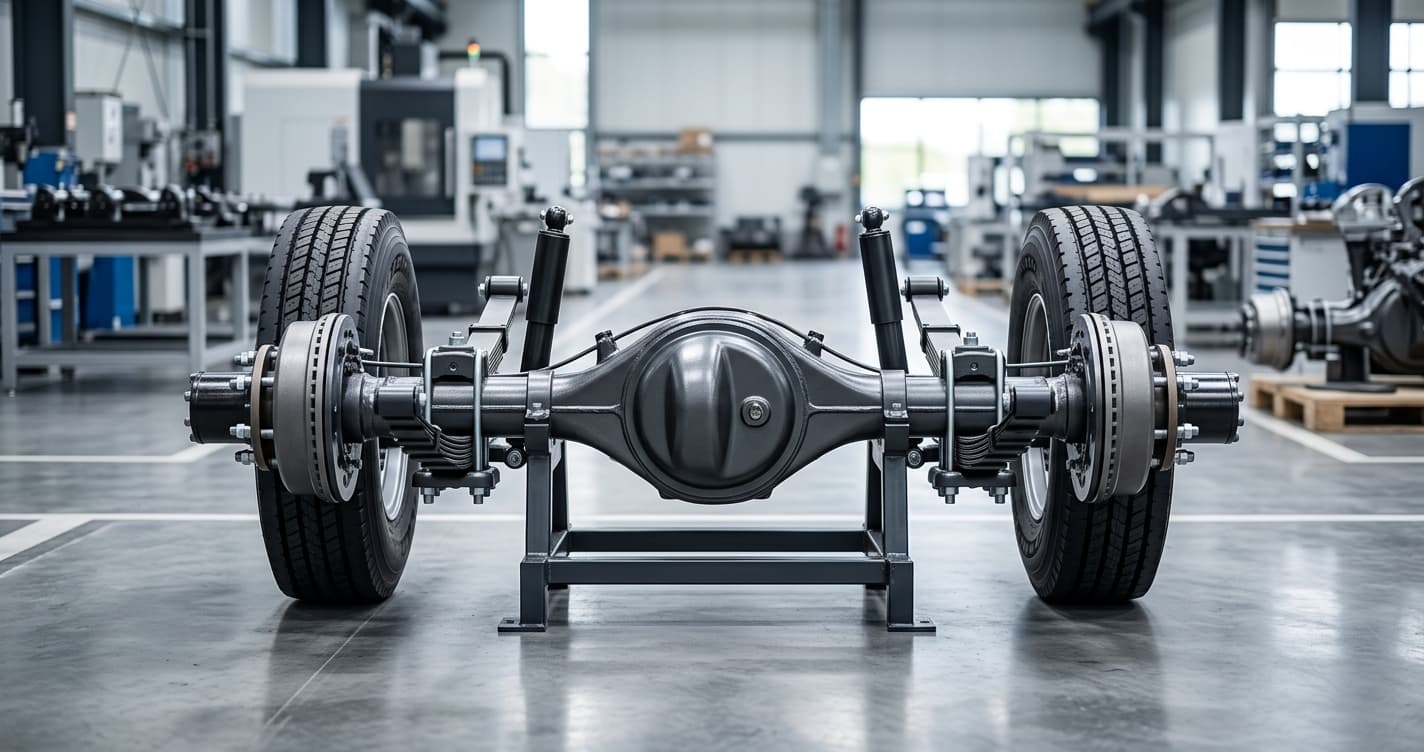
Here’s the good news: the market for aftermarket truck axle parts quality products is booming. According to industry reports, the global commercial vehicle aftermarket grew at a CAGR of approximately 4.5% between 2020 and 2025, with the Asia-Pacific region (led by China) accounting for the largest share of production and export.
Why? Because Chinese truck brands — Sinotruk HOWO, Shacman, FAW, Dongfeng, Foton, JAC, and Beiben — now dominate roads across Africa, Southeast Asia, the Middle East, South America, and Central Asia. Where the trucks go, the parts demand follows.
This surge in commercial vehicle drivetrain parts sourcing from China has also driven growth in related categories: wholesale engine parts demand is climbing, bulk automotive components orders are getting larger, and the engine replacement parts market is more competitive than ever. The suppliers who can handle high volume engine parts supply alongside drivetrain components are the ones winning long-term partnerships.
| Factor | Unreliable Supplier | Reliable Supplier |
|---|---|---|
| Average Part Failure Rate | 12–18% | < 2% |
| Fleet Downtime (days/year) | 15–30 days | 2–5 days |
| Warranty Claim Processing | 45–90 days | 7–15 days |
| Repeat Order Confidence | Low | High |
| Long-term Cost per Unit | Higher (hidden costs) | Lower (total value) |
| Supply Chain Disruption Risk | High | Minimal |
The numbers don’t lie. A “reliable truck axle parts supplier” isn’t a luxury — it’s the difference between profit and pain.
The 8 Non-Negotiable Criteria for Choosing a Reliable Truck Axle Spare Parts Supplier
Think of this as your supplier dating checklist. Except instead of “must love dogs,” it’s “must not destroy my business.” Here are the eight criteria that separate the professionals from the pretenders.
1. Industry Experience — Have They Survived the “Trial by Fire”?
There’s a reason we emphasize 10+ years of experience when evaluating an OEM truck axle replacement parts vendor. The truck parts industry is full of nuances that only time teaches you.
An experienced supplier knows that a Sinotruk HOWO A7 rear axle is NOT the same as a T7H rear axle — even though they look similar in photos. They know the bearing specifications differ between a Shacman F3000 and an X3000. They’ve seen every fitment mistake, every shipping complication, and every quality dispute — and they’ve built systems to prevent them.
A supplier with 15 years in the business has survived market crashes, shipping crises, and demanding customers. That survival is your insurance policy. Learn about our journey and experience here.
2. Product Range & Brand Coverage — Can They Be Your One-Stop Shop?
Imagine ordering axle shafts from one supplier, differential gears from another, wheel hubs from a third, and bearings from a fourth. Now imagine tracking four shipments, four quality standards, four invoices, and four potential problems.
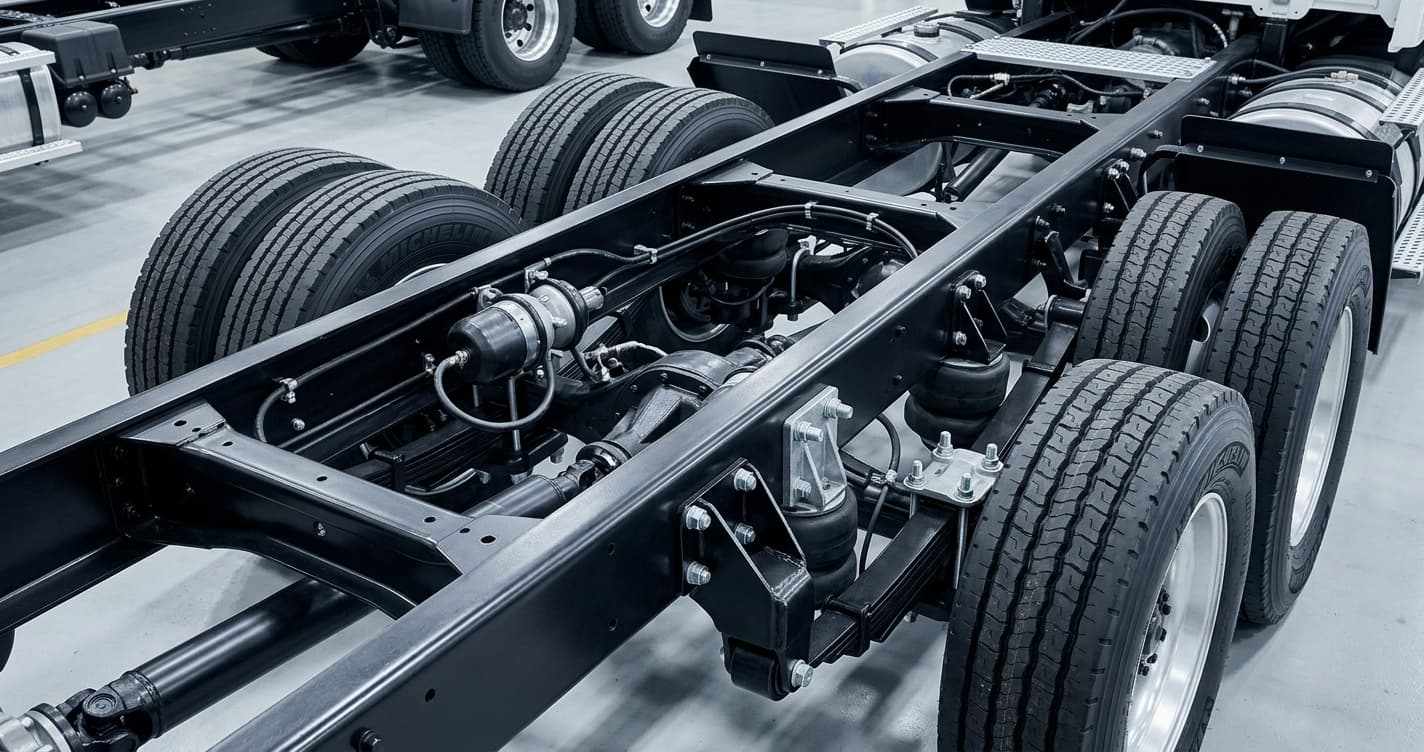
The best truck axle spare parts supplier covers multiple Chinese truck brands AND multiple component categories under one roof: axle assemblies, differential gears, wheel hubs, axle shafts, bearings, seals, brake drums, and more.
This one-stop-shop capability connects directly to popular motor spares distribution efficiency. When your supplier also handles high volume engine parts supply and other systems, your logistics simplify dramatically. Fewer suppliers = fewer headaches = more profit. Explore our brand coverage and browse parts by system.
3. Quality Assurance & Certification — Show Me the Paperwork
Trust, but verify. A professional supplier doesn’t just tell you their parts are good — they prove it.
Look for: ISO 9001 certification (minimum), material test reports (especially for forged and heat-treated components like axle shafts), and willingness to accept third-party inspection before shipment.
Here’s the golden rule for verifying aftermarket truck axle parts quality: Sample first, trust later. Any supplier who resists sending samples or gets defensive about inspection requests is waving a red flag the size of a truck tarp.
4. Pricing Transparency — Fair, Not Just Cheap
Let’s talk about the elephant in the room: price. Yes, it matters. But the lowest quote often hides the highest total cost.
A transparent supplier gives you a clear breakdown: unit price, packaging cost, inspection fees (if any), inland freight to port, and documentation charges. No surprises after you’ve already committed.
In the engine replacement parts market and bulk automotive components space, pricing psychology is real. Some suppliers quote impossibly low to win your first order, then raise prices or cut quality on repeat orders. The smart move? Benchmark against 3–5 suppliers, compare total landed costs, and choose value — not just the smallest number on a spreadsheet.
5. Supply Chain Reliability & Lead Times — Can They Deliver When It Matters?
Here’s a real scenario: A fleet operator in East Africa needs 200 axle shafts for Sinotruk HOWO trucks within 15 days. Their trucks are grounded. Revenue is bleeding. They contact their supplier.
Supplier A says: “Let me check with the factory. Maybe 45 days.” Supplier B says: “We have 180 in stock, can produce the remaining 20 in 5 days. Shipping in 3 days.”
Which supplier do you think gets the long-term contract?
Inventory management capability and warehouse readiness separate real suppliers from brokers who only place factory orders after receiving your payment. Ask for warehouse photos with date stamps. Verify stock levels before ordering. Lead time consistency is the hallmark of a professional operation.
6. Communication & After-Sales Support — Do They Ghost You After Payment?
We’ve all experienced it: the supplier who replies in 5 minutes during the quotation stage, then takes 5 days to respond after you’ve paid. It’s the supplier equivalent of a bad first date who never calls back.
Set a benchmark: a reliable truck axle spare parts supplier responds within 24 hours, even on complex technical questions. They have staff who understand commercial vehicle drivetrain parts sourcing — not just salespeople reading from a catalog.
After-sales support means they help you when things go wrong, not just when things are profitable.See how we handle support and problem-solving.
7. Customer References & Track Record — Let Their Clients Do the Talking
Any supplier can claim to be “the best.” But can they prove it?
Ask for case studies. Request contact details of existing customers (with their permission, of course). Look for verifiable reviews, testimonials, or long-term partnership evidence.
Red flag: If a supplier has been in business for “10 years” but can’t provide a single customer reference? Something doesn’t add up. A strong track record speaks louder than any sales pitch. Read our customer success stories.
Common Problems When Sourcing Truck Axle Spare Parts (And Exactly How to Solve Them)
We’ve been in this industry for 15 years. We’ve heard every horror story, fixed countless sourcing nightmares, and helped customers recover from supplier disasters. Here are the five most common problems — and exactly how to prevent or solve them.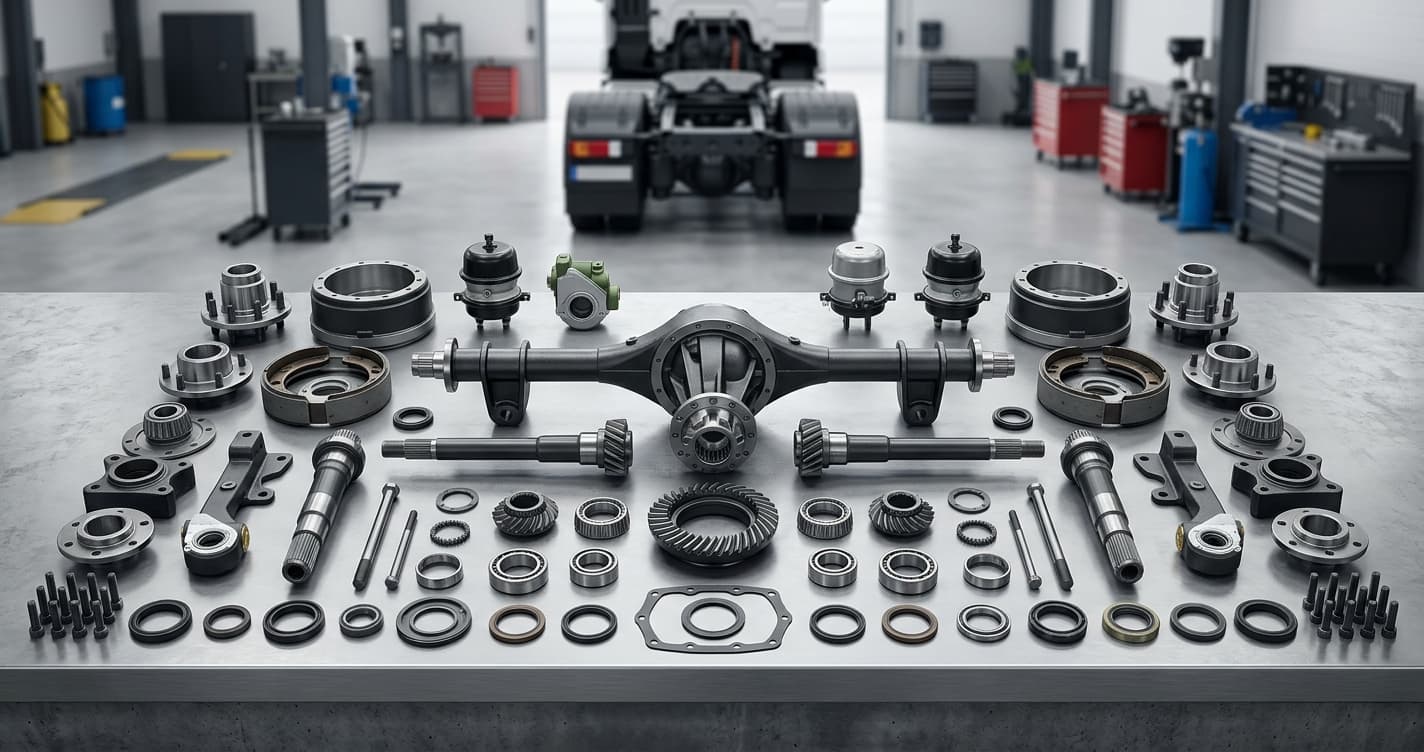
Problem 1: “The Parts I Received Don’t Fit My Truck Model”
Why it happens: This is the #1 complaint in commercial vehicle drivetrain parts sourcing. It usually stems from vague communication — a buyer says “HOWO rear axle shaft” without specifying whether it’s an A7, T7H, or N7. The axle ratios, spline counts, and shaft lengths differ between models. A supplier without model-specific expertise simply guesses — and guesses wrong.
How to solve it: Always provide your truck’s VIN number, the specific axle model number (usually stamped on the axle housing), and photos of the existing parts. Work with suppliers who maintain detailed cross-reference databases for Chinese truck brands. If they can’t tell you the difference between a Sinotruk HC16 and an MCY13 axle without looking it up? They’re not specialized enough.
Need help identifying the right part? Our technical team can assist.
Problem 2: “Quality Is Inconsistent Between Batches”
Why it happens: Some suppliers quietly switch sub-suppliers to save costs — your first order comes from Factory A (good quality), your third order comes from Factory C (terrible quality). Without incoming quality inspection processes, these switches go undetected until parts fail in the field.
How to solve it: Request batch-level material test reports and hardness certificates. Establish a written quality agreement that specifies material grades, heat treatment standards, and dimensional tolerances — with penalty clauses for non-compliance. Always start with trial orders before committing to large bulk automotive components purchases. Trust is built batch by batch.
Problem 3: “Lead Times Keep Getting Delayed”
Why it happens: The supplier has no real inventory. They’re a broker — they take your order, collect your payment, then place an order with a factory. If the factory is busy, you wait. If there’s a raw material shortage, you wait longer. They promised 15 days but deliver in 45.
How to solve it: Before ordering, ask for warehouse photos or videos with visible date stamps. Request a stock list with quantities. Better yet, conduct a video tour of their warehouse. Choose suppliers with dedicated axle parts inventory — companies that invest in stocking commonly demanded items because they understand their customers’ urgency. Brokers pretending to be wholesalers will always let you down when speed matters most.
Problem 4: “I Can’t Get Technical Support After the Sale”
Why it happens: Many trading companies employ salespeople with zero technical background. They can quote you a price, but they can’t tell you the correct axle ratio for a Shacman F3000 6×4 tractor or the bearing specification for a Dongfeng KL drive axle. When installation problems arise, they go silent.
How to solve it: Test their technical knowledge during the inquiry stage. Ask specific questions: “What’s the difference between the 8.7 and 5.73 ratio differential for Shacman X3000?” or “Which seal kit fits the Dongfeng Tianlong rear axle housing?” If they fumble during the sales process, they’ll absolutely fumble when you need urgent technical support post-delivery.
Problem 5: “Pricing Seems Good But Hidden Costs Appear Later”
Why it happens: The quoted FOB price looks competitive, but it excludes: export-grade packaging (extra $2–5/piece), fumigation certificates, inland freight to port, documentation fees, or inspection charges. By the time you add everything up, the “cheap” supplier is actually more expensive than the transparent one.
How to solve it: Request a fully landed cost breakdown before committing. Clarify Incoterms (FOB, CIF, DDP) upfront and confirm exactly what’s included. Compare total cost of ownership across suppliers — not just the unit price line item. A professional supplier presents all costs clearly from the beginning because they have nothing to hide.
| Common Problem | Root Cause | Quick Solution | Prevention Strategy |
|---|---|---|---|
| Parts don’t fit | Poor communication / wrong specs | Provide VIN + axle model + photos | Work with brand-specialized suppliers |
| Inconsistent quality | Supplier switches sources | Batch test reports + QA agreement | Trial orders before bulk commitment |
| Delayed lead times | No real inventory | Verify warehouse stock | Choose stocking suppliers, not brokers |
| No after-sales support | No technical team | Test knowledge during inquiry | Evaluate support before first order |
| Hidden costs | Incomplete quotation | Request landed cost breakdown | Clarify all Incoterms and fees upfront |
Red Flags That Scream “Walk Away From This Supplier”
Not every supplier deserves your business. Here are the warning signs that should make you close that chat window and move on — no matter how sweet the deal sounds.
The “Too Good to Be True” Price Tag 🚩
If a supplier’s price is 40% below the market average for OEM truck axle replacement parts, ask yourself: where are they cutting corners? Inferior materials? Skipped heat treatment? Recycled bearings? In this industry, you genuinely get what you pay for. A differential assembly that costs half the normal price will likely last half as long — or less.
No Factory Visits or Video Calls Allowed 🚩
Transparency is non-negotiable in heavy duty axle components wholesale. If a supplier refuses to show you their warehouse, won’t do a video call, or makes excuses every time you suggest a visit — they’re hiding something. Maybe they don’t have inventory. Maybe they don’t have a warehouse. Maybe they’re operating from a laptop in a coffee shop. Either way, run.
They Claim to Supply “Everything for Every Brand” 🚩
A supplier claiming to stock parts for every truck brand on earth probably specializes in none. The Chinese truck parts market alone requires deep expertise across Sinotruk, Shacman, FAW, Dongfeng, Foton, JAC, and Beiben — each with dozens of models and axle variants. A focused supplier who knows their niche will serve you infinitely better than a jack-of-all-trades who knows nothing deeply.
Zero Online Presence or Verifiable Reviews 🚩
It’s 2024. A legitimate truck axle spare parts supplier has a website, social media presence, customer testimonials, or at minimum, a verifiable business registration. If Google has never heard of them, that’s a problem. No digital footprint often means no accountability.
Pressure to Pay 100% Upfront With No Milestone Terms 🚩
Professional suppliers understand international trade payment norms. A 30% deposit with 70% before shipment (against inspection photos or B/L copy) is standard. If someone demands 100% T/T upfront with no negotiation, no milestone structure, and no escrow option — they either don’t trust their own product or they’re planning to disappear with your money.
Why Chinese Truck Brands Dominate the Global Aftermarket — And What It Means for Your Sourcing
If you’re reading this article, chances are your business revolves around Chinese truck brands. And you’re not alone — these brands have quietly (and not so quietly) taken over roads across the developing world.
The Rise of Sinotruk, Shacman, FAW, Dongfeng, Foton & Beiben in Global Markets
The numbers are staggering. China exported over 500,000 commercial vehicles in 2023, with Sinotruk alone shipping more than 100,000 units to overseas markets. Shacman, FAW, and Dongfeng collectively serve fleets in over 90 countries.
In Africa, Chinese trucks now account for an estimated 60–70% of new heavy-duty truck registrations in many countries. Southeast Asia, the Middle East, and South America tell similar stories. These aren’t just trucks — they’re economic lifelines for construction, mining, logistics, and agriculture.
And every single one of those trucks will need spare parts. Axle shafts wear out. Bearings fail. Differential gears need replacement. The aftermarket demand — including the engine replacement parts market and drivetrain components — is surging in direct proportion to the installed fleet base.
China’s Manufacturing Ecosystem Advantage for Bulk Automotive Components
China doesn’t just make the trucks — it makes the entire ecosystem of parts that keep them running. Integrated supply chains mean that raw materials, forging, machining, heat treatment, and assembly all happen within a concentrated industrial zone. This drives costs down while maintaining quality at scale.
The popular motor spares distribution network originating from China now serves 100+ countries, with established shipping routes, consolidation hubs, and logistics partnerships that make bulk automotive components sourcing faster and more affordable than ever before.
For buyers, this means one thing: the smartest sourcing strategy for Chinese truck axle parts is to source from China itself — from suppliers embedded in this ecosystem who have direct factory relationships and deep brand expertise.
| Chinese Truck Brand | Popular Models | Common Axle Parts in Demand | Primary Export Markets |
|---|---|---|---|
| Sinotruk HOWO | A7, T7H, N7, TX | Differential gears, axle shafts, wheel hubs | Africa, Middle East, Southeast Asia |
| Shacman | F3000, X3000, H3000 | Drive axle assemblies, bearings, seals | Middle East, Central Asia, Africa |
| FAW | J6, J7, JH6 | Rear axle housings, ring & pinion sets | Southeast Asia, South America, Africa |
| Dongfeng | KL, KX, Tianlong | Axle shafts, brake drums, hub assemblies | Africa, Southeast Asia, Middle East |
| Foton | Auman, EST-A | Differential cases, bearings, flanges | South America, Africa, Southeast Asia |
| Beiben | V3, V3ET | Drive axle gears, wheel studs, seals | Africa, Middle East, Central Asia |
| JAC | Gallop, K7 | Axle shafts, hub caps, bearing kits | South America, Southeast Asia, Africa |
Step-by-Step: How to Vet a Truck Axle Spare Parts Supplier (Our Proven Process)
Theory is great, but you need a practical, repeatable process. Here’s the exact step-by-step method we recommend to our customers — the same process smart distributors use to separate real suppliers from pretenders.
Step 1: Initial Research & Shortlisting
Start with 8–10 potential suppliers. Use online platforms (Alibaba, Made-in-China, Global Sources), industry trade shows (Canton Fair, Automechanika), and referrals from trusted industry contacts. Look for suppliers who specifically mention Chinese truck brands and axle components — not generalists who sell “everything automotive.”
Step 2: Send a Detailed Inquiry (Test Their Response)
Don’t just ask for a price list. Send a specific, technical inquiry: “I need 100 pieces of rear axle shaft for Sinotruk HOWO A7, HC16 axle, ratio 4.38, left side. Please confirm part number, material specification, lead time, and MOQ.”
Watch how they respond. A professional supplier will confirm specifications, ask clarifying questions, and provide detailed answers within 24–48 hours. A weak supplier will send a generic catalog or take a week to reply.
Step 3: Request Samples & Documentation
Order samples of 2–3 critical parts. Inspect them physically: check dimensions against OEM specifications, verify material hardness, examine surface finish, and test fitment if possible. Request material certificates, hardness test reports, and photos of the production process.
Step 4: Conduct a Video Factory/Warehouse Tour
In the post-COVID era, video tours are standard practice. A serious supplier will happily walk you through their warehouse via WeChat, WhatsApp, or Zoom. Look for organized inventory, clear labeling by brand and model, proper storage conditions, and evidence of active stock movement. If the warehouse looks empty or disorganized, that tells you everything about their operational capability.
Step 5: Place a Trial Order
Start small. Order 20–50 pieces of your most critical parts. Evaluate the entire experience: communication speed, packaging quality, shipping accuracy, documentation completeness, and actual lead time versus promised lead time. This trial order is your real-world test — it reveals everything a sales pitch cannot.


