In the complex ecosystem of a heavy-duty truck, the wiring harness acts as the central nervous system, transmitting vital electrical signals and power to every component. From engine management and lighting to advanced telematics and safety systems, the integrity of the wiring harness is paramount for reliable operation. When a wiring harness fails, it can lead to a cascade of electrical issues, often resulting in frustrating downtime and costly repairs. For fleet managers and maintenance professionals overseeing Chinese trucks such as Sinotruk (HOWO), Shacman, FAW (Jiefang), Foton, and Dongfeng, understanding the symptoms and causes of wiring harness failure is not just beneficial—it’s a critical aspect of proactive maintenance. This comprehensive guide will delve into the essential role of wiring harnesses, detail common failure modes, provide systematic diagnostic procedures, and offer practical advice for repair and preventive measures. Our aim is to empower you with the knowledge to maintain the electrical health of your heavy-duty vehicles, ensuring consistent performance and minimizing operational disruptions. For more general company information, please visit our Mettlead homepage or learn more about us on our about us page.
The Electrical Backbone: Understanding the Function of Truck Wiring Harnesses
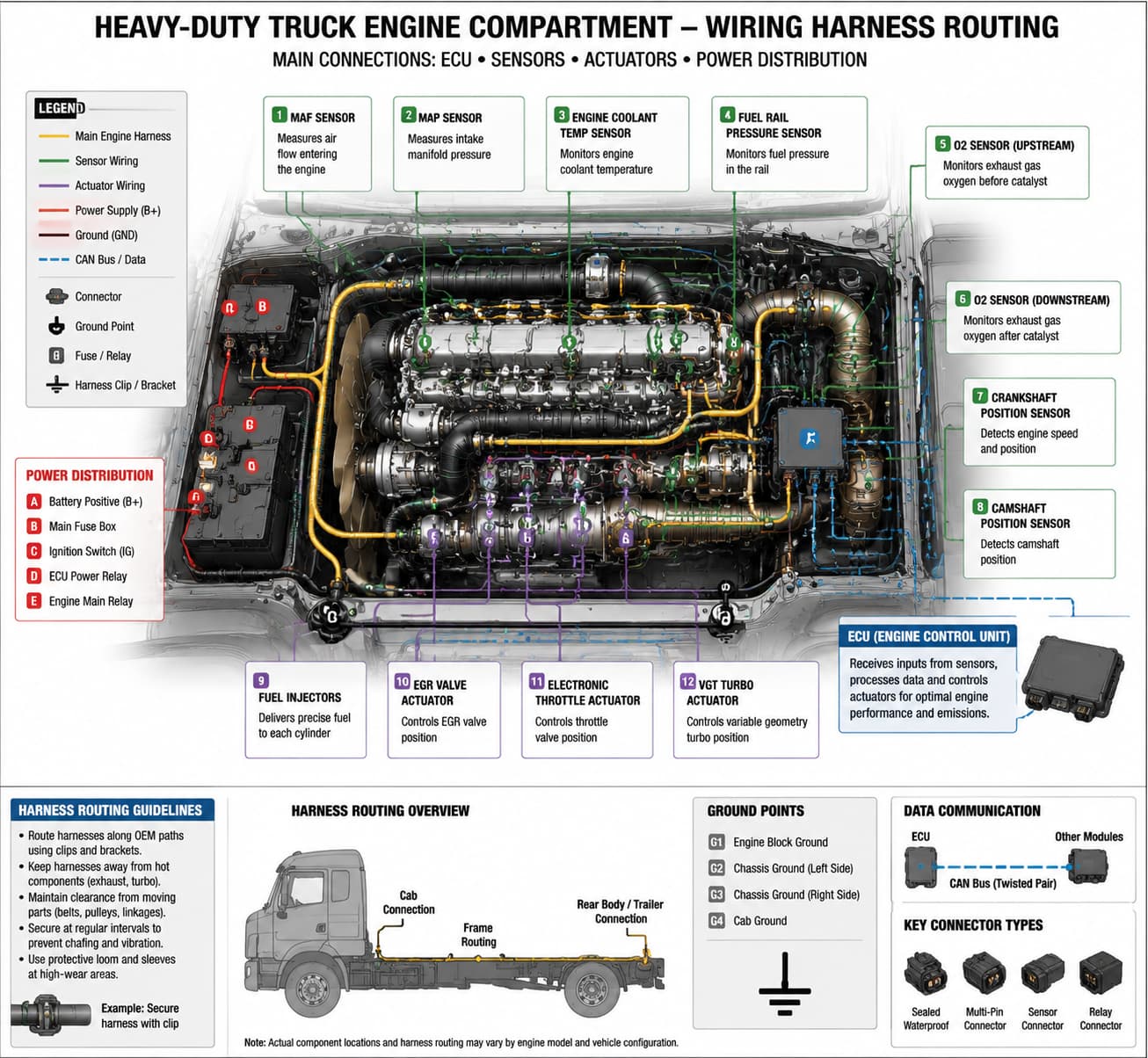
A truck wiring harness is a meticulously organized assembly of wires, terminals, and connectors that transmit electrical power and data throughout the vehicle. It’s designed to simplify the electrical system, making it more robust and easier to install. Furthermore, it protects individual wires from the harsh operating environment of a heavy-duty truck. You can find more details on specific product systems on our product system page.
1. Power Distribution
The harness efficiently distributes electrical power from the battery and alternator to various components, including lights, sensors, actuators, and electronic control units (ECUs). Consequently, it ensures that each component receives the correct voltage and current for optimal operation. This is particularly vital for power-hungry systems in modern FAW and Foton trucks.
2. Signal Transmission
Beyond power, wiring harnesses are crucial for transmitting data and control signals between ECUs and various sensors and actuators. This includes signals for engine timing, fuel injection, braking systems, and diagnostic information. Therefore, any disruption in these signal paths can lead to severe performance issues or system failures.
3. Protection and Organization
The harness bundles wires together, protecting them from abrasion, heat, moisture, and chemical exposure. This organization also simplifies troubleshooting and maintenance, as wires are neatly routed and identified. In addition, the outer sheathing provides an extra layer of defense against the elements and mechanical stress, common in Sinotruk (HOWO) and Shacman vehicles.
💡 Pro-Tip: OEM vs. Aftermarket Harnesses
While aftermarket wiring harnesses can be more affordable, OEM (Original Equipment Manufacturer) harnesses are designed to precise specifications, ensuring optimal fit, material quality, and electrical performance. For critical systems in heavy-duty trucks, investing in a high-quality, OEM-equivalent harness is often a more reliable long-term solution. Always consider the specific demands of your Dongfeng or FAW truck when choosing replacement parts.
Common Causes of Truck Wiring Harness Failure
Wiring harnesses in heavy-duty trucks operate in extremely demanding environments, making them susceptible to various forms of degradation and damage. Understanding these root causes is crucial for effective prevention and repair. For further assistance, our technical support page is always available.
1. Abrasion and Chafing: The Wear and Tear
Constant vibration, friction against chassis components, engine parts, or other harnesses can lead to abrasion and chafing of the outer insulation. Over time, this exposes the internal wires, making them vulnerable to short circuits, corrosion, and breakage. Furthermore, improper routing or insufficient securing of the harness can exacerbate this issue. Consequently, this is a very common problem in areas where the harness passes through tight spaces or near moving parts.
2. Heat Damage: The Silent Destroyer
Exposure to excessive heat from the engine, exhaust system, or turbocharger can degrade the wire insulation, making it brittle and prone to cracking. This is particularly problematic in engine compartments where temperatures can soar. In addition, prolonged heat exposure can increase the resistance of the wires themselves, leading to voltage drops and reduced current flow. Specifically, wires that are too close to hot components in Sinotruk (HOWO) and Shacman trucks can suffer from this.
3. Moisture and Corrosion: The Environmental Assault
Water ingress, especially in areas exposed to road spray, rain, or high humidity, can lead to corrosion of terminals and connectors. This corrosion, often appearing as a green or white powdery substance, increases resistance, impedes electrical flow, and can cause intermittent connections. Furthermore, moisture combined with road salt or other chemicals can accelerate the corrosive process, leading to premature failure. Consequently, sealed connectors are crucial in heavy-duty applications, particularly for Dongfeng trucks operating in diverse climates.
4. Vibration Fatigue: The Constant Stressor
Heavy-duty trucks are subjected to continuous vibration, which can cause individual wires within the harness to fatigue and break over time. This is especially true at connection points or where wires are bent sharply. In addition, the constant movement can loosen terminals within connectors, leading to intermittent electrical contact. Specifically, this type of failure is often difficult to diagnose as the break might not be immediately visible.
5. Chemical Exposure: The Degrader
Exposure to oil, fuel, brake fluid, battery acid, or cleaning agents can degrade the insulation material of the wiring harness. This chemical attack can soften, swell, or crack the insulation, leaving the conductors exposed and vulnerable to short circuits or corrosion. Therefore, proper routing away from potential chemical spills is essential.
6. Rodent Damage: The Unseen Threat
Rodents, attracted to the soy-based insulation used in some modern wiring, can chew through harnesses, causing open circuits, short circuits, and intermittent electrical problems. This type of damage is often hidden and can be particularly challenging to locate. Consequently, it’s a problem that can affect any truck, including FAW and Foton models parked for extended periods.
7. Improper Installation or Repair: Human Error
Incorrect installation during manufacturing or subsequent repairs can significantly contribute to harness failure. This includes:
- Improper Routing: Wires routed too tightly, pinched, or left unsupported.
- Poorly Crimped Terminals: Leads to high resistance and intermittent connections.
- Inadequate Sealing: Connectors not properly sealed against moisture.
- Incorrect Wire Gauge: Using wires that are too thin for the current load, leading to overheating.
Therefore, attention to detail during installation and repair is paramount. For high-quality components and proper installation guidance, our technical support page can provide valuable resources.
⚠️ Caution: Intermittent Problems
Wiring harness failures often manifest as intermittent problems, which can be the most frustrating to diagnose. These issues might appear only under specific conditions (e.g., engine vibration, temperature changes, or moisture). Never dismiss intermittent electrical glitches; they are often early warnings of a more significant harness problem that needs attention.
Symptoms of Truck Wiring Harness Failure
Identifying the symptoms of a failing wiring harness can be challenging, as they often mimic other electrical or component failures. However, recognizing patterns and specific indicators can help narrow down the diagnosis. Here are the most common symptoms:
| Symptom | Primary Indication | Possible Harness Problem |
|---|---|---|
| Intermittent Electrical Malfunctions | Lights flickering, gauges erratic, radio cutting out, power windows failing intermittently. | Loose connections, partial wire breaks, corrosion, chafing. |
| Engine Performance Issues | Rough idling, misfires, stalling, reduced power, poor fuel economy. | Damaged wires to sensors (e.g., O2, MAF, Crankshaft Position), injectors, or ignition coils. |
| Warning Lights on Dashboard | Check Engine Light (CEL), ABS light, Airbag light, etc., illuminating without clear cause. | Open circuits, short circuits, or high resistance in sensor wiring. |
| Foul Odors (Burning Plastic/Rubber) | Distinct smell of burning insulation. | Short circuit, overloaded circuit, severe chafing causing arcing. |
| Complete Loss of Power to a System | Headlights, wipers, or entire dashboard not functioning. | Completely severed wire, blown fuse due to short, faulty connector. |
| Visible Damage to Harness | Frayed insulation, exposed wires, signs of rodent chewing, melted sections. | Abrasion, heat damage, chemical exposure, animal damage. |
1. Intermittent Electrical Malfunctions
This is perhaps the most common and frustrating symptom. You might experience lights flickering, gauges behaving erratically, the radio cutting out, or power windows failing intermittently. Furthermore, these issues often appear and disappear seemingly at random, making them difficult to pinpoint. Consequently, intermittent problems are frequently caused by loose connections within a connector, partial wire breaks that only lose contact under vibration, or subtle corrosion increasing resistance. This is a prevalent issue in older Sinotruk (HOWO) and Shacman models.
2. Engine Performance Issues
Since the engine wiring harness connects critical sensors (e.g., oxygen sensors, MAF sensors, crankshaft position sensors) and actuators (e.g., fuel injectors, ignition coils) to the Engine Control Unit (ECU), any fault can severely impact engine performance. Symptoms can include rough idling, misfires, stalling, reduced power, poor acceleration, or decreased fuel economy. In addition, a damaged wire to a sensor can send incorrect data to the ECU, leading to improper engine operation. Specifically, this can be a major concern for the sophisticated engines in FAW and Foton trucks.
3. Warning Lights on the Dashboard
The illumination of various warning lights, such as the Check Engine Light (CEL), ABS light, or Airbag light, without any apparent mechanical fault, can often point to a wiring harness issue. This occurs when a sensor’s wiring is compromised, leading to an open circuit, short circuit, or high resistance, which the ECU interprets as a fault within the system. Consequently, the ECU logs a Diagnostic Trouble Code (DTC), triggering the warning light. For troubleshooting these codes, our technical support page can offer valuable insights.
4. Foul Odors (Burning Plastic or Rubber)
A distinct smell of burning plastic or rubber is a serious warning sign that should never be ignored. This odor indicates that a wire is overheating, usually due to a short circuit, an overloaded circuit, or severe chafing causing arcing. Furthermore, this can quickly escalate into an electrical fire, posing a significant safety risk. Therefore, immediate investigation and repair are necessary if you detect such an odor.
5. Complete Loss of Power to a System
In more severe cases, a complete break in a wire or a severe short circuit can lead to a total loss of power to an entire system. This could manifest as headlights not working, wipers failing, or the entire dashboard going dark. Consequently, this often indicates a blown fuse (due to a short) or a completely severed power wire within the harness. This can be particularly dangerous if it affects critical safety systems in Dongfeng trucks.
6. Visible Damage to the Harness
Sometimes, the problem is overtly visible. Frayed insulation, exposed copper wires, signs of rodent chewing, melted sections, or obvious kinks and pinches in the harness are clear indicators of damage. While these are easier to spot, they still require immediate attention to prevent further electrical issues or safety hazards. Regular visual inspections are crucial for catching these problems early.
💡 Pro-Tip: The Wiggle Test
For intermittent electrical problems, a
wiggle test can be surprisingly effective. With the engine running or the affected system activated, gently wiggle and flex sections of the wiring harness, especially near connectors and routing points. If the symptom momentarily changes or disappears, you’ve likely found the area of the fault. This is a quick and dirty method to narrow down the problem area before more in-depth diagnostics. For more insights into troubleshooting, explore our customer success cases.
Diagnosing Truck Wiring Harness Problems: A Systematic Approach
Diagnosing wiring harness issues requires patience, a systematic approach, and the right tools. Given the complexity of modern heavy-duty truck electrical systems, a thorough diagnostic process is essential to accurately identify the fault and avoid unnecessary component replacement. This is particularly true for sophisticated systems in Sinotruk (HOWO), Shacman, FAW, Foton, and Dongfeng trucks.
⚠️ Caution: Electrical System Safety
Always prioritize safety when working with electrical systems. Disconnect the battery (negative terminal first) before performing any invasive tests or repairs. Wear appropriate personal protective equipment (PPE), including safety glasses and insulated gloves. Be aware of high voltages and currents, which can cause severe injury or damage. If you are unsure about any diagnostic step, consult the truck’s service manual or seek professional assistance. Our technical support page offers valuable resources.
1. Visual Inspection: The Foundation of Diagnosis
As with battery cables, a meticulous visual inspection is the first and often most revealing step. Follow the entire length of the suspected harness, paying close attention to:
- Chafing Points: Look for areas where the harness rubs against sharp edges, brackets, or other components.
- Melted or Burnt Insulation: Indicates overheating due to short circuits or excessive current.
- Rodent Damage: Search for chew marks, especially in hidden areas or where the truck has been parked for extended periods.
- Corroded Connectors: Disconnect and inspect connectors for green or white powdery buildup on terminals.
- Loose Connections: Gently tug on individual wires within connectors to check for proper seating.
- Proper Routing and Securing: Ensure the harness is correctly routed and secured with clips, preventing unnecessary movement or stress.
2. Scan for Diagnostic Trouble Codes (DTCs)
Modern heavy-duty trucks are equipped with sophisticated ECUs that monitor various systems. When a fault occurs, the ECU often stores a Diagnostic Trouble Code (DTC). Using a diagnostic scan tool, retrieve any stored DTCs. These codes can provide a starting point for diagnosis, indicating which circuit or component is experiencing a fault. However, remember that a DTC points to a symptom, not necessarily the root cause. For instance, a
DTC for a faulty sensor might actually be caused by a damaged wire in the harness leading to that sensor. This is where further testing becomes crucial.
3. Continuity and Resistance Testing
Using a digital multimeter (DMM), you can perform continuity and resistance tests to check the integrity of individual wires within the harness. This helps identify open circuits (broken wires) or short circuits (wires touching each other or ground). Specifically, for continuity:
- Disconnect Both Ends: Ensure the wire or circuit segment you are testing is completely disconnected from power and any components.
- Set Multimeter: Set your DMM to the continuity or ohms (Ω) setting.
- Test: Place one probe at each end of the wire. A good wire should show very low resistance (ideally less than 0.5 ohms) and the multimeter should beep (for continuity). An open circuit will show an “OL” (open loop) reading.
For resistance, measure the resistance of individual wires. While a good wire should have negligible resistance, any significantly higher reading indicates internal damage or corrosion. However, remember that small increases in resistance are best detected with a voltage drop test under load.
4. Voltage Drop Testing: Uncovering Hidden Resistance
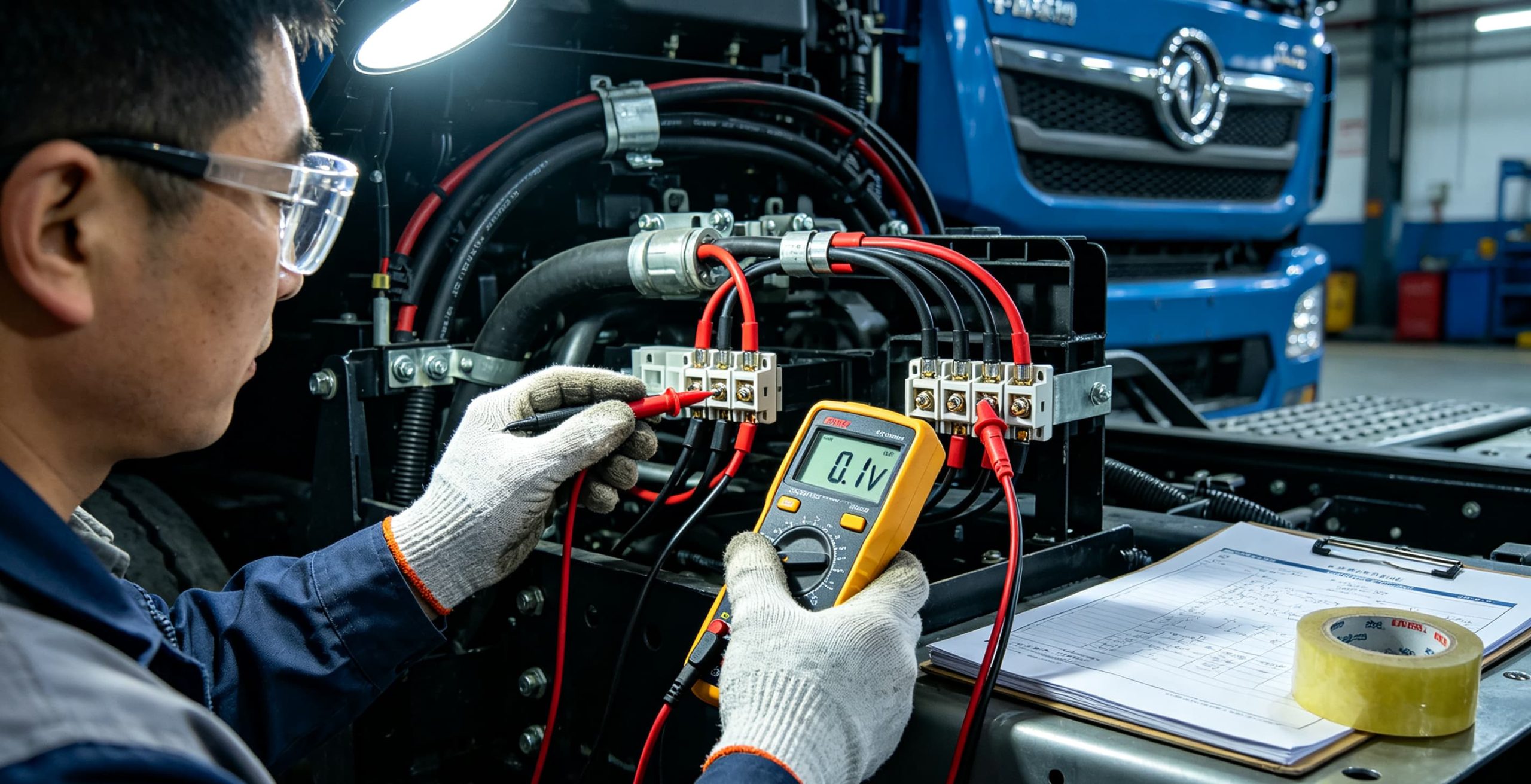
Similar to battery cables, voltage drop testing is critical for diagnosing high resistance in wiring harness circuits, especially those carrying power to components. This test measures the voltage lost across a wire or connector while the circuit is active. A significant voltage drop indicates excessive resistance, which can be caused by corrosion, loose terminals, or internal wire damage. For example, if a component is not receiving its full voltage, it will not operate correctly. This is a common diagnostic technique for Dongfeng and Foton trucks.
| Test Type | Multimeter Connection | Expected Reading (Max) | Indication of Problem |
|---|---|---|---|
| Power Side Voltage Drop | Positive lead on power source (e.g., battery positive), negative lead on component power input. Circuit active. | 0.2V (12V system) / 0.4V (24V system) | High resistance in power wire or connector. |
| Ground Side Voltage Drop | Positive lead on component ground output, negative lead on battery negative. Circuit active. | 0.2V (12V system) / 0.4V (24V system) | High resistance in ground wire or connector. |
| Across a Connector | Positive lead on one side of connector, negative lead on other side of same wire. Circuit active. | 0.1V (12V system) / 0.2V (24V system) | High resistance within the connector terminals. |
🔍 Technical Deep-Dive: Understanding Intermittent Faults
Intermittent wiring harness faults are notoriously difficult to diagnose. They often occur due to partial breaks in wires that only lose contact under specific conditions (e.g., engine vibration, temperature changes causing expansion/contraction, or moisture ingress). To diagnose these, techniques like the “wiggle test” (gently manipulating the harness while monitoring electrical signals) or using a graphing multimeter/oscilloscope to capture transient voltage drops can be invaluable. Sometimes, simply heating or cooling a suspected section of the harness can reveal the fault. For more detailed technical insights, explore our product system page.
5. Load Testing Individual Circuits
For circuits that power high-current components, a simple continuity test might not reveal a problem that only appears under load. In such cases, load testing involves applying a small load (e.g., a test light or a low-wattage bulb) to the circuit while measuring voltage. If the voltage drops significantly under this load, it indicates high resistance in the wiring. This is more effective than just checking continuity, as it simulates real-world conditions.
6. Thermal Imaging: Spotting Hotspots
Infrared thermal imaging cameras can quickly identify hotspots in a wiring harness or connectors. Areas of high resistance generate heat, and a thermal camera can make these invisible problems visible. Scanning the harness during operation, especially when a fault is present, can pinpoint the exact location of a problematic connection or damaged wire. This advanced diagnostic tool is becoming increasingly popular for its efficiency in detecting subtle issues.
Repairing and Replacing Truck Wiring Harnesses
Once a wiring harness fault has been accurately diagnosed, the next step is repair or replacement. The decision between repairing a section of the harness and replacing the entire unit depends on the extent and nature of the damage. For heavy-duty trucks, especially those from Sinotruk (HOWO), Shacman, FAW, Foton, and Dongfeng, quality repairs are paramount.
⚠️ Caution: Professional Repair Recommended
Repairing wiring harnesses, especially those for critical engine or safety systems, requires specialized tools, knowledge, and experience. Improper repairs can lead to further electrical problems, component damage, or even safety hazards. If you are not confident in your abilities, it is always best to seek assistance from a qualified heavy-duty truck technician or refer to our technical support page.
1. Repairing Damaged Wires
For isolated damage, such as a single chafed wire or a corroded terminal, a localized repair might be feasible. This involves:
- Cutting Out Damaged Section: Carefully cut out the damaged section of the wire.
- Splicing New Wire: Use high-quality, correct-gauge wire to splice in a new section. Employ proper splicing techniques, such as crimping with heat-shrinkable butt connectors or soldering, followed by heat shrink tubing for environmental sealing.
- Replacing Terminals: If a terminal is corroded or damaged, carefully remove it from the connector housing and crimp on a new, OEM-spec terminal using the correct crimping tool.
- Sealing: Ensure all repairs are properly sealed against moisture and contaminants using heat shrink tubing with adhesive lining or liquid electrical tape.
2. Replacing Connectors
If a connector housing is cracked, melted, or has multiple corroded/loose terminals, it is often more efficient and reliable to replace the entire connector. This typically involves:
- Identifying Connector Type: Ensure you have the correct replacement connector, including the housing, terminals, and seals.
- Pin Removal Tool: Use a specialized pin removal tool to extract the old terminals from the connector housing.
- Crimping New Terminals: Crimp new terminals onto the wires and insert them into the new connector housing, ensuring they lock securely in place.
- Sealing: Apply dielectric grease to the new connector and ensure it is properly sealed when reconnected.
3. Replacing the Entire Wiring Harness
In cases of extensive damage, multiple localized faults, or when the harness is old and brittle, replacing the entire wiring harness is often the most reliable and cost-effective long-term solution. This is a more involved process but ensures the complete restoration of electrical integrity. For high-quality replacement harnesses, always check our product brand page.
- Disconnect Battery: Always start by disconnecting the battery.
- Document Connections: Take numerous photos and make detailed diagrams of all connections and routing paths before removal. This is crucial for reassembly.
- Remove Components: Disconnect all components connected to the harness (sensors, actuators, ECUs, lights, etc.).
- Unroute Old Harness: Carefully unroute the old harness, noting all clips, ties, and grommets.
- Install New Harness: Route the new harness exactly as the old one, securing it with new clips and ties.
- Reconnect Components: Reconnect all components, ensuring terminals are clean and connections are secure.
- Test System: Reconnect the battery and thoroughly test all electrical systems. Clear any DTCs.
💡 Pro-Tip: Use OEM-Equivalent Parts
When replacing sections of a harness or entire harnesses, always use OEM-equivalent quality wires, terminals, and connectors. These are designed to withstand the specific environmental and electrical stresses of heavy-duty truck applications. Inferior quality components can lead to premature failure and recurring problems. For reliable parts, consider Mettlead, a trusted supplier for HOWO, Shacman, and other Chinese truck brands.
Preventive Maintenance for Truck Wiring Harnesses
Proactive maintenance is the most effective way to prevent wiring harness failures and ensure the long-term reliability of your heavy-duty truck. Regular inspections and adherence to best practices can significantly extend the lifespan of these critical components. For more insights into maintaining your fleet, explore our customer success cases.
1. Regular Visual Inspections
Incorporate thorough visual inspections of all accessible wiring harnesses into your routine maintenance schedule. Look for signs of chafing, cracks, melted insulation, corrosion at connectors, and any evidence of rodent activity. Pay particular attention to areas near heat sources, moving parts, and where harnesses pass through bulkheads or chassis components.
2. Proper Routing and Securing
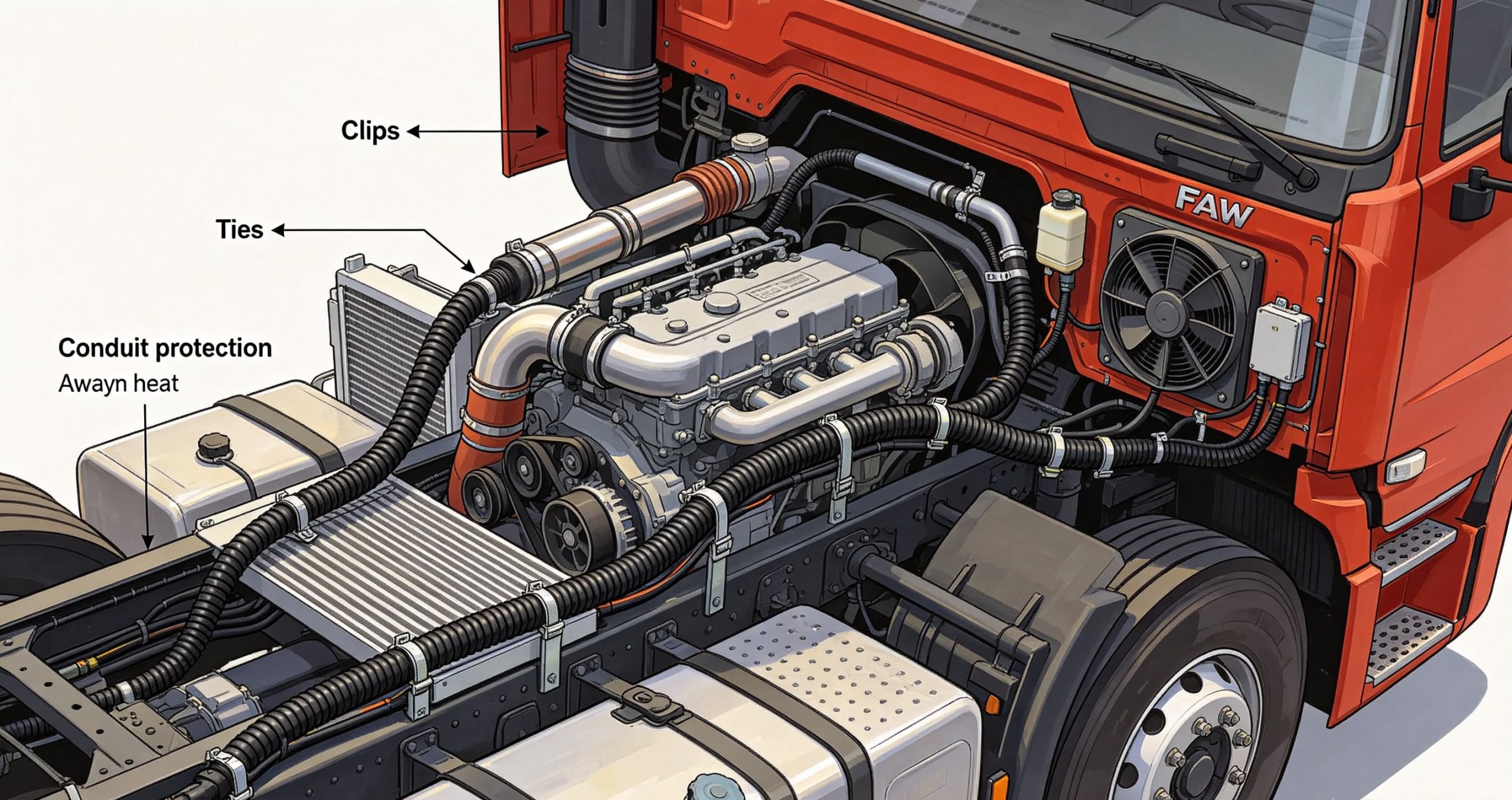
Ensure all harnesses are correctly routed and securely fastened with appropriate clips, ties, and grommets. This prevents them from rubbing against abrasive surfaces or becoming entangled with moving parts. Avoid sharp bends or excessive tension on the harnesses. If a clip is broken, replace it promptly to prevent the harness from shifting.
3. Keep Connectors Clean and Sealed
Periodically inspect connectors for dirt, moisture, and corrosion. Use specialized electrical contact cleaner to clean terminals, and apply dielectric grease to help prevent moisture ingress and corrosion. Ensure all connectors are fully seated and their seals are intact. This is especially important for harnesses exposed to the elements in Dongfeng and FAW trucks.
4. Protect Against Heat and Chemicals
Where possible, ensure harnesses are routed away from extreme heat sources (e.g., exhaust manifolds, turbochargers) and potential chemical spills (e.g., fuel lines, oil filters). If rerouting is not possible, consider adding additional heat shielding or protective conduits to vulnerable sections of the harness. This proactive approach significantly extends the life of the insulation.
5. Rodent Deterrence
For trucks parked for extended periods, especially in rural areas, consider rodent deterrence measures. This can include using ultrasonic repellents, placing traps, or applying rodent-repellent tape to vulnerable sections of the harness. Regular inspection for signs of rodent activity (e.g., droppings, nesting materials) is also crucial.
6. Use Correct Tools for Repairs
If repairs are necessary, always use the correct tools for crimping, soldering, and terminal removal. Using improper tools can damage wires or terminals, leading to future problems. Invest in high-quality electrical repair tools to ensure durable and reliable connections. For more information about our company and commitment to quality, visit our about us page.
Advanced Troubleshooting Techniques for Complex Wiring Harness Issues
For persistent or elusive wiring harness problems, especially in modern heavy-duty trucks with intricate electronic systems, advanced diagnostic techniques are often required. These methods go beyond basic multimeter tests and can help pinpoint intermittent faults or subtle degradations that are otherwise difficult to detect.
1. Oscilloscope Analysis: Capturing Transient Signals
An oscilloscope is an invaluable tool for diagnosing intermittent electrical problems. Unlike a multimeter, which provides a snapshot of voltage or current, an oscilloscope displays electrical signals as waveforms over time. This allows technicians to observe transient voltage drops, signal noise, or intermittent opens/shorts that might occur only for milliseconds. For example, a faulty sensor wire might show a clean signal most of the time but exhibit a momentary drop-out under specific vibrations or temperature changes. An oscilloscope can capture these elusive events, providing crucial evidence for diagnosis. This is particularly useful for engine management and communication bus (CAN bus) wiring harnesses in advanced FAW and Foton trucks.
2. Power Probe Testing: Active Circuit Diagnosis
A Power Probe is a versatile tool that can supply power or ground to a circuit, test for continuity, and measure voltage. This allows for active diagnosis of circuits. For instance, if a component is not receiving power, a Power Probe can be used to supply power directly to the component to confirm its functionality, thereby isolating the problem to the wiring harness. It can also be used to test for short circuits to ground by applying a fused power source and observing current draw. However, extreme caution must be exercised to avoid shorting out sensitive electronic components.
3. Load Testing with a Test Light or Bulb: Simulating Real-World Conditions
While a multimeter can check for continuity, it doesn’t always reveal if a wire can carry sufficient current under load. A simple test light or a low-wattage bulb can be used to load test individual wires. By connecting the test light across a suspected wire and activating the circuit, you can observe the brightness of the bulb. A dim bulb indicates high resistance in the wire, even if the multimeter shows continuity. This method is particularly effective for power and ground wires that supply components like lights, motors, or solenoids. For example, if a headlight circuit shows continuity but the light is dim, a load test can confirm high resistance in the wiring harness.
4. Freeze Spray and Heat Gun: Inducing Intermittent Faults
For intermittent faults that are temperature-sensitive, freeze spray or a heat gun can be used to induce the fault. By carefully applying freeze spray to a suspected section of the harness, you can cool the wires and connectors. If the symptom appears or disappears, it indicates a temperature-related issue, such as a cracked solder joint or a wire with a poor connection that expands or contracts with temperature. Conversely, a heat gun can be used to warm up a section of the harness. This technique requires careful application to avoid damaging the insulation or other components. This can be a useful technique for diagnosing elusive problems in Sinotruk (HOWO) and Shacman trucks operating in extreme climates.
💡 Pro-Tip: Utilize Wiring Diagrams
Always consult the truck’s specific wiring diagrams and service manuals. These diagrams provide invaluable information on wire colors, connector pinouts, component locations, and circuit paths. They are essential for understanding the electrical flow and accurately pinpointing the source of a fault within the complex network of a heavy-duty truck’s wiring harness. For more detailed technical insights, explore our product system page.
Conclusion
The wiring harness is an indispensable component of any heavy-duty truck, serving as the critical link for all electrical and electronic systems. Failures, whether due to abrasion, heat, corrosion, or vibration, can lead to a wide array of frustrating and potentially dangerous symptoms. By understanding the common causes, employing systematic diagnostic techniques, and adhering to best practices for repair and preventive maintenance, you can significantly enhance the reliability and longevity of your fleet. Furthermore, proactive management of your truck’s wiring harnesses ensures that your Sinotruk (HOWO), Shacman, FAW, Foton, or Dongfeng trucks remain on the road, operating efficiently and safely. For more information about our company and commitment to quality, visit our Mettlead homepage.
Frequently Asked Questions (FAQs) about Truck Wiring Harnesses
A1: Common causes include abrasion and chafing from vibration, heat damage from engine components, moisture ingress leading to corrosion, vibration fatigue causing internal wire breaks, chemical exposure, rodent damage, and improper installation or previous repairs.
A2: Wiring harness issues often manifest as intermittent electrical problems, multiple seemingly unrelated faults, or symptoms that change with vibration or temperature. Diagnostic steps like visual inspection, scanning for DTCs, and performing continuity, resistance, and voltage drop tests can help pinpoint the fault to the harness. If multiple components in a circuit are failing, the harness connecting them is a strong suspect.
A3: The decision depends on the extent and nature of the damage. For isolated damage (e.g., a single chafed wire or corroded terminal), a high-quality localized repair might be sufficient. However, for extensive damage, multiple faults, or an old, brittle harness, replacing the entire unit is often the more reliable and safer long-term solution. Improper repairs can lead to recurring issues.
A4: Essential tools include a digital multimeter (DMM) for continuity, resistance, and voltage drop tests, a good quality test light, a diagnostic scan tool for retrieving DTCs, and a set of specialized terminal release tools for working with connectors. Advanced tools like thermal imaging cameras and oscilloscopes can also be very helpful for complex or intermittent faults.
A5: Preventive maintenance includes regular visual inspections for damage and corrosion, ensuring proper routing and securing of harnesses, keeping connectors clean and sealed with dielectric grease, protecting harnesses from extreme heat and chemical exposure, and implementing rodent deterrence measures if necessary. Using high-quality, OEM-equivalent replacement parts during any repairs is also crucial.
A6: Absolutely. The engine wiring harness connects critical sensors (e.g., oxygen, MAF, crankshaft position) and actuators (e.g., fuel injectors, ignition coils) to the Engine Control Unit (ECU). Damage to these wires can lead to incorrect data being sent to the ECU or improper operation of actuators, resulting in symptoms like rough idling, misfires, stalling, reduced power, and poor fuel economy.
A7: For reliable, high-quality replacement wiring harnesses for HOWO, Shacman, FAW, Foton, and Dongfeng trucks, you should source from reputable suppliers like Mettlead. We offer a wide range of genuine and OEM-equivalent components designed to meet the demanding specifications of heavy-duty applications. Visit our product brand page to explore our offerings.


