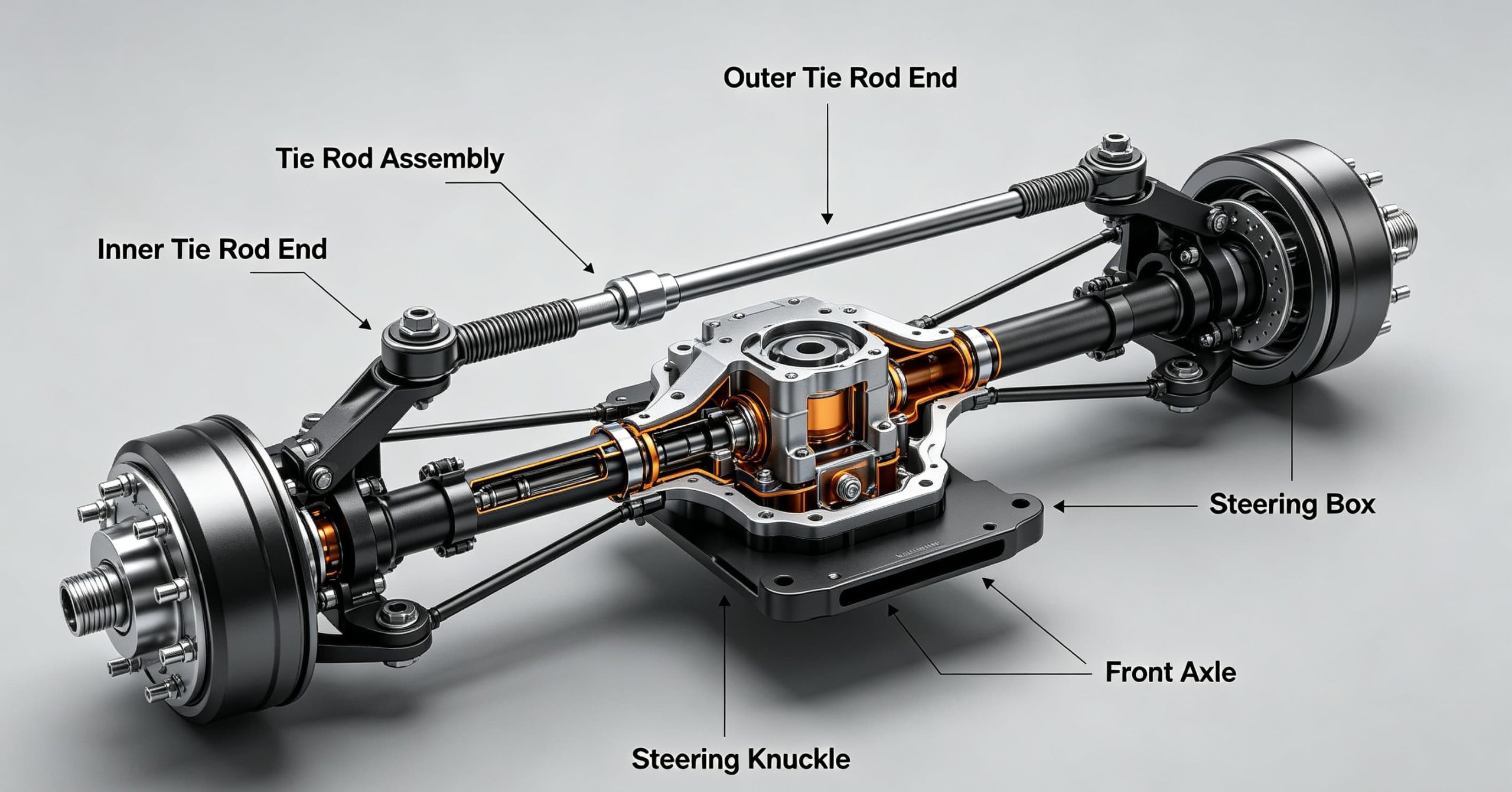
Tie rod ends are one of the most indispensable wearable components in a heavy-duty truck’s entire steering linkage system. Simply put, they act as the flexible connection bridge between the horizontal steering tie rod and the front wheel steering knuckle. Unlike rigid fixed parts, tie rod ends can freely swing and rotate within a fixed angle range. This unique design achieves two core functions at the same time.
On one hand, they accurately transmit steering power from the steering box to the front wheels. This ensures synchronous left and right deflection during driver operation. On the other hand, they effectively buffer and filter continuous road vibration and impact. This protects the steering box, steering column and other precision steering parts from rigid impact damage.
This key chassis part is universally applicable to all mainstream Chinese heavy-duty truck models. It perfectly matches SINOTRUK HOWO and SITRAK series, SHACMAN X3000, M3000 and F3000 models, FAW J6, J7 and Aowei trucks, as well as FOTON Auman full-range heavy-duty vehicles. For long-distance freight vehicles, engineering transport trucks and mining special trucks, the working condition of tie rod ends directly determines steering accuracy, straight-line driving stability and overall driving safety.
In actual fleet management and daily truck operation, most drivers and maintenance personnel tend to focus too much on core large components. These include engine power performance, gearbox shifting smoothness and brake system sensitivity. In contrast, tiny chassis wearable parts like tie rod ends are often ignored in daily inspection and maintenance work.
In fact, tie rod ends belong to high-frequency vulnerable parts that bear alternating load for a long time. Even tiny initial wear gaps will gradually expand with the accumulation of driving mileage. If hidden dangers are not eliminated in time, minor faults will evolve into serious steering failures. These failures include continuous vehicle drifting, high-speed steering shake, steering jamming and obvious chassis abnormal noise. In severe cases, they may cause sudden steering failure during driving, bringing huge safety risks to cargo transportation and driver personal safety.
This comprehensive professional maintenance guide is tailored for heavy-duty truck users and maintenance technicians. It systematically sorts out the complete structure and working principle of tie rod ends, summarizes all intuitive failure symptoms that are easy to observe in daily use, and deeply analyzes all internal and external root causes leading to tie rod end damage. Meanwhile, it provides standardized disassembly, replacement and installation steps, professional four-wheel alignment adjustment standards and scientific daily maintenance schemes. For more systematic truck chassis steering fault diagnosis and repair knowledge, you can browse and learn in our exclusive truck technical support category.
Basic Structure & Working Principle of Truck Tie Rod Ends
Before conducting fault judgment and professional maintenance, it is necessary to fully understand the basic structure and working logic of heavy-duty truck tie rod ends. This helps maintenance personnel quickly locate fault points and avoid misjudgment and blind disassembly.
The complete tie rod assembly of modern heavy-duty trucks is divided into two types according to installation positions: inner tie rod end and outer tie rod end. The two sets of parts are symmetrically installed on the left and right sides of the front axle. They cooperate with each other to complete the overall steering transmission work. Although the installation positions are different, the internal structural composition and working principle of the inner and outer tie rod ends are basically consistent.
A standard heavy-duty truck reinforced tie rod end consists of multiple core precision components. The main parts include external threaded connecting rod, integral wear-resistant steel ball head, high-strength compression spring, copper-based wear-resistant bushing, elastic sealing ring, integrated rubber dust boot, bottom fixing base and grease injection nozzle. Compared with light truck and van tie rod ends, heavy-duty models adopt integral forging thickened structure. The overall tensile resistance, impact resistance and load-bearing performance are greatly improved to adapt to long-term heavy-load and harsh road driving conditions.
Each component has an irreplaceable independent function. The steel ball head is the core moving part that realizes steering swing. The internal compression spring always maintains pre-tightening pressure on the ball head and bushing. It automatically compensates for tiny gaps generated by mechanical wear to avoid virtual steering position. The copper bushing reduces metal-to-metal friction and improves wear resistance and service life. The external rubber dust boot is the key protective barrier of the whole component.
In the daily driving process of the truck, the steering box outputs push-pull power according to the driver’s steering operation. The power is transmitted to the tie rod pipe first, and then transmitted to the front wheel steering knuckle through the tie rod end. At this time, the internal ball head flexibly swings and rotates to adapt to the wheel deflection angle and chassis up and down jitter. This ensures that the steering action is smooth and unobstructed without rigid jamming.
Furthermore, the sealed internal cavity is filled with high-temperature resistant lubricating grease. The grease forms a uniform protective oil film on the surface of the ball head and bushing. It effectively reduces friction resistance, avoids dry wear and reduces steering operating resistance. The external rubber dust boot tightly seals the internal cavity. It completely isolates external rainwater, muddy water, road dust, sand and gravel impurities.
It is worth emphasizing that tie rod ends are completely exposed to the front chassis of the vehicle. They are in a working state of bearing alternating impact load and environmental erosion all year round. Therefore, they are classified as mandatory inspection wearable parts in daily vehicle maintenance. Once a single component fails, the overall steering transmission efficiency will be affected. If you need to purchase original high-strength wear-resistant tie rod ends and complete steering system supporting parts suitable for full-series heavy trucks, you can check our professional truck chassis system parts product library for one-stop model matching and procurement.
Common Tie Rod End Failure Symptoms (Easy to Observe & Judge)
Tie rod end failure is a gradual process from slight wear to complete failure. Every fault stage has corresponding obvious external symptoms. Drivers and maintenance personnel can accurately judge the wear degree and fault severity through driving feel, vehicle running state, abnormal noise and visual inspection. This allows timely maintenance and replacement to avoid fault escalation.
1. Vehicle Drifting & Unstable Straight-Line Driving
Abnormal vehicle drifting is the most typical and earliest symptom of tie rod end wear. Under the premise of normal tire air pressure, consistent tire wear, intact front axle parts and no brake drag failure, the truck cannot keep straight when driving on flat and straight roads. It will automatically drift left or right without steering operation.
This phenomenon occurs because the worn tie rod end produces excessive internal gaps. The steering transmission structure is loose, resulting in inconsistent stress on the left and right front wheels. During high-speed driving, this drifting problem will become more serious. Drivers need to continuously correct the steering wheel to maintain straight driving, which greatly increases driving fatigue and reduces long-distance driving safety.
In addition, high-speed body floating and steering wheel vibration are also common accompanying symptoms. When the vehicle speed reaches 60km/h to 80km/h or above, the front chassis will produce obvious jitter. The higher the speed, the more obvious the vibration. After eliminating tire dynamic balance deviation, wheel deformation and brake drum failure, it can be confirmed that the fault is caused by loose tie rod ends.
Moreover, poor steering self-return performance is another key judgment basis. After completing the turning action and releasing the steering wheel, the steering wheel cannot automatically return to the middle position smoothly. It needs manual auxiliary reset. This fully indicates that the internal ball head clearance of the tie rod end is too large and the steering transmission has virtual position.
2. Loose Virtual Steering & Abnormal Steering Resistance
In the early stage of tie rod end wear, the most intuitive driving feeling is excessive steering free travel. When the driver slightly turns the steering wheel left and right within a small angle range, the front wheels have no synchronous response. The steering feels empty and unfocused, and the steering accuracy is significantly reduced.
With the continuous aggravation of wear, the internal matching gap increases further. The truck will show unbalanced steering resistance on both sides. Specifically, left steering is heavy and right steering is light, or vice versa. This asymmetric steering feeling directly affects the driver’s accurate control of the vehicle direction.
When the tie rod end is severely worn or partially stuck due to dirt blockage, intermittent jamming and unsmooth resistance will occur during steering. Especially in-situ steering and low-speed turning, the jamming feeling is more obvious. This not only affects driving experience, but also brings great hidden dangers to emergency obstacle avoidance and road condition response.
3. Front Chassis Regular Abnormal Impact Noise
Abnormal noise is the most sensitive early warning signal of tie rod end failure, which is easy to find in daily driving. When the truck passes through bumpy roads, gravel roads, road pits and uneven road sections, the front axle position will emit continuous and regular “clunking” impact noise.
The root cause of the noise is the loose internal ball head structure. When the vehicle jitters up and down, the ball head collides with the bushing under vibration, producing obvious metal impact sound. The more serious the wear gap, the louder and more frequent the noise.
In addition, dry friction noise will appear during in-situ steering and low-speed reversing. This situation mostly occurs after the dust boot is damaged and grease is lost. The metal parts are in direct dry friction state, resulting in harsh friction sound, which can be used as an important basis for judging tie rod end lubrication failure.
4. Visible External Damage & Grease Leakage Traces
Drivers can complete visual inspection of tie rod ends within 2 minutes during daily pre-departure inspection. The first inspection item is the integrity of the external rubber dust boot. Long-term exposure to sunlight, rain and frost will cause rubber aging, hardening and cracking. Once the dust boot cracks, deforms or falls off, the internal sealing structure will fail completely.
After the dust boot is damaged, the internal high-temperature lubricating grease will gradually leak out. Obvious grease stains and dust accumulation will appear at the ball head joint. The loss of lubricating grease will lead to rapid dry wear of internal precision parts and accelerate the scrapping speed of tie rod ends.
Furthermore, manual detection can be used for auxiliary judgment. Park the vehicle on flat ground, hold the front wheel left and right to shake gently. If there is obvious loose gap and abnormal shaking, it can be confirmed that the tie rod end has been severely worn and needs to be replaced in time.
Main Root Causes of Truck Tie Rod End Wear & Damage
In actual use, the natural service life of qualified heavy-duty truck tie rod ends can reach 80,000 to 120,000 kilometers. Most early failures are not caused by part aging, but by the joint influence of unreasonable driving habits, harsh driving environments, missing maintenance, external impact and inferior parts. Clarifying these causes can effectively reduce repeated failures.
1. Unstandardized Daily Driving Behaviors
Unreasonable driving habits are the primary cause of premature tie rod end wear. Many truck drivers are used to in-situ sharp steering and frequent limit steering operation. When the vehicle is static, the friction and pressure borne by the tie rod end ball head are several times higher than those during driving. Long-term static limit steering will cause rapid wear of the bushing and fatigue failure of the internal compression spring.
Long-term overloaded driving is also a key factor in accelerating damage. Excessive cargo weight increases the overall load of the front axle, raises front wheel steering resistance, and makes the tie rod end bear long-term excessive tension and pressure. This easily causes structural fatigue and gap looseness.
In addition, speeding through road pits, curbs and obstacles will produce instantaneous strong impact force. The impact force directly acts on the tie rod end through the front wheel, causing hidden damage to internal precision matching structures and gradually expanding wear gaps.
2. Harsh Road & Complex Weather Erosion
Tie rod ends are exposed to the front chassis without any protective shielding. They face continuous environmental erosion throughout the year. In rainy and snowy weather, road muddy water, rainwater and snowmelt mixed with corrosive substances will splash onto the tie rod end surface. Over time, it will cause rubber dust boot aging and metal part corrosion.
For trucks often driving on construction sites, mining areas and dusty mountain roads, fine sand and gravel will adhere to the tie rod end gaps. Once the dust boot has tiny cracks, hard sand particles will enter the internal cavity, mix with lubricating grease to form abrasive mortar, and continuously polish the ball head and bushing, resulting in rapid failure.
3. Missing & Non-Standard Daily Maintenance
Regular grease injection maintenance is the core measure to extend the service life of tie rod ends, but it is often ignored by most users. Long-term lack of grease refilling will make the internal parts work in dry friction state. The wear speed is dozens of times faster than normal lubrication state.
At the same time, the use of inferior lubricating grease will also cause failure. Low-quality grease has poor high-temperature resistance and poor adhesion. It will dilute and flow out in high-temperature driving environment, cannot form effective protective oil film, and loses lubrication and anti-wear effect.
In addition, long-term failure to check the locking nut tightness will lead to loose installation. The tie rod end vibrates continuously during driving, which further aggravates internal wear and gap expansion, forming a vicious cycle of failure.
4. External Collision Scratch & Wheel Alignment Deviation
Front wheel scratches, collisions and chassis bottom bumps during driving and parking will cause tie rod end deformation and angle displacement. The original parallel stress structure is destroyed, resulting in uneven internal stress and unilateral accelerated wear.
After long-term vehicle use, the front wheel toe-in, camber and other positioning data will deviate. Uncorrected wheel alignment errors will make the tie rod end bear asymmetric alternating force during each steering process, which continuously damages the internal matching structure and causes early failure.
5. Inferior & Refurbished Replacement Parts
Many fleet owners and individual drivers choose low-cost refurbished tie rod ends and inferior auxiliary parts to save maintenance costs. These unqualified parts have rough processing precision, unqualified ball head roundness, insufficient spring pre-tightening force and poor rubber dust boot toughness.
Inferior tie rod ends have no strict quality inspection before leaving the factory. They are prone to loose gaps, grease leakage and abnormal noise after a short period of use. The failure rate is extremely high, which not only increases repeated maintenance costs, but also brings serious driving safety hazards.
Standard Step-by-Step Tie Rod End Replacement & Repair Process
When the tie rod end has obvious looseness, cracked dust boot, serious grease leakage and irreversible wear failure, simple maintenance and adjustment cannot restore its working performance. Only standardized overall replacement can eliminate hidden dangers. The following is the official standard repair process suitable for all heavy-duty trucks.
Step 1: Site preparation, vehicle fixing and cleaning
Park the truck on a flat and hard ground, tighten the hand brake and pad the rear tires to prevent sliding. Use a professional jack and lifting equipment to stably lift the front axle until the front wheels are completely off the ground. Clean the surface dust, oil dirt and rust of the old tie rod end with a brush and cleaning agent to ensure clear observation and convenient disassembly.
Step 2: Loosen fasteners and remove the old tie rod end
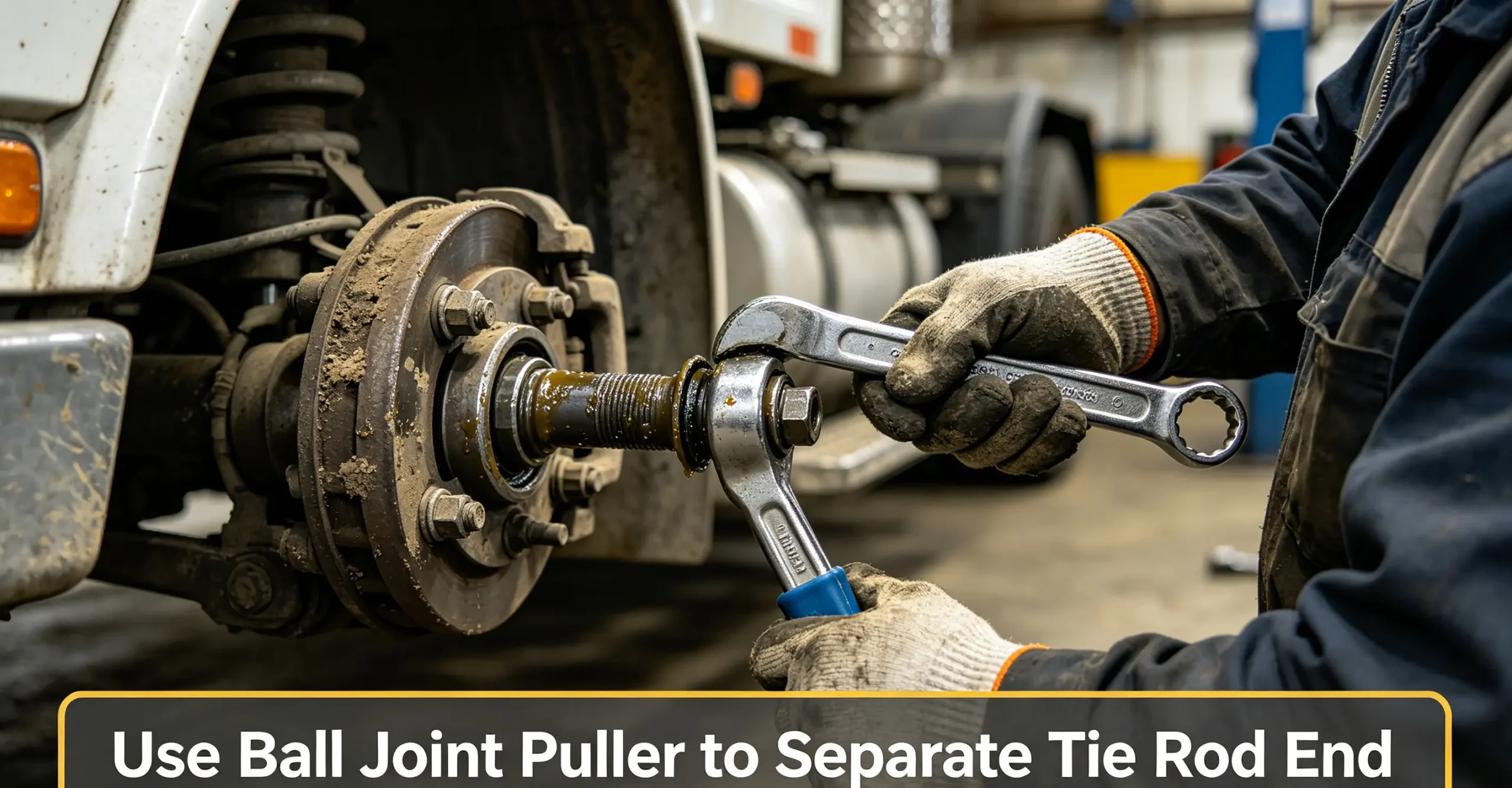
Use a socket wrench to loosen the outer locking nut of the tie rod end thread. Then use a special ball head puller to clamp the ball head pin. Apply even force to separate the tie rod end ball head from the steering knuckle mounting hole. After confirming complete separation, screw out the old tie rod end from the tie rod pipe thread and take it out completely.
Step 3: Adjust new part size and pre-lubricate
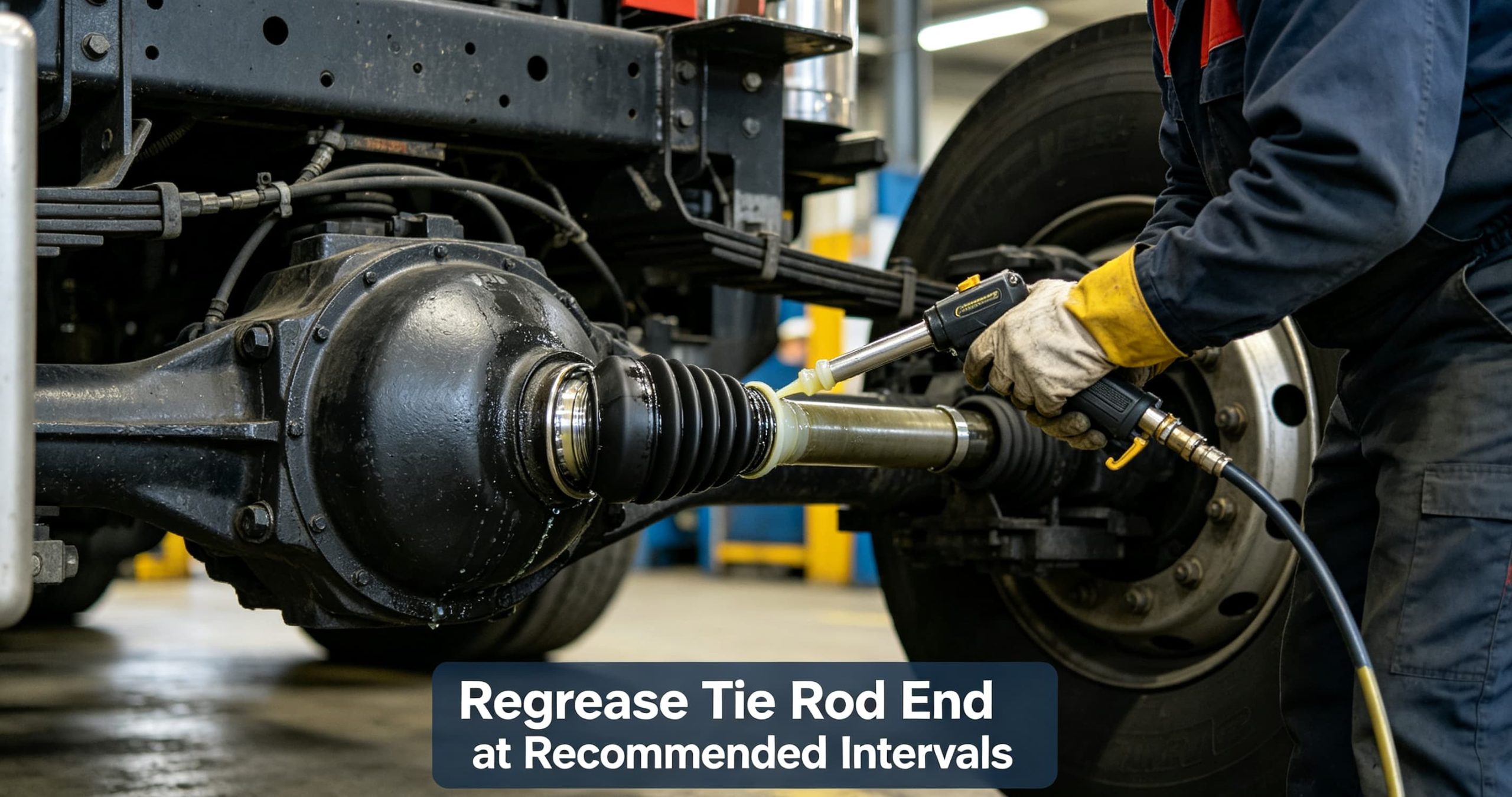
Compare the thread extension length of the new tie rod end with the old one to ensure consistent installation size. This can effectively reduce the later alignment adjustment range. Inject sufficient high-temperature resistant lithium-based grease through the grease nozzle until the grease overflows slightly, which proves that the internal cavity is fully filled and lubricated.
Step 4: Install and fasten components
Align the new tie rod end thread with the tie rod pipe and screw it in place. Insert the ball head pin into the steering knuckle mounting hole, install the fixing gasket and nut, and tighten it with a torque wrench according to the standard torque. Finally, lock the thread locking nut firmly to prevent vibration looseness during driving.
Step 5: Professional four-wheel alignment correction
After replacing the left and right tie rod ends, the original factory wheel positioning data will change inevitably. It is necessary to send the vehicle to a professional maintenance station for four-wheel alignment and front wheel toe-in adjustment. Correct the steering deviation to ensure straight-line driving stability and steering accuracy.
Daily Simple Inspection & Scientific Maintenance Tips
Scientific daily maintenance is the most effective way to extend the service life of tie rod ends and reduce failure rate. All inspection items are simple and efficient, which can be completed by drivers in daily pre-departure and parking inspection.
First, conduct regular visual appearance inspection. Check the rubber dust boot for aging, cracking, deformation and falling off every week. Replace damaged dust boots in time to avoid dust and muddy water intrusion and grease loss.
Second, adhere to regular grease injection maintenance. Under normal road conditions, inject high-quality lubricating grease every 10,000 to 20,000 kilometers. For mining and mountain road conditions, shorten the cycle to 5,000 to 8,000 kilometers to ensure long-term internal lubrication.
Third, regularly detect structural looseness. Manually shake the front wheels left and right every month to check for loose gaps. If abnormal looseness is found, check and replace parts in time to avoid fault escalation.
Fourth, standardize daily driving habits. Try to avoid long-term static limit steering, frequent overloaded driving and speeding over potholes. Good driving habits can reduce tie rod end impact wear by more than 60%.
FAQs About Truck Tie Rod End Issues
Q1: Can I continue driving with slightly worn tie rod ends?
Slight wear with tiny gaps allows short-distance low-speed driving. However, it is impossible to adapt to high-speed and long-distance transportation. Users must arrange replacement maintenance as soon as possible to avoid sudden steering failure and safety accidents.
Q2: What is the core cause of tie rod end abnormal noise?
The main cause is excessive internal wear gaps and lubrication failure. Vibration impact during driving causes metal collision between the ball head and the bushing. Bumpy road conditions will significantly aggravate the abnormal noise.
Q3: What is the standard replacement cycle of tie rod ends?
Under flat road and standard load conditions, the replacement cycle is 80,000–120,000 kilometers. For harsh working conditions such as mining areas and mountain roads, the cycle needs to be shortened to 40,000–60,000 kilometers.
Q4: Is four-wheel alignment necessary after every replacement?
Yes. Tie rod end replacement will change the front wheel toe-in data. Without alignment correction, the vehicle will have drifting and uneven tire wear problems, which will affect driving stability.
Q5: Can greasing repair severely worn tie rod ends?
Greasing only solves lubrication problems and eliminates slight dry friction noise. For parts with excessive gaps, cracked dust boots and metal wear, replacement is the only effective and safe solution.
Final Summary
Tie rod ends are small but core safety components in the heavy-duty truck steering system. Their working state directly affects vehicle steering accuracy, driving stability and transportation safety. Most tie rod end failures are caused by unreasonable driving habits, insufficient daily maintenance and harsh working environments, rather than natural aging.
Adhering to regular visual inspection, standardized grease maintenance and correct driving habits can greatly extend the service life of tie rod ends and reduce vehicle failure rate and maintenance costs. Timely replacement of worn and failed parts can effectively eliminate steering shake, vehicle drifting, chassis abnormal noise and other faults, ensuring safe and stable vehicle operation.
If you need original authentic, high wear-resistant truck tie rod ends and full-series steering system spare parts, Mettlead provides one-stop heavy-duty truck accessory supply and professional technical after-sales support for global users.


