Truck Steering Box Failure Signs & Causes
The steering box is the core control component of the entire heavy-duty truck steering system. It undertakes the important task of converting the driver’s steering force into powerful steering power, and transmits steering commands stably to the front axle steering mechanism. For all mainstream Chinese heavy-duty trucks including SINOTRUK HOWO, SITRAK, SHACMAN X3000, FAW J6, J7 and FOTON Auman series vehicles, the steering box directly determines driving safety, steering stability and vehicle control performance. Once the steering box appears abnormal wear, internal part damage, oil leakage, gear gap failure and other faults, it will directly affect the driving experience, and even cause serious traffic safety accidents in severe cases.
Most truck drivers and fleet maintenance personnel often ignore daily inspection and regular maintenance of the steering box. In the daily transportation process, they only pay attention to engine power, braking performance and tire wear conditions, and lack sufficient attention to the health status of the steering system. In fact, the steering box is a vulnerable component that is easy to be affected by road conditions, driving habits, load status and lubrication conditions. Long-term high-intensity use will gradually lead to aging and failure of internal worm gears, bearings, sealing parts and connecting structures. If early failure signals are not detected and maintained in time, small problems will continue to evolve into major faults, resulting in high maintenance costs, long vehicle downtime and unpredictable driving risks.
This professional comprehensive guide focuses on heavy-duty truck steering box related professional knowledge, systematically sorts out all visible and perceptible steering box failure signs in actual driving, deeply analyzes all common internal and external inducements leading to steering box damage, and supplements practical inspection methods, simple troubleshooting ideas and scientific daily maintenance schemes. All content is fully adapted to the use characteristics and maintenance standards of domestic heavy trucks, which can help fleet managers, maintenance technicians and individual truck drivers quickly judge fault types, find out root causes, and formulate targeted maintenance and replacement plans. If you need to view more heavy truck chassis system fault diagnosis knowledge and standardized maintenance tutorials, please browse our professional truck technical support category to obtain complete systematic maintenance materials.
Basic Introduction to Heavy Truck Steering Box Structure and Working Principle
Before learning all failure manifestations and inducing factors of the steering box, users need to fully understand the basic internal structure and normal working operation logic of the heavy-duty truck steering box. Only by mastering the working principle can we accurately correspond different abnormal phenomena to damaged internal parts, so as to realize rapid fault location and efficient maintenance operation.
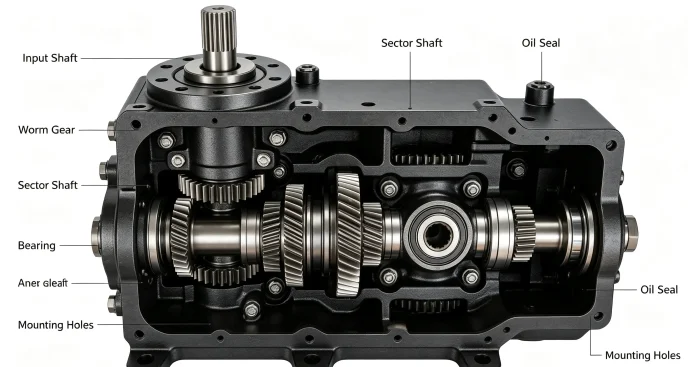
The mainstream heavy-duty trucks on the market mostly adopt integral power steering box assembly structure. The whole set of assembly is mainly composed of shell body, worm gear assembly, steering sector shaft, internal rolling bearings, adjusting gap screw, power hydraulic oil cavity, high-pressure oil pipe interface, upper and lower connecting splines, internal sealing ring group, oil filling port and oil drain port and other core components. Different from the mechanical steering box used in old-fashioned light trucks, the modern heavy truck steering box is matched with the power steering oil pump and hydraulic oil storage tank, relying on hydraulic pressure to assist steering, which greatly reduces the physical strength required by the driver to turn the steering wheel, and is more suitable for long-distance high-load transportation work.
In the normal working state of the vehicle, when the driver rotates the steering wheel left and right, the steering column transmits the torque to the worm gear inside the steering box through the upper spline structure. The worm gear meshes with the sector shaft gear to realize mechanical rotation transmission. At the same time, the hydraulic power system inputs high-pressure steering oil into the designated oil cavity inside the steering box according to the steering direction, uses hydraulic thrust to assist the gear structure to rotate, completes the steering power assistance work, and finally outputs the steering power through the lower end sector shaft to drive the steering rocker arm, tie rod, steering knuckle and other series of connecting parts, so as to realize the left and right deflection adjustment of the front wheels and complete the vehicle steering action.
During the whole steering process, the internal gear meshing gap, bearing rotation flexibility, internal hydraulic sealing performance and steering oil cleanliness will directly affect the smoothness, sensitivity and stability of the whole steering operation. All parts inside the steering box are in a high-frequency linkage operation state. Long-term operation will produce normal mechanical wear. When the wear exceeds the design allowable range, or the internal lubrication environment and hydraulic working environment are damaged, various typical steering box failure symptoms will appear one after another.
In the whole truck chassis system layout, the steering box is installed on the right side of the vehicle frame close to the front axle, which is in the lower middle position of the whole vehicle. It is easy to be splashed by muddy water, sediment and road dust during driving, and also bears the vibration impact transmitted by the vehicle frame in real time. This special installation position also virtually increases the aging speed and failure probability of the steering box assembly. If you need to purchase original and high-quality replacement steering box assemblies and matching steering connecting rod parts suitable for SINOTRUK, SHACMAN, FAW and FOTON full-series models, you can check our complete truck chassis system parts product library to complete one-stop model matching and spare parts procurement work.
Complete List of Typical Truck Steering Box Failure Signs
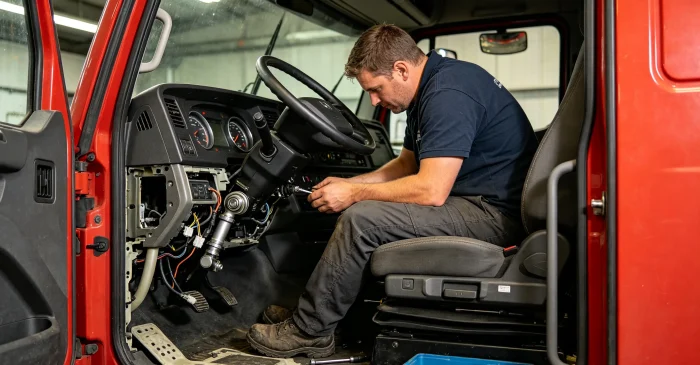
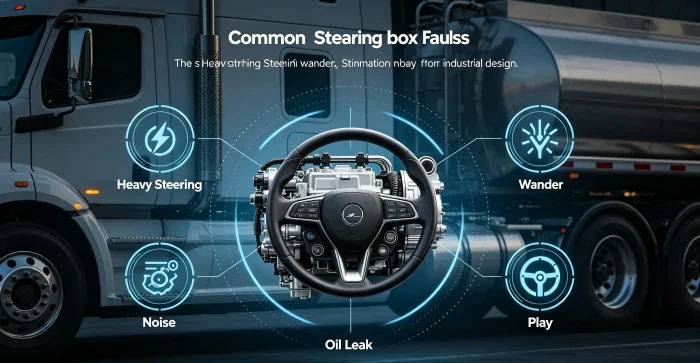
The failure of the heavy truck steering box will show obvious layered abnormal manifestations from the early stage to the middle and late stage. Drivers can accurately judge the current health degree of the steering box through driving hand feeling, abnormal sound, vehicle running state, oil leakage phenomenon and other intuitive performances, and carry out maintenance and replacement operations in advance to avoid sudden failure during driving and induce safety accidents. We classify all failure signs into driving hand feeling abnormality, abnormal noise phenomenon, oil leakage failure, running deviation abnormality and functional failure five major categories for detailed explanation.
1. Abnormal Steering Hand Feeling Symptoms
Steering hand feeling change is the earliest and most obvious early warning signal of steering box failure, which is easy to be perceived by drivers in daily driving. The first common manifestation is heavy steering operation. When turning the steering wheel left and right, it obviously feels laborious and stiff, which is far heavier than the normal driving hand feeling. It needs to consume more physical strength to complete the steering action. This situation is mostly caused by excessive wear of internal bearings, blocked internal oil circuit of the steering box, aging and deterioration of steering hydraulic oil, and excessive meshing gap adjustment of internal gears.
On the contrary, another extreme hand feeling failure is too loose steering and excessive free travel of the steering wheel. When the driver rotates the steering wheel left and right within a certain angle range, the front wheels do not respond synchronously, resulting in obvious empty position. The free travel is seriously beyond the normal standard range. In the process of straight-line driving, the steering wheel shakes obviously, and the vehicle cannot keep a stable straight-line driving state. This failure is mainly caused by excessive wear of internal worm gears and sector shafts, serious increase of gear meshing gap, loose internal fixing structure and failure of gap adjusting parts.
In addition, there will also be intermittent jamming and unsmooth steering phenomena. In the process of uniform rotation of the steering wheel, there will be sudden stagnation and jamming feeling at a fixed angle position. After breaking through the jamming position, it will return to normal again. This irregular steering stagnation is mostly caused by local deformation of internal gear teeth, bearing rolling damage, impurity blockage inside the hydraulic oil circuit and unsmooth movement of internal transmission parts. In the process of vehicle driving and turning, this jamming phenomenon will seriously affect the driver’s judgment and operation rhythm, bringing great hidden dangers to safe driving.
Unilateral heavy steering is also a common steering box failure sign. The steering wheel is laborious to turn to the left, but normal to turn to the right, or vice versa. The steering resistance on both sides is seriously inconsistent. This asymmetric failure is usually caused by unilateral wear of internal gear parts, unilateral blockage of internal power-assisted oil circuit and abnormal damage of unilateral internal limiting structure of the steering box.
2. Abnormal Noise Generated by Steering Box Failure
When the internal parts of the steering box are severely worn and damaged, obvious different types of abnormal noise will be generated during steering operation, which can be used as an important basis for judging the fault location. The first type is dull collision noise. When turning the steering wheel to the limit position left and right, obvious heavy collision and impact sound can be heard near the steering box installation position. This is caused by excessive internal gear gap, loose fixing parts, and impact collision between internal moving parts when reaching the limit steering angle.
The second type is continuous friction and grinding noise. In the process of slow steering and reversing steering, there is continuous metal dry friction sound inside the steering box. The sound becomes more obvious when the vehicle is driving at low speed and turning. This kind of noise indicates that the internal lubrication is insufficient, the steering oil is seriously deteriorated and failed, the bearing is lack of oil and worn, and the metal parts are in direct contact and friction without oil film protection.
In addition, there is also resonance vibration noise. When the vehicle is driving at a fixed speed, obvious vibration noise will be transmitted from the steering wheel to the cab. After inspection and elimination of tire abnormality, front axle abnormality and connecting rod looseness, it can be determined that the noise comes from the loose internal structure of the steering box. Long-term vibration will further aggravate the looseness of internal parts and accelerate the expansion of faults.
3. Steering Box Oil Leakage Failure Signs
Hydraulic power steering box relies on clean and sufficient steering hydraulic oil to complete power-assisted work and internal lubrication and heat dissipation work. Once oil leakage occurs, it will directly trigger a series of steering system failures. The most common leakage position is the upper end of the steering box where the steering column is connected and the lower end of the sector shaft extending position, followed by the joint of the high-pressure oil pipe and the shell sealing gasket position.
In the early stage of oil leakage, only a small amount of oil stains and oil stains appear on the surface of the steering box shell. With the continuous increase of driving mileage, the leakage volume gradually increases, resulting in the continuous decline of the liquid level of the steering oil tank. Drivers often need to add steering hydraulic oil frequently to maintain normal steering power assistance. In the middle and late stage of serious oil leakage, the steering oil consumption increases sharply, and even the phenomenon of insufficient power assistance and instantaneous failure of power assistance occurs during driving.
Long-term oil leakage will lead to insufficient internal oil storage of the steering box, poor internal parts lubrication, accelerated wear and tear, and the dust and sediment in the external air will enter the interior of the steering box along the leakage gap, pollute the clean steering oil, form oil sludge and impurity particles, block the internal oil circuit, and form a vicious cycle of failure, which greatly shortens the overall service life of the steering box assembly.
4. Vehicle Running Deviation and Unstable Control Signs
When the steering box internal parts are worn unevenly and the transmission clearance is unbalanced, the vehicle will appear obvious automatic running deviation in the straight-line driving state. Under the condition of ensuring normal tire air pressure, consistent tire wear and correct front wheel alignment data, the truck will automatically deviate to the left or right when driving on a flat straight road. The driver needs to always hold the steering wheel to correct the direction to keep straight driving, which greatly increases driving fatigue.
At the same time, the vehicle will have poor following performance during driving. After turning and returning to the straight state, the steering wheel cannot automatically return to the middle position smoothly, and needs manual auxiliary reset. The difficulty of automatic return directly reflects the abnormal wear and unbalanced internal resistance of the steering box, which is one of the important external manifestations of the decline of the overall performance of the steering box.
When driving on curved roads and mountain roads, the vehicle’s steering response becomes slow and lagging. After rotating the steering wheel, the front wheels have obvious delay response, which cannot quickly follow the driver’s operation rhythm. In emergency avoidance operations, this response lag will seriously affect the driver’s operation efficiency and greatly increase the risk of traffic collision accidents.
5. Advanced Functional Failure Dangerous Signs
When the steering box fault develops to the advanced stage, extremely dangerous functional failure phenomena will appear, which must stop driving immediately for maintenance and replacement, and it is strictly forbidden to continue driving with faults. The first dangerous sign is sudden steering failure and instantaneous loss of power assistance. In the process of high-speed driving or downhill turning, the steering wheel suddenly becomes extremely heavy, and the driver cannot easily control the driving direction, which is easy to cause vehicle out of control.
The second dangerous manifestation is internal gear tooth jumping and steering failure. When the internal gear is severely worn and tooth breaking occurs, the steering wheel will suddenly idle and lose transmission connection, resulting in the front wheels losing control instantly, which is an extremely serious safety fault.
In addition, serious steering box shell cracking and structural deformation will also lead to overall displacement of the steering assembly, dislocation of transmission positions, and complete paralysis of the whole steering system, which will directly make the vehicle unable to drive normally.
Main Root Causes Leading to Truck Steering Box Failure
After sorting out all failure signs, we need to deeply analyze all internal and external inducements that cause steering box damage and aging. Most steering box failures are not caused by natural aging and service life expiration, but are jointly induced by unreasonable daily driving habits, poor working environment, non-standard maintenance operations, unqualified oil products and inferior matching parts. Mastering these inducing reasons can effectively reduce the failure rate of the steering box and extend its overall service life in daily use.
1. Unreasonable Daily Driving Habits (Human Primary Cause)
First of all, frequent sharp steering and steering to the limit for a long time is the main driving habit that accelerates steering box damage. Many drivers are used to turning the steering wheel to the left and right limit positions in place or at low speed for a long time when parking, reversing and adjusting the position. Instant limit steering will make the internal gear structure of the steering box bear the maximum instantaneous impact torque, and the internal hydraulic pressure will rise sharply in an instant, which is easy to cause deformation of gear teeth, damage of internal limiting parts and impact damage of sealing structures.
Long-term overloaded driving will also increase the operating load of the steering box. After the vehicle is overloaded, the front axle load increases, the steering resistance rises sharply, and the steering box needs to output greater steering torque to complete the steering action. Working under high load state for a long time will accelerate the fatigue wear of all internal transmission parts and shorten the normal service life.
In addition, driving at high speed through pothole roads, curb impact and rough road conditions will make the front wheels produce strong instantaneous impact force, which will be directly transmitted to the inside of the steering box through the steering connecting rod and rocker arm structure, resulting in loose internal fixing parts, increased meshing gap and hidden damage of internal precision parts.
2. Poor Working Environment and External Erosion
The steering box is installed at the lower position of the vehicle frame, which is directly exposed to the external complex road environment. In rainy days, muddy water, rainwater and road sewage will splash and soak the steering box shell for a long time. In snowy and icy weather, the road salt and snowmelt will corrode the shell surface and external connecting parts, and gradually erode the external sealing structure, inducing slow oil leakage failure.
In the transportation environment of construction sites, mines and gravel roads, a large amount of dust, sediment and fine gravel will adhere to the gap of the steering box and the telescopic position of the sector shaft. After long-term accumulation, it will enter the interior along the moving gap, pollute the steering oil, wear the internal sealing ring, and cause accelerated aging and damage of precision parts inside the assembly.
3. Non-standard Maintenance and Irregular Oil Replacement
Regular replacement of steering hydraulic oil is the core maintenance work to maintain the healthy state of the steering box. Many fleets and drivers ignore the oil replacement cycle and use the same batch of steering oil for many years without replacement. After long-term use, the steering oil will oxidize, deteriorate, emulsify and produce a large number of oil sludge and impurities. The deteriorated oil cannot play a good role in lubrication, power assistance, heat dissipation and cleaning, and will directly cause increased internal wear and oil circuit blockage.
Random addition of inferior steering hydraulic oil and mixed use of different brands and different models of steering oil will lead to changes in oil viscosity, decline in high and low temperature resistance, unstable hydraulic transmission effect, and abnormal wear of internal hydraulic components. In addition, failure to replace the steering oil filter element for a long time will lose the filtering effect, and impurities will directly circulate in the steering system, accelerating the wear of the steering box inner wall and gear parts.
Daily lack of regular inspection work, failure to timely check the liquid level of steering oil, timely deal with slight oil leakage faults, and failure to regularly adjust the internal gear meshing gap according to the driving feeling will lead to the continuous accumulation of small faults and eventually evolve into major maintenance faults that need to replace the whole assembly.
4. Loosening and Abnormity of External Connecting Parts
The steering box needs to be matched with rocker arms, tie rods, ball heads, steering knuckles and other external connecting parts to work together. When the external ball head is loose, the tie rod is deformed and the connecting gap is too large, the abnormal vibration and impact generated during driving will be directly transmitted to the steering box, changing its normal stress state, resulting in loose internal parts and increased wear gap. Many drivers only replace the steering box after steering failure, but ignore the hidden dangers of external connecting parts, resulting in repeated damage of the newly replaced steering box in a short time.
5. Inferior Quality Steering Box and Unqualified Accessories
When replacing the steering box assembly in the later stage, choosing refurbished accessories, low-cost inferior steering boxes and non-matched model products is also an important reason for rapid failure. Inferior steering boxes are rough in internal processing, unqualified in gear hardness, poor in sealing material durability, unstable in internal assembly clearance, and cannot adapt to the high-load and high-intensity working environment of heavy trucks. They are prone to oil leakage, heavy steering and part wear in a short period of use.
Only the original factory standard steering box assembly and supporting original sealing accessories can ensure stable long-term operation, reduce failure probability, and effectively reduce the later comprehensive maintenance cost of the vehicle.
Simple Daily Inspection Methods for Steering Box
In the daily vehicle pre-departure inspection work, drivers can complete the basic health inspection of the steering box in a short time without professional maintenance tools. First, visually check whether there is oil leakage and oil stain on the surface of the steering box assembly, carefully observe the oil seepage at the shaft end and oil pipe interface, and check whether the liquid level of the steering oil tank is within the standard scale range.
Second, static steering test is carried out in the parking state. Slowly turn the steering wheel left and right to feel whether the steering hand feeling is smooth and consistent, whether there is jamming, stagnation and abnormal noise, and check whether the steering free travel is within the normal range.
Third, combine the road test driving feeling to judge. Pay attention to whether the vehicle deviates automatically during straight-line driving, whether the steering response is sensitive, and whether the steering wheel can return to the position normally after turning. Once any abnormal signs are found, arrange inspection and maintenance in advance to eliminate hidden dangers.
Effective Measures to Extend Steering Box Service Life
First, develop good driving habits, try to avoid in-situ sharp steering and long-term limit steering operation, slow down when passing bad road sections, reduce the impact of road conditions on the steering system, and strictly abide by the vehicle rated load standard to avoid long-term overload use.
Second, strictly implement the regular maintenance cycle, replace the steering hydraulic oil and filter element on time according to the mileage, select high-quality special steering oil suitable for heavy trucks, keep the internal oil circuit clean and unobstructed, and ensure good internal lubrication and power-assisted effect.
Third, regularly check and tighten the fixing bolts of the steering box, inspect the looseness and wear of external steering connecting rods and ball head parts, eliminate external abnormal vibration transmission in time, and regularly adjust the internal gear meshing gap of the steering box to keep the steering hand feeling in the best state.
Fourth, clean the dust and sediment on the surface of the steering box regularly in daily use, keep the external installation environment clean, and reduce the erosion of external impurities and sewage on the sealing structure.
FAQs About Truck Steering Box Failure
Q1: Can the steering box still be driven with slight oil leakage?
Slight slow oil leakage can continue short-distance driving, but it is necessary to frequently check and supplement steering oil, and arrange maintenance and replace sealing parts as soon as possible. It is not recommended to run long-distance routes to avoid insufficient oil volume leading to steering failure.
Q2: Is heavy steering necessarily caused by steering box damage?
Not necessarily. Heavy steering may also be caused by insufficient steering oil, failure of power steering oil pump, front axle positioning error and tire failure. It is necessary to eliminate external faults first, and then confirm whether it is an internal steering box fault.
Q3: How often is the most reasonable cycle to replace truck steering hydraulic oil?
Under normal road conditions and standard load use, it is recommended to replace steering oil and filter element every 60000 to 80000 kilometers. For vehicles often running on mountain roads and bad roads, the replacement cycle needs to be shortened to 40000 to 50000 kilometers.
Q4: Can the worn steering box be repaired instead of replaced directly?
For simple faults such as single sealing oil leakage and unreasonable gap adjustment, professional maintenance and repair can be carried out. If the internal gear is severely worn, broken teeth and the shell is deformed, it is recommended to replace the whole assembly directly to ensure driving safety.
Q5: What is the harm of excessive free travel of the steering wheel?
Excessive free travel will lead to inaccurate vehicle direction control, easy running deviation, delayed steering response, increased driving difficulty, and it is easy to cause direction judgment errors during high-speed driving, increasing the probability of traffic accidents.
Final Summary
The steering box is the core safety control part of heavy-duty trucks, and its stable working state is directly related to the personal safety of drivers and the normal operation of transportation fleets. All steering box failures have obvious early warning signs in the early stage of development. Drivers only need to pay more attention to daily driving hand feeling and vehicle running state, and match with regular routine maintenance work, which can effectively avoid most serious steering box faults.
Most steering box damage is caused by accumulated bad driving habits and irregular maintenance. Standardizing driving operation, implementing scientific maintenance schemes and selecting qualified matching parts are the three core ways to reduce steering box failure rate. Timely discovering faults, locating causes and solving problems in advance can not only save a lot of later high maintenance costs, but also create a safe and stable driving environment for long-distance transportatio
If you need to purchase original matching steering box assemblies, steering oil pumps, steering tie rods and other full-series heavy truck steering system accessories,Mettlead professional heavy truck spare parts supplier provides global one-stop spare parts supply, technical matching and after-sales service support. For more truck chassis fault diagnosis and maintenance knowledge, continue to follow our truck technical support category.


