
Understanding the Lifespan of Truck Wheel Bearings
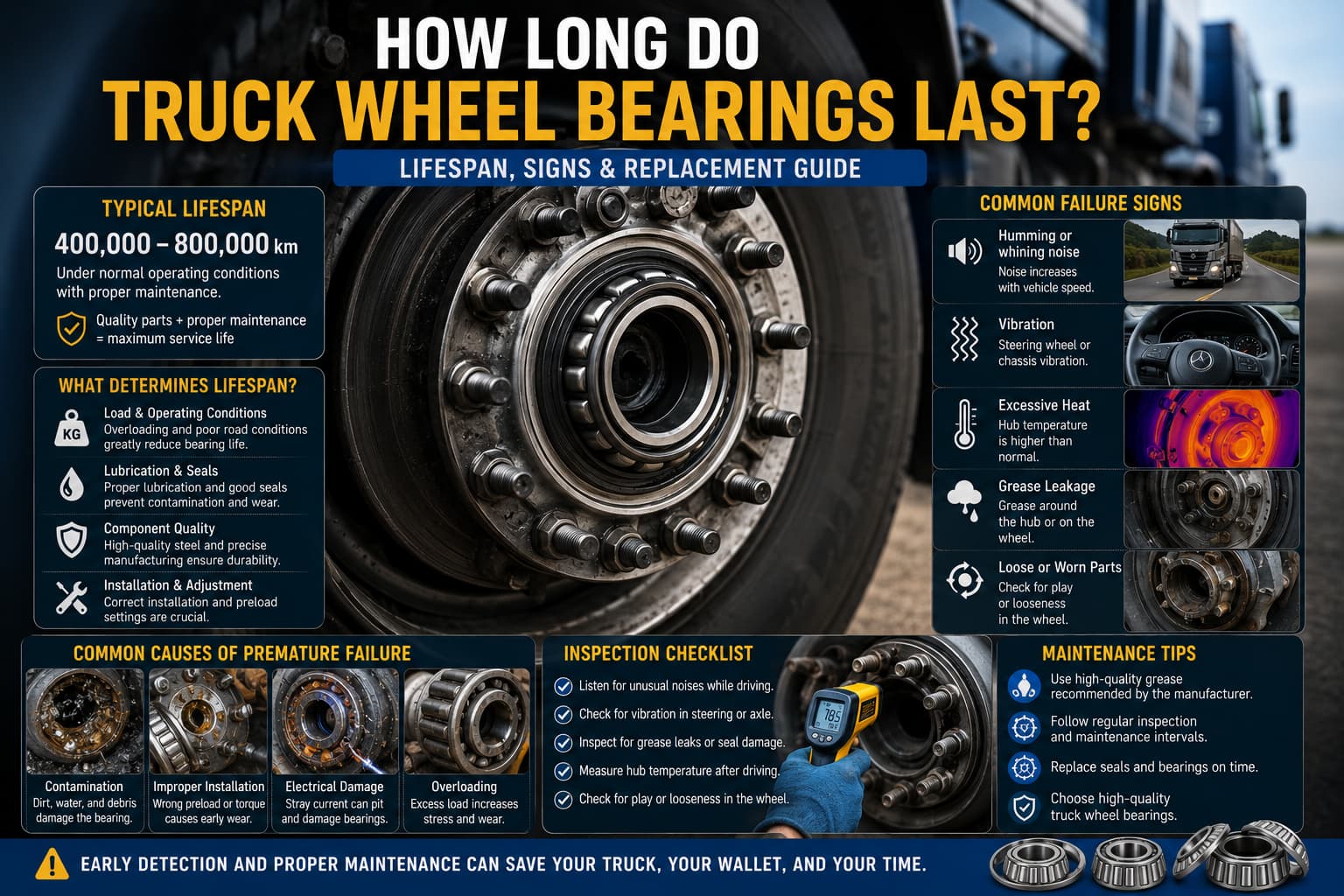
For fleet operators and owner-drivers alike, knowing how long your hub assemblies will last is critical to preventing costly roadside breakdowns. Under normal operating conditions, quality truck wheel bearings are engineered to deliver between 400,000 and 800,000 kilometers of reliable service. However, real-world longevity depends heavily on load patterns, road conditions, maintenance practices, and the quality of components installed.
According to data compiled from commercial fleet maintenance records through early 2026, premature bearing failure accounts for approximately 30% of unplanned axle-related downtime in heavy-duty vehicles. This translates to an average repair cost of $1,200–$3,500 per incident when factoring in towing, labor, and lost revenue. Understanding what drives these failures — and how to prevent them — can save thousands annually.
What Determines How Long These Components Last?
Load and Operating Conditions
Overloading is the single greatest accelerator of heavy duty wheel bearing wear. When a truck consistently operates above its Gross Vehicle Weight Rating (GVWR), the rolling elements inside the hub assembly experience exponentially higher contact stress. A 10% overload can reduce component life by up to 30%.
Road surface quality also plays a significant role. Vehicles operating primarily on well-maintained highways experience far less shock loading than those running on unpaved or potholed routes. Temperature extremes — both hot desert corridors and freezing northern climates — further stress seals and lubricants.
Lubrication and Seal Integrity
Proper lubrication is the lifeblood of any rolling-element assembly. Grease degradation, contamination from water or road debris, and seal failure are responsible for roughly 50% of premature failures in commercial vehicles. Modern unitized hub assemblies use lifetime-sealed designs, but traditional adjustable configurations require periodic repacking at intervals of 100,000–150,000 km.
Component Quality and Manufacturing Tolerances
Not all bearings are created equal. Budget components sourced from unverified suppliers often use inferior steel grades (below 52100 chromium steel standards) and looser manufacturing tolerances. Investing in the best truck wheel bearings for heavy duty use — from reputable manufacturers with documented quality certifications — typically yields 40–60% longer service life compared to generic alternatives.
Truck Wheel Bearing Failure Symptoms and Signs
Early detection is the key to avoiding catastrophic wheel-end separation. Here are the progressive warning indicators every driver and technician should recognize:
| Stage | Symptom | Severity | Action Required |
|---|---|---|---|
| Early | Faint humming or cyclic noise at 60+ km/h | Low | Schedule inspection within 2 weeks |
| Moderate | Noticeable vibration through steering or chassis | Medium | Inspect within 48 hours |
| Advanced | Grinding sound, ABS warning light, uneven tire wear | High | Immediate service required |
| Critical | Visible wheel wobble, heat discoloration on hub, smoke | Severe | Stop vehicle immediately |
A common complaint is truck wheel bearing noise when driving at highway speed — typically manifesting as a low-frequency drone that changes pitch with vehicle speed but not engine RPM. This distinguishes it from transmission or differential noise. The sound often intensifies when the vehicle leans toward the affected side during lane changes.
Root Causes of Premature Failure
Contamination Ingress
Damaged or degraded seals allow moisture, road salt, and fine particulates to enter the raceway. Once contamination reaches the rolling surfaces, abrasive wear accelerates exponentially. Fleet data shows that vehicles operating in coastal or heavily salted road environments experience 25–35% shorter bearing service intervals.
Improper Installation
Incorrect preload adjustment is a leading cause of early failure in adjustable configurations. Over-tightening generates excessive heat and accelerates fatigue, while under-tightening allows lateral movement that damages the cage and rollers. Torque specifications must be followed precisely — typically 200–270 Nm for Class 8 truck spindle nuts, followed by a controlled back-off procedure.
Electrical Damage (Stray Current)
An increasingly recognized failure mode in modern trucks involves electrical arcing through the bearing assembly. Stray currents from improperly grounded electrical systems or faulty ABS sensors can pit the raceway surfaces, creating a characteristic “fluting” pattern. This issue has become more prevalent as vehicles incorporate additional electronic systems.
Material Fatigue
Even under ideal conditions, every rolling-element assembly has a finite fatigue life. The L10 rating — the mileage at which 10% of a population will show fatigue — provides a statistical baseline. For quality heavy-duty components, this typically falls between 600,000 and 1,000,000 km under rated load conditions.
Diagnostic and Inspection Procedures
Proper semi truck bearing maintenance requires systematic inspection at every preventive maintenance interval. Here is the recommended diagnostic workflow:
- Visual inspection: Check for grease leakage, seal condition, rust staining, and heat discoloration around the hub area.
- Play check: With the wheel elevated, grasp at 12 and 6 o’clock positions and rock. Any perceptible movement exceeding 0.05 mm indicates excessive endplay.
- Rotation test: Spin the wheel by hand and feel for roughness, catching, or irregular resistance.
- Temperature comparison: After a road test, use an infrared thermometer to compare hub temperatures side-to-side. A differential exceeding 15°C suggests a problem.
- Noise isolation: Use a chassis stethoscope or electronic listening device on the spindle or knuckle to isolate the source of any abnormal sound.
For fleets seeking detailed guidance on inspection protocols, our technical support resources provide step-by-step procedures for various axle configurations.
Replacement Intervals and Mileage Guidelines
While there is no universal wheel bearing replacement mileage that applies to every application, the following table provides general guidance based on vehicle class and operating conditions:
| Vehicle Class | Application | Typical Replacement Interval | Severe Duty Interval |
|---|---|---|---|
| Class 6 (Medium Duty) | Regional delivery | 500,000–700,000 km | 300,000–450,000 km |
| Class 7 (Heavy Medium) | Construction / refuse | 400,000–600,000 km | 250,000–400,000 km |
| Class 8 (Heavy Duty) | Long-haul linehaul | 600,000–800,000 km | 400,000–550,000 km |
| Class 8 (Heavy Duty) | Vocational / off-road | 350,000–500,000 km | 200,000–350,000 km |
These figures assume OEM-quality or equivalent components. Using substandard parts can reduce these intervals by 40% or more. When sourcing replacements, consider browsing by product category brand or product category system to find components matched to your specific axle configuration.
How to Replace Truck Wheel Bearings Yourself
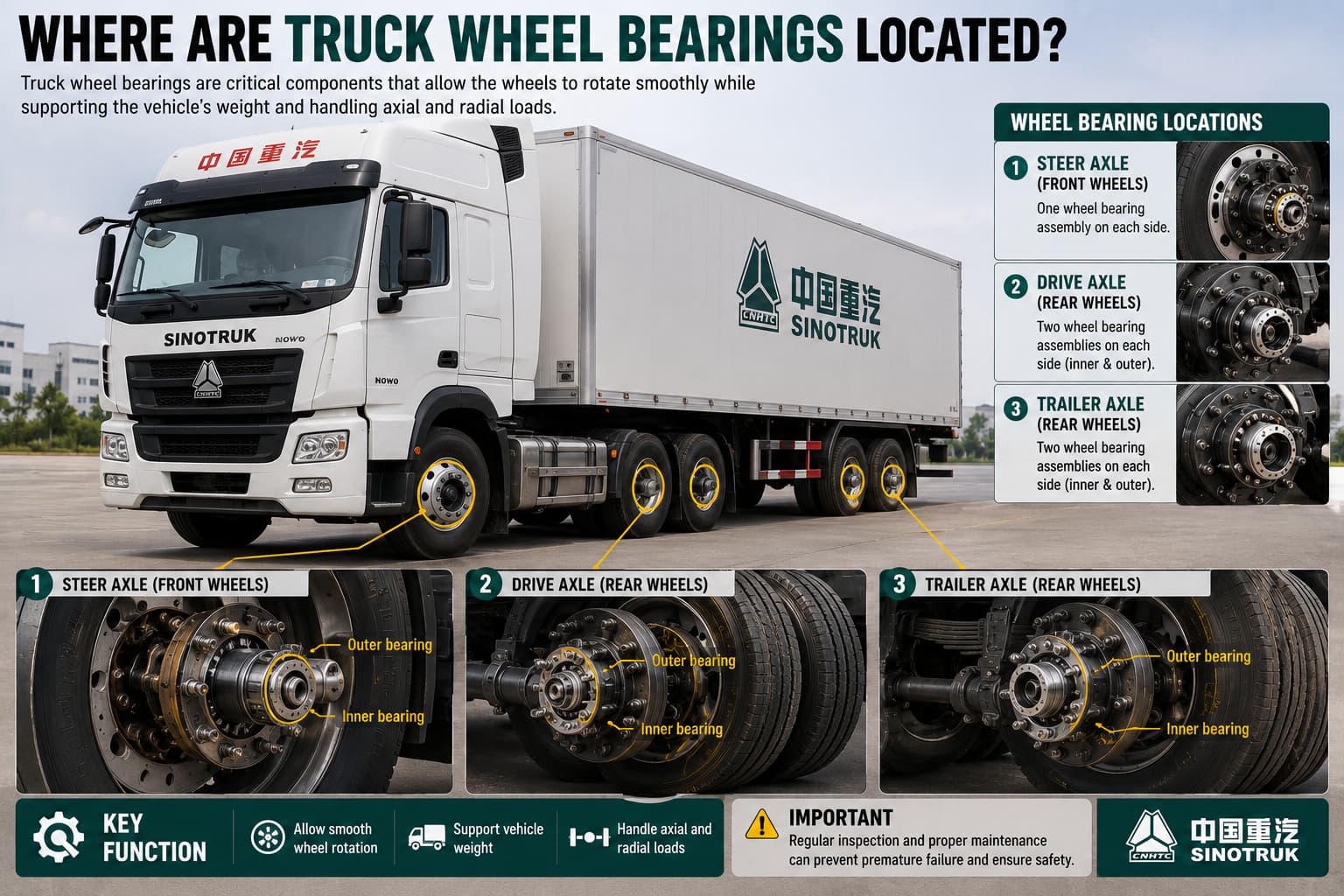
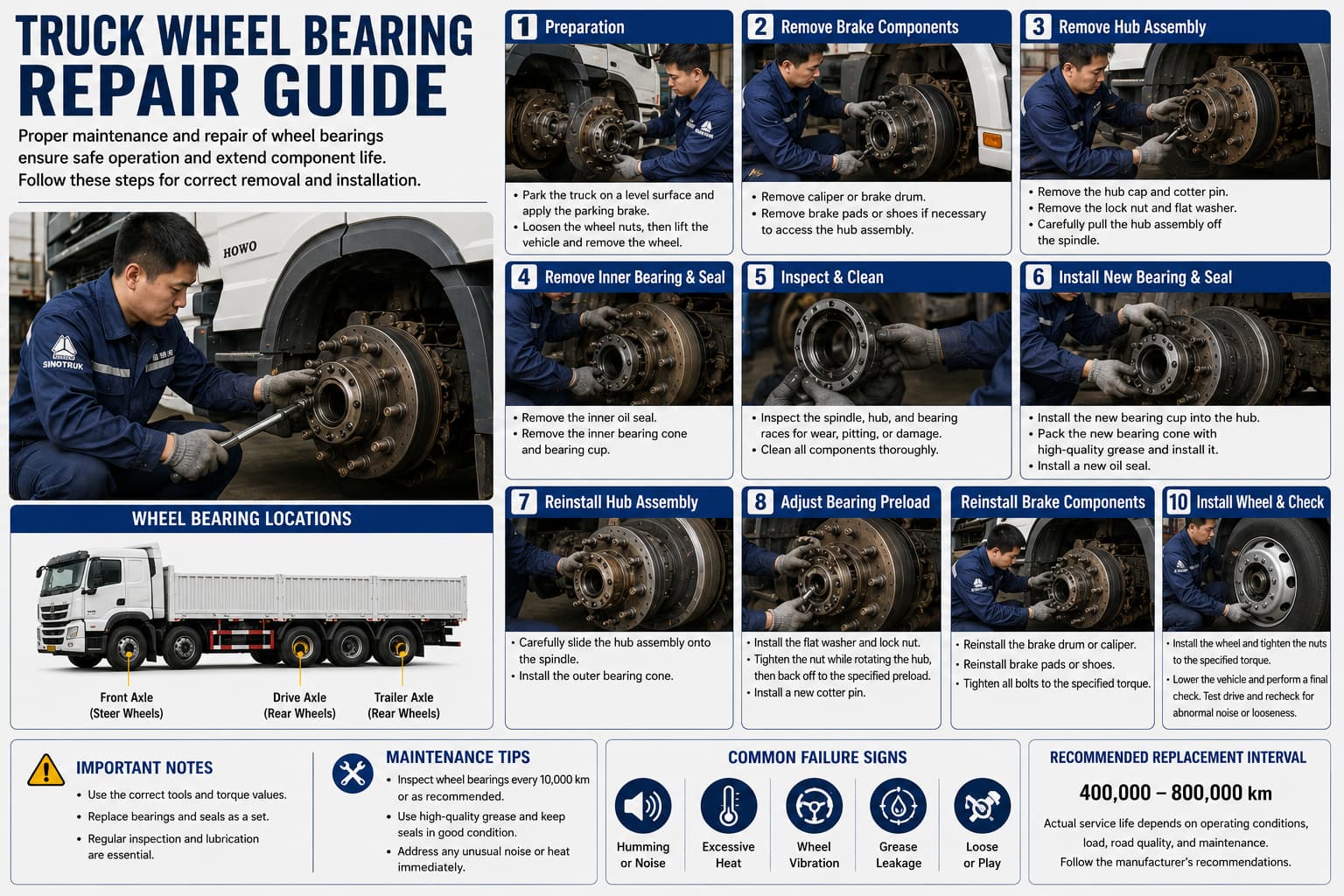
For owner-operators with mechanical aptitude and proper tooling, hub assembly replacement is achievable in a shop environment. Here is a condensed procedure for a typical Class 8 steer axle:
- Safely elevate and support the vehicle. Remove the wheel and tire assembly.
- Remove the brake caliper or drum, then the hub cap and lock nut assembly.
- Carefully slide the hub and rotor assembly off the spindle, catching the outer bearing cone.
- Remove the inner seal and bearing cone. Thoroughly clean and inspect the spindle for scoring or wear.
- If races require replacement, use a brass drift to drive them out evenly, then press new races flush and square.
- Pack new cones with the specified grease (typically NLGI #2 lithium complex), reinstall with new seals, and adjust preload per manufacturer specifications.
This process requires specialized tools including a hydraulic press, bearing packer, and calibrated torque wrench. If you lack experience, learning how to replace truck wheel bearings yourself through hands-on training is strongly recommended before attempting the job on a revenue vehicle.
Choosing Quality Replacement Components
The aftermarket is flooded with options ranging from premium OEM-equivalent parts to low-cost alternatives of questionable origin. When evaluating suppliers, consider these criteria:
- Material certification: Genuine high-carbon chromium steel (GCr15/52100) with documented heat treatment records.
- Dimensional accuracy: Tolerances within ISO 492 Class 0 or better.
- Seal quality: Multi-lip designs with integrated dust shields for contamination resistance.
- Traceability: Laser-etched lot numbers enabling full supply chain verification.
- Warranty coverage: Minimum 12-month or 150,000 km warranty from the supplier.
Mettlead specializes in sourcing top rated truck wheel bearings 2026 and other critical drivetrain components for Chinese-manufactured heavy vehicles including Sinotruk, Shacman, and FAW platforms. With direct factory relationships and rigorous incoming quality inspection, every part shipped meets or exceeds OEM specifications. Explore our full range of truck parts or review real-world fleet outcomes in our cooperative case studies.
Preventive Strategies to Maximize Service Life
Extending the operational life of your hub assemblies requires a proactive approach. Implement these practices to push toward the upper end of expected service intervals:
- Adhere strictly to GVWR limits — even occasional overloading causes cumulative damage.
- Inspect seals at every brake service interval and replace at the first sign of deterioration.
- Use only manufacturer-specified grease types and quantities during repacking.
- Verify proper endplay adjustment after any hub removal and reinstallation.
- Address ABS sensor faults promptly to prevent electrical damage to adjacent components.
- Monitor tire condition — cupping or feathering patterns can indicate bearing-related alignment issues.
Commercial truck bearing failure signs often appear weeks or months before catastrophic failure. Training drivers to report unusual noises or vibrations immediately creates a critical early-warning system that protects both equipment and personnel.
When to Seek Professional Help
While routine inspection is straightforward, certain situations demand professional intervention. If you observe heat discoloration on the spindle, detect metallic particles in the grease, or measure endplay beyond specification after adjustment, the underlying cause may extend beyond simple component replacement. Spindle damage, housing bore wear, or axle deflection issues require specialized measurement equipment and machining capabilities.
For sourcing guidance or application-specific questions, don’t hesitate to contact us directly. Our engineering team — with over 15 years of experience supporting international fleets — can recommend the correct part numbers and configurations for your specific axle models. Learn more about us and our commitment to keeping commercial vehicles running safely and efficiently.
Frequently Asked Questions
How many kilometers can I expect from a quality hub bearing on a Class 8 truck?
Under normal linehaul conditions with proper maintenance, premium components typically deliver 600,000–800,000 km of service. Severe-duty applications such as construction or refuse hauling may see replacement needed between 350,000–500,000 km due to higher shock loads and contamination exposure.
What is the most common early warning sign of bearing deterioration?
A low-frequency humming or droning noise that increases with vehicle speed — but does not change with engine RPM — is the most reliable early indicator. This sound typically becomes noticeable above 60 km/h and may shift during turns as load transfers between sides.
Can I extend the life of my hub assemblies by using synthetic grease?
Yes, in many cases. Synthetic lithium complex or polyurea-based greases offer superior high-temperature stability and oxidation resistance compared to conventional mineral-based products. However, you must verify compatibility with existing seal materials and never mix grease types within the same assembly.
Is it safe to continue driving after noticing a slight hum from the wheel end?
A faint hum in the early stage typically allows continued operation for a limited period — generally a few thousand kilometers — provided you schedule inspection promptly. However, if the noise progresses to grinding, or if you detect any vibration or wheel play, the vehicle should be taken out of service immediately to prevent wheel separation.
How does the truck wheel bearing lifespan compare between unitized (pre-set) and adjustable designs?
Unitized hub assemblies eliminate the risk of improper preload adjustment and generally offer more consistent longevity across a fleet. Adjustable designs can achieve equal or greater life when maintained by skilled technicians, but they are more susceptible to human error during service. The industry trend has shifted strongly toward pre-set configurations for steer and drive axles in new vehicles.


