
Why Early Detection of Bearing Wear Matters for Fleet Safety
A failing truck wheel bearing is one of the most dangerous yet frequently overlooked maintenance issues in heavy-duty transport. According to a 2025 FMCSA crash causation study, hub assembly failures contributed to over 4,200 roadside breakdowns monthly across North American fleets. Detecting degradation early prevents catastrophic wheel separation, protects cargo, and dramatically reduces unplanned downtime.
As an analyst who has spent over fifteen years evaluating drivetrain component failures across commercial fleets, I can confirm that most catastrophic hub failures show clear warning signs weeks—sometimes months—before the final event. The challenge lies in training operators and technicians to recognize these indicators before they escalate.
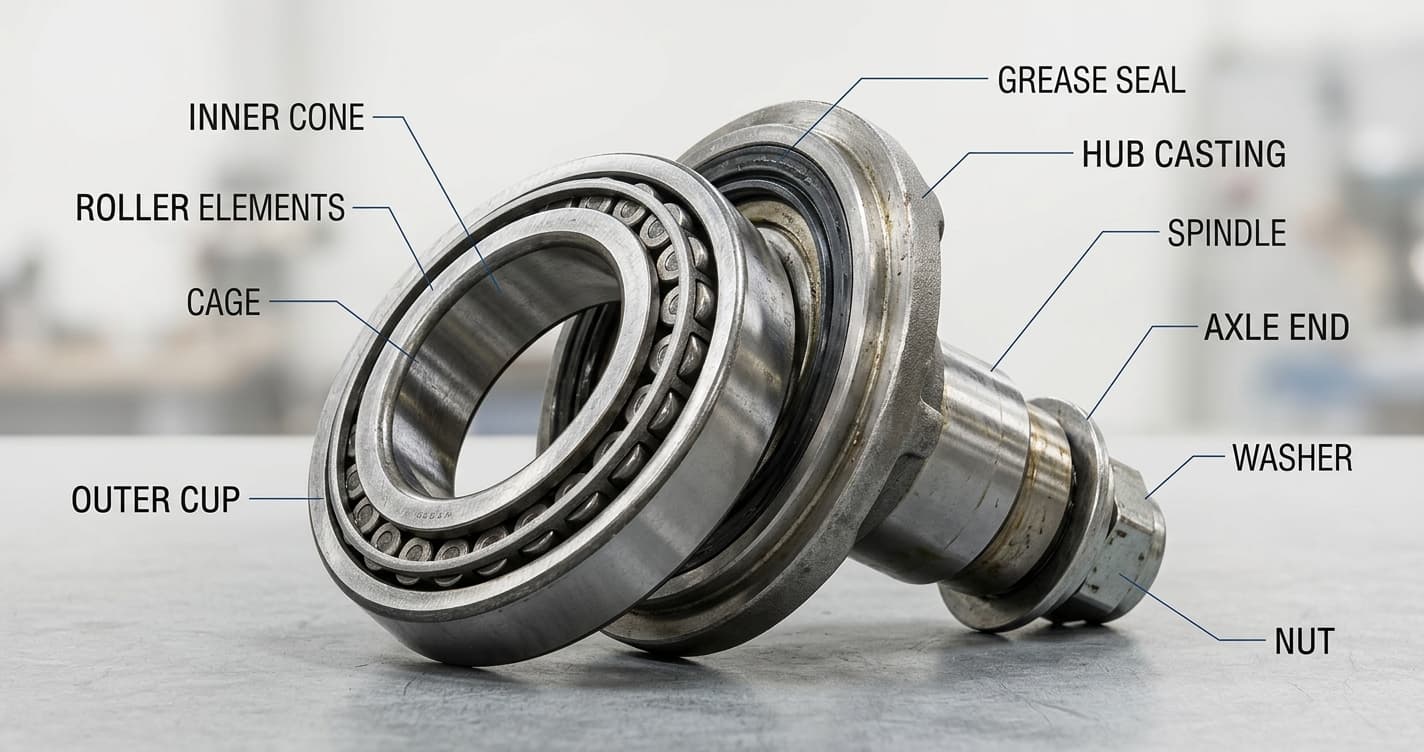
Common Warning Signs of Excessive Hub Bearing Degradation
Audible Indicators
The earliest detectable symptom is typically a low-frequency humming or growling noise that increases proportionally with vehicle speed. This sound originates from pitting or spalling on the roller surfaces and raceways. Drivers often describe it as a “droning” that shifts tone during lane changes, as lateral load transfer alters pressure distribution on the damaged component.
In advanced stages, you may hear clicking or snapping during low-speed turns. This indicates excessive internal clearance and potential cage failure. A diesel engine knocking sound at idle can sometimes mask these subtle bearing noises, so technicians should perform rolling inspections with the powertrain disengaged whenever possible.
Thermal Anomalies
Infrared thermography has become a standard fleet inspection tool. A healthy hub assembly typically operates 20–40°C above ambient temperature under normal highway loads. When internal friction increases due to lubricant breakdown or surface damage, temperatures can spike above 120°C. Many fleets now use trailer-mounted thermal sensors that flag anomalies in real time.
Excessive heat accelerates grease degradation, creating a destructive feedback loop. If a coolant system failure or radiator malfunction is simultaneously present on the vehicle, elevated under-hood temperatures can further stress adjacent drivetrain seals, compounding the problem.
Vibration and Handling Changes
Worn hub assemblies introduce play that manifests as steering wheel shimmy or a vague, wandering feel at highway speeds. On steer axles, this is particularly dangerous because it mimics tire balance issues, leading technicians down the wrong diagnostic path. On drive axles, vibration may be confused with driveshaft imbalance or connecting rod bearing wear in the powertrain.
A simple jack-and-rock test remains one of the most reliable field diagnostics. With the wheel elevated, grasp it at 12 and 6 o’clock and attempt to rock it. Any perceptible movement exceeding 0.05 mm of axial play indicates the assembly requires immediate attention.
Visual and Physical Evidence
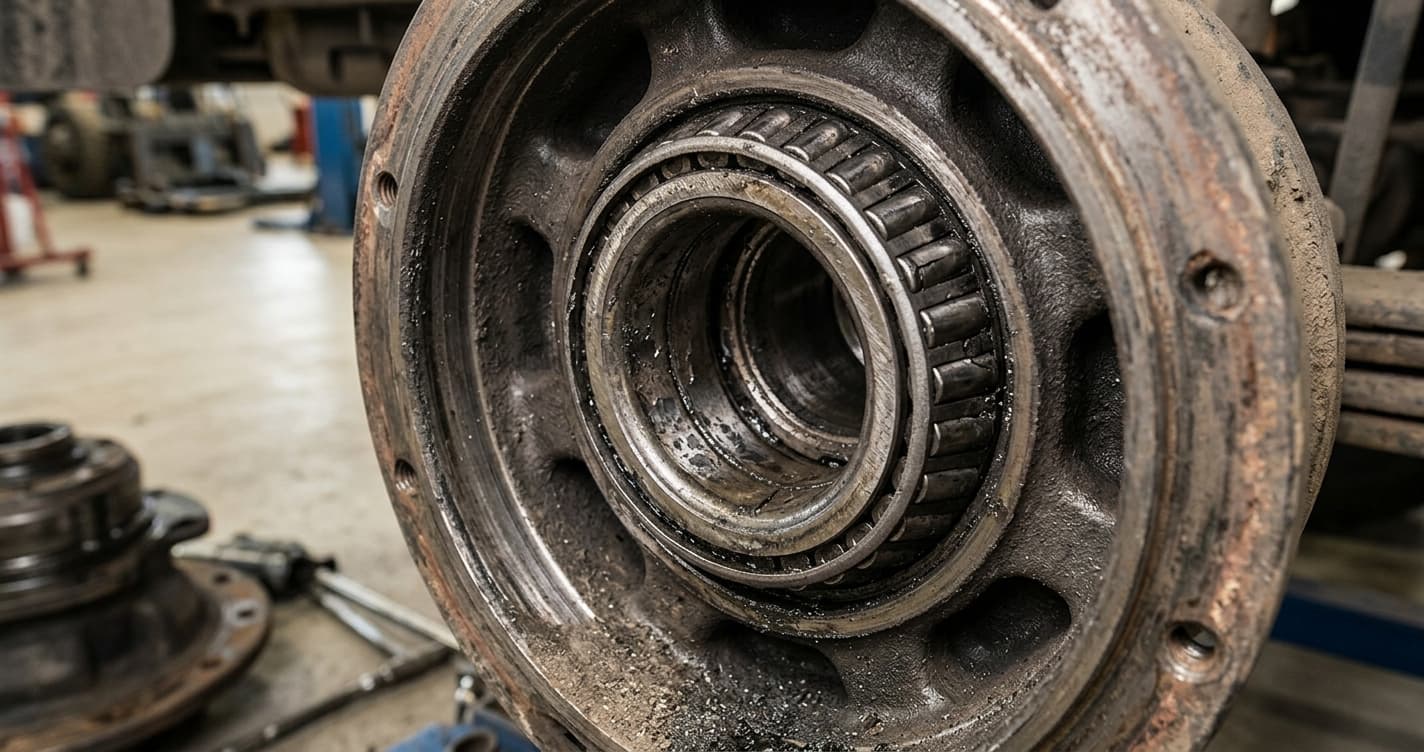
During routine brake inspections, technicians should look for grease leakage around the hub cap or seal area. Dark, contaminated lubricant suggests moisture intrusion or thermal breakdown. Metal particles visible in the grease confirm active surface deterioration.
Uneven tire wear—particularly feathering or cupping on the inner shoulder—often points to excessive bearing play altering wheel alignment geometry. This symptom is frequently misattributed to suspension issues, delaying proper diagnosis.
Root Causes of Premature Bearing Failure
| Cause | Mechanism | Typical Time to Failure | Prevention |
|---|---|---|---|
| Contamination ingress | Water or debris bypasses seals, causing corrosion pitting | 15,000–40,000 km after seal breach | Regular seal inspection; replace damaged seals immediately |
| Improper preload adjustment | Excessive tightness causes overheating; too loose allows impact loading | 20,000–60,000 km | Follow OEM torque specifications precisely |
| Lubricant starvation | Insufficient or degraded grease increases metal-to-metal contact | 10,000–30,000 km | Adhere to repack intervals; use correct NLGI grade |
| Overloading | Sustained loads beyond rated capacity cause subsurface fatigue | 30,000–80,000 km | Enforce payload limits; monitor axle weights |
| Misalignment during installation | Cocked rollers create uneven load zones and accelerated spalling | 5,000–20,000 km | Use proper press tools; verify seating with dial indicators |
Overloading is particularly prevalent in mining and construction applications. A 2024 fleet maintenance survey by TMC/ATA found that dump trucks operating above rated GVW experienced hub assembly failures at 2.7 times the rate of properly loaded vehicles. For operators running heavy-duty tippers, understanding the howo 6×4 tipper truck fuel cost per kilometer also helps correlate excessive fuel burn with mechanical drag from failing bearings.
Diagnostic Workflow: From Symptom to Confirmation
Step 1: Driver Report and Road Test
Begin with a structured driver interview. Document noise characteristics, speed dependency, and any recent events such as pothole impacts or water crossings. Conduct a road test at varying speeds, noting whether symptoms change during left versus right turns—this helps isolate the affected side.
Step 2: Static Inspection
Elevate the axle and perform the rock test at both 12/6 and 3/9 o’clock positions. Spin the wheel by hand, feeling for roughness, catches, or irregular resistance. Inspect the hub seal for leakage and check the condition of expelled grease. A thermostat stuck closed on the engine cooling circuit should also be ruled out as a source of elevated underbody heat that could affect nearby components.
Step 3: Measurement and Confirmation
Use a dial indicator mounted against the hub face to quantify axial endplay. Compare readings against manufacturer specifications. For most Class 8 applications, acceptable endplay ranges from 0.001″ to 0.005″. Readings beyond 0.008″ typically warrant replacement regardless of visual condition.
Advanced fleets are now integrating vibration analysis with accelerometers mounted on the spindle nut. Spectral analysis can identify characteristic defect frequencies for inner race, outer race, and roller element faults—often detecting problems 50,000 km before audible symptoms appear.
Step 4: Disassembly and Root Cause Analysis
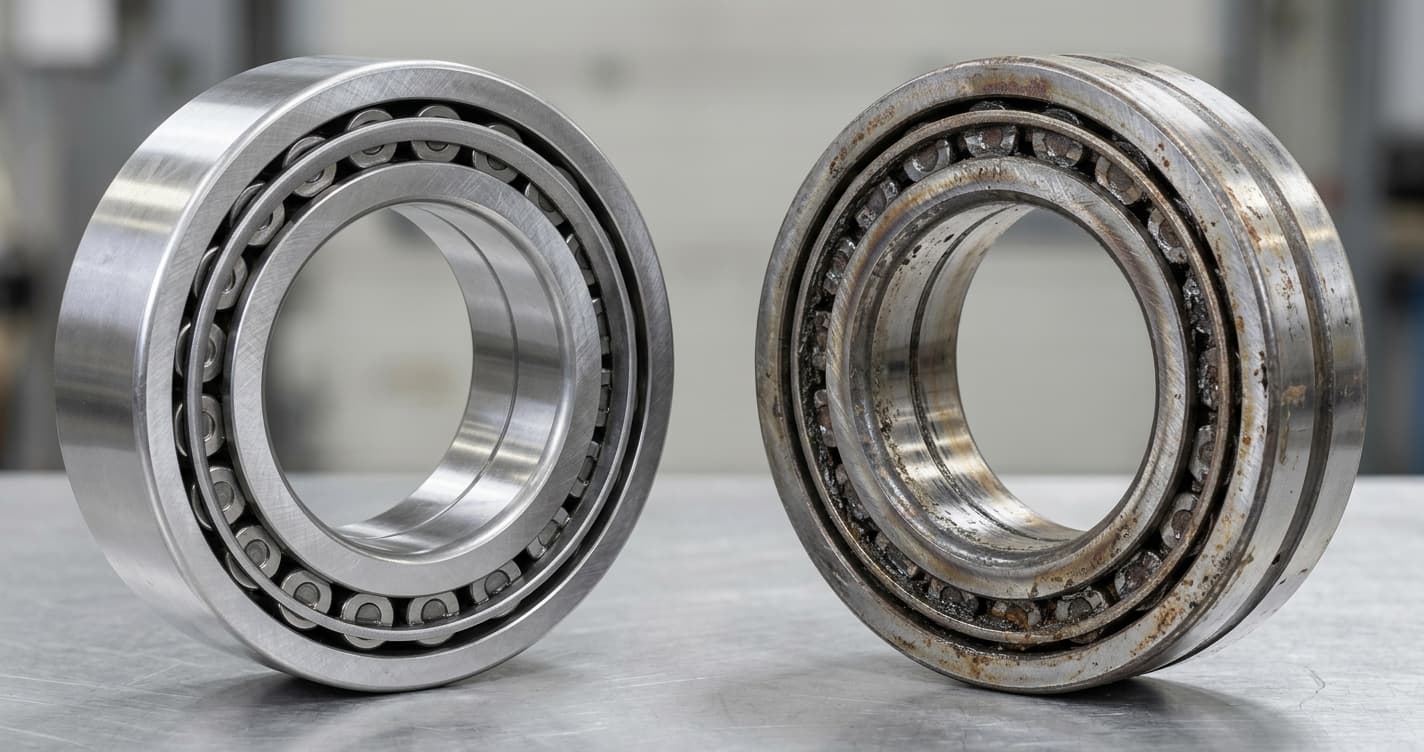
Upon removal, document the failure pattern. Spalling concentrated on the loaded zone suggests overload or misalignment. Uniform corrosion pitting indicates contamination. Discoloration (blue or straw-colored raceways) confirms thermal damage from lubricant failure. This root cause analysis prevents repeat failures after replacement.
Impact on Operating Costs and Fuel Efficiency
A degraded hub assembly doesn’t just risk safety—it directly impacts the bottom line. Increased rolling resistance from a rough or binding bearing can raise diesel fuel efficiency losses by 1.5–3% per affected wheel position. For a long-haul tractor covering 150,000 km annually, that translates to thousands of dollars in wasted fuel.
Fleet managers focused on how to reduce truck fuel consumption often overlook drivetrain friction as a contributing factor. While fuel consumption optimization typically centers on aerodynamics and driver behavior, mechanical drag from worn rotating components is a significant and correctable variable. Operators tracking sinotruk howo 371 fuel consumption per km have reported measurable improvements after replacing worn hub assemblies during scheduled maintenance.
For those evaluating chinese truck operating costs, bearing quality directly influences total cost of ownership. Premium components with tighter manufacturing tolerances and superior metallurgy consistently deliver longer service life, even under demanding conditions. The best fuel cards for truck drivers won’t offset losses caused by preventable mechanical inefficiency.
Recommended Solutions and Replacement Parts
When replacement is confirmed, selecting the correct specification is critical. OEM-equivalent components must match the original bearing’s dynamic load rating, contact angle, and dimensional tolerances. Inferior aftermarket parts with inadequate heat treatment or loose tolerances will fail prematurely, negating any initial cost savings.
Our inventory includes precision-manufactured hub assemblies and individual bearing sets for all major heavy-duty platforms, including HOWO, Shacman, and FAW chassis. Each component undergoes hardness testing, dimensional verification, and surface finish inspection before shipping. Browse our full range by product category brand or search by product category system to find exact-fit replacements.
For operators running Sinotruk platforms seeking sinotruk howo a7 fuel efficiency tips, replacing worn rotating components is one of the highest-ROI maintenance actions available. Proper bearing condition also supports accurate readings when using a truck fuel cost per mile calculator, since mechanical drag distorts baseline consumption figures.
We also supply matched seal kits, spindle nuts, and hub caps to ensure a complete, leak-free installation. Our diesel engine and drivetrain parts catalog covers components from combustion chamber pressure sensors to water pump leak repair kits—everything needed to keep heavy-duty vehicles operating at peak efficiency.
Preventive Maintenance Schedule
| Interval | Action | Notes |
|---|---|---|
| Every pre-trip | Listen for abnormal noise; check for hub heat | Use back of hand near hub cap (never touch directly) |
| Every 30,000 km | Jack-and-rock test; visual seal inspection | Document findings in maintenance log |
| Every 100,000 km | Full repack with fresh grease; measure endplay | Replace seals at every repack |
| Every 300,000 km | Complete hub assembly replacement (preventive) | Adjust based on operating conditions |
Fleets operating in high-moisture environments, extreme temperatures, or heavy-duty mileage applications such as mining should compress these intervals by 30–50%. Tracking howo dump truck diesel consumption rate 2025 data alongside maintenance records helps correlate fuel burn spikes with component degradation.
Real-World Case: Mining Fleet Reduces Downtime by 62%
A Central African mining operation running 45 HOWO 6×4 dump trucks experienced an average of 3.2 bearing-related roadside failures per month in early 2025. After implementing a structured inspection program with thermal scanning and scheduled replacements using OEM-specification parts, failures dropped to 1.2 per month within six months. Review similar outcomes in our cooperative cases section.
The fleet also reported a 2.1% improvement in heavy-duty vehicle mileage across the entire operation, attributed to eliminating mechanical drag from degraded assemblies. Annual savings exceeded $180,000 in combined fuel, towing, and lost-productivity costs. This demonstrates how fleet fuel management extends well beyond fuel purchasing strategies.
When to Seek Expert Assistance
If your maintenance team encounters repeated premature failures despite following correct installation procedures, the root cause may involve spindle wear, housing bore damage, or systemic overloading. Our engineering team provides remote and on-site technical support including failure analysis, specification verification, and application engineering for demanding operating environments.
Understanding diesel engine knocking under load causes and how to fix diesel engine knocking noise is equally important, since powertrain vibrations can accelerate hub component fatigue through transmitted shock loads. A holistic approach to drivetrain health—addressing fuel injector timing, piston slap, and cetane number optimization alongside rotating component maintenance—delivers the best long-term reliability outcomes.
Operators who have experienced diesel engine knocking when cold start or diesel engine knocking after fuel injector replacement should investigate whether those vibration events have accelerated wear on adjacent rotating assemblies. Learn more about us and our commitment to heavy-duty parts quality, or contact us directly for application-specific guidance.
Frequently Asked Questions
How long do heavy-duty hub bearings typically last under normal conditions?
Under proper loading, correct preload adjustment, and regular lubrication, quality hub assemblies on Class 8 trucks typically achieve 400,000–600,000 km of service life. Severe-duty applications such as construction or mining may see 200,000–350,000 km. Factors including sinotruk howo 420 hp fuel consumption liters per 100km correlate with load intensity, which directly affects bearing longevity.
Can I continue driving if I suspect a worn hub assembly?
No. Once symptoms are detected, the vehicle should be inspected at the earliest safe opportunity. Continued operation risks wheel separation, which endangers the driver, other road users, and cargo. At minimum, reduce speed and avoid highway operation until a qualified technician confirms the component’s condition.
What grease specification should I use for repacking?
Most heavy-duty applications require NLGI Grade 2 lithium-complex or calcium-sulfonate grease with a minimum dropping point of 260°C and excellent water washout resistance. Always verify against the chassis manufacturer’s specification. Using incorrect lubricant is a leading cause of premature failure, similar to how diesel truck fuel additives reviews emphasize using only compatible chemistry in fuel systems.
How does bearing condition affect fuel economy?
A single degraded hub assembly can increase rolling resistance enough to raise fuel consumption by 1.5–3% at that wheel position. Across a 6×4 configuration with multiple affected positions, the cumulative impact on commercial truck diesel costs becomes substantial. Fleets pursuing truck fuel efficiency tips 2026 should include rotating component health in their optimization programs alongside sinotruk diesel engine performance tuning.
What distinguishes OEM-quality replacement bearings from budget alternatives?
OEM-specification components feature through-hardened or case-carburized steel with controlled retained austenite levels, tighter dimensional tolerances (typically ISO Class 0 or better), and superior surface finish on raceways. Budget alternatives often use lower-grade steel with inconsistent heat treatment, leading to early spalling. The price difference is typically 20–40%, but service life can differ by 200–300%, making premium parts the clear value choice for howo truck fuel efficiency and overall operating economics.


