
Understanding the Numbers on Your Truck Tires
Every tire sidewall carries a coded sequence of numbers and letters that tells you everything about its dimensions, capacity, and intended use. For truck owners—whether managing a single pickup or an entire fleet—decoding this information is essential for safety, performance, and cost control. This guide breaks down how to read truck tire size markings across light-duty, medium-duty, and heavy commercial categories.
According to the Tire and Rim Association’s 2025 standards update, incorrect sizing remains a leading contributor to premature tire failure in commercial applications. Understanding these markings eliminates guesswork and prevents costly mistakes.
Anatomy of a Tire Sidewall Code
A typical marking like LT265/70R17 121/118Q E contains five critical data points. Each segment communicates a specific dimension or performance characteristic. Let’s dissect them one by one.
Tire Type Prefix
The first letter(s) indicate the vehicle category the tire was engineered for. “LT” stands for Light Truck, “P” for Passenger, and “ST” for Special Trailer. Commercial truck tires designed for semi-trailer rigs often carry no prefix at all, using a purely metric designation instead.
Section Width
The three-digit number (e.g., 265) represents the cross-sectional width in millimeters, measured from sidewall to sidewall when mounted on the recommended rim. Wider sections provide more contact area but increase rolling resistance.
Tire Aspect Ratio
The two-digit number after the slash (e.g., 70) is the sidewall height expressed as a percentage of the section width. A 265/70 tire has a sidewall height of 185.5 mm. Lower profiles deliver sharper handling; taller profiles absorb more road impact—a critical consideration for off-road and heavy-load applications.
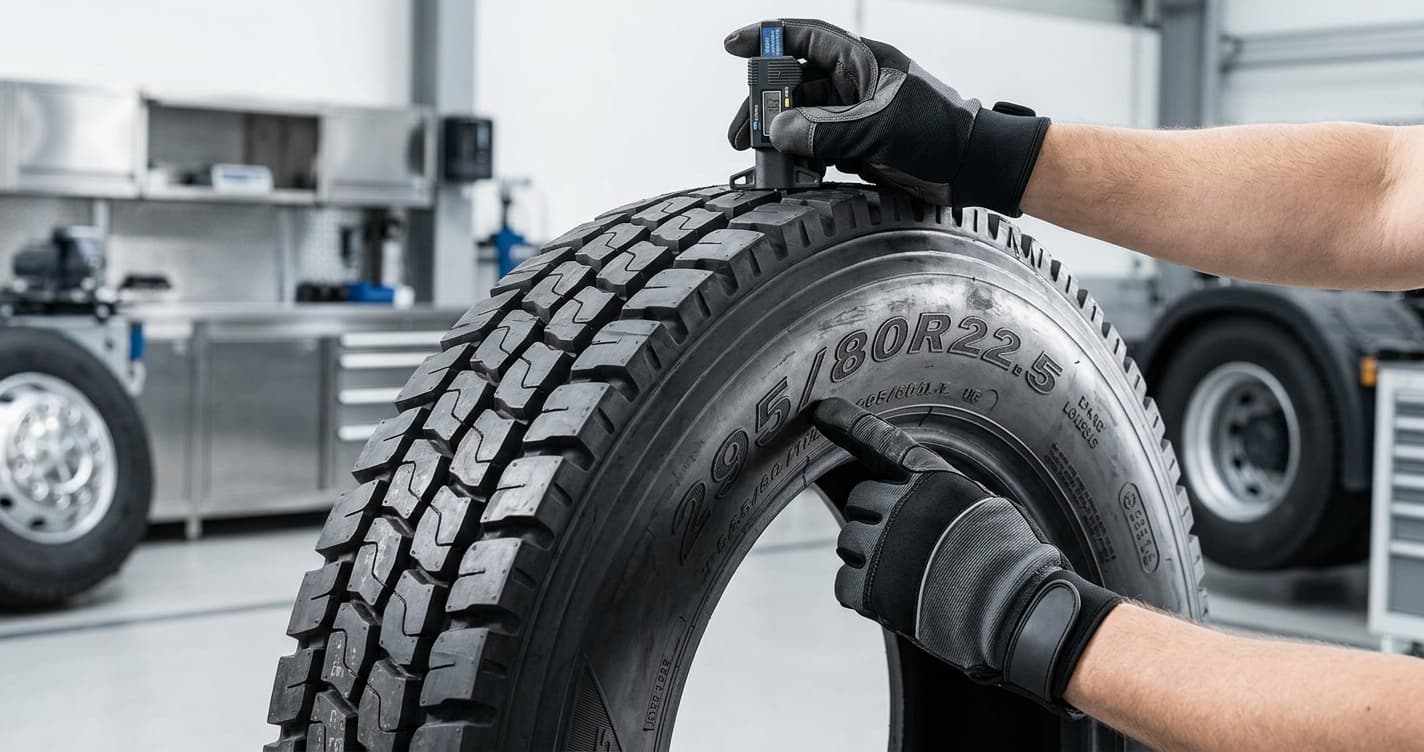
Construction Type and Rim Diameter
“R” denotes radial construction, the industry standard since the 1980s. The final number (e.g., 17) is the wheel diameter in inches. Matching this precisely to your rim is non-negotiable for safe mounting.
Load Index and Speed Rating
The numbers following the diameter (121/118) represent load capacity per tire in single and dual configurations. The letter (Q) indicates maximum sustained speed. The final letter (E) designates the load range rating, which correlates to ply strength and maximum inflation pressure.
Category Breakdown: Light-Duty Trucks
Half-ton pickups (Ford F-150, RAM 1500, Chevrolet Silverado 1500) typically use LT-prefix or P-metric tires ranging from 245 to 305 mm in width. Choosing the best tire size for a half-ton truck depends on your primary use case—towing, daily commuting, or off-road exploration.
Many owners ask what size tires fit my truck without lifting. The answer depends on factory wheel well clearance, offset, and suspension geometry. Most half-tons accommodate 1–2 inches of additional diameter without modification. Beyond that, rubbing at full steering lock becomes likely.
| Truck Model | Factory Size | Max Size Without Lift | Recommended Lift for Oversize |
|---|---|---|---|
| Ford F-150 (2023–2026) | 275/65R18 | 295/70R18 (33.3″) | 2″ leveling kit |
| RAM 1500 (2022–2026) | 275/60R20 | 295/65R20 (33.5″) | 2.5″ front spacer |
| Chevrolet Silverado 1500 | 265/65R18 | 285/70R18 (33.0″) | 2″ leveling kit |
| Toyota Tundra (2024–2026) | 265/60R20 | 285/65R20 (33.5″) | 2″ spacer lift |
The biggest tire size for a stock truck varies by manufacturer, but the table above reflects real-world fitment data confirmed by installer feedback. Always verify with a truck tire size comparison chart specific to your year and trim level.
Category Breakdown: Medium-Duty Trucks
Class 4–6 vehicles (Ford F-450/550, International MV, Freightliner M2 106) use commercial truck tire dimensions that differ significantly from light-duty formats. Common sizes include 19.5″ and 22.5″ rim diameters with section widths from 225 to 315 mm.
These vehicles prioritize load capacity over aesthetics. A typical medium-duty marking reads 245/70R19.5 136/134M G, where the “G” load range indicates 14-ply equivalent strength and a maximum inflation level of 110 PSI.
Category Breakdown: Heavy Commercial (Class 7–8)
Semi-trucks and 18-wheelers operate on an entirely different sizing convention. The most common designation—11R22.5—uses imperial width (11 inches) with radial construction on a 22.5-inch rim. The absence of an aspect ratio number means the sidewall height defaults to approximately 100% of width.
Understanding how to read truck tire size numbers in this format is straightforward once you recognize the imperial convention. The “R” still means radial, and the rim diameter follows the same logic as light-duty applications.
| Position | Common Size | Typical Application | PSI Recommendation |
|---|---|---|---|
| Steer Axle | 295/75R22.5 | Long-haul, regional | 100–110 PSI |
| Drive Axle | 11R22.5 | Traction, all-season | 95–105 PSI |
| Trailer | 11R24.5 | Free-rolling, low heat | 100–110 PSI |
| Wide-Base Single | 445/50R22.5 | Fuel efficiency, weight savings | 110–120 PSI |
Maintaining correct tire pressure for 18 wheeler tires directly impacts fuel economy. The American Trucking Associations reported in 2025 that every 10 PSI of underinflation reduces fuel efficiency by approximately 1%, costing fleets thousands annually.
How to Verify Your Current Sizing
Beyond reading the sidewall, three additional sources confirm your vehicle’s specifications:
- Door jamb placard: Lists original equipment sizes, cold inflation pressures, and load limits.
- Owner’s manual: Provides approved alternative sizes and fleet tire specifications for different load scenarios.
- Manufacturer VIN lookup tools: Cross-reference your build sheet for exact factory configuration.
For commercial operators, knowing how to check tire pressure on a semi truck at every pre-trip inspection is a DOT compliance requirement. A calibrated tire pressure gauge—preferably digital—delivers readings accurate to ±1 PSI. The best tire pressure gauge for commercial trucks features a dual-head chuck for inner duals and a bleed valve for precise adjustment.
Tire Pressure Monitoring and Maintenance
Modern trucks increasingly rely on TPMS sensor technology to provide real-time inflation data. However, sensors can fail or lose calibration. Knowing how to use a digital tire pressure gauge on truck tires remains a fundamental skill for any driver or fleet technician.
Industry best practice recommends checking inflation how often to check tire pressure on a truck—at minimum before every trip when tires are cold (ambient temperature, not driven for 3+ hours). For long-haul operations, weekly verification with a handheld gauge supplements electronic monitoring.
Changing Tires: What You Need to Know
Understanding sizing is only half the equation. When a roadside tire change becomes necessary, preparation determines whether you’re back on the road in 30 minutes or stranded for hours.
Learning how to change a truck tire by yourself starts with carrying the right equipment. The best tools to change a truck tire include a properly rated hydraulic jack (minimum 4-ton for light trucks, 12-ton for medium-duty), a torque wrench calibrated for your lug nut torque specifications, and a breaker bar for seized fasteners.
For those wondering how much does it cost to change a truck tire, roadside service averages $150–$400 depending on location and vehicle class. DIY truck tire replacement eliminates labor costs but requires proper hydraulic jack placement knowledge to avoid frame damage.

Emergency Situations
In rare cases, drivers ask about methods to change truck tire without jack—a scenario that should only be attempted using natural terrain features (ditches, ramps) as a last resort. The safer approach is always carrying a rated jack and following a change truck tire step by step guide that prioritizes personal safety over speed.
Proper spare tire mounting technique ensures the replacement stays secure. Torque lug nuts in a star pattern to manufacturer specifications, then re-torque after 50–100 miles of driving.
Selecting the Right Size for Your Application
Choosing dimensions involves balancing multiple factors: load capacity, fuel efficiency, ride comfort, and terrain compatibility. The semi truck wheel size you select affects everything from braking distance to tire maintenance intervals.
For fleet managers evaluating options, our cooperative case studies demonstrate how proper sizing decisions reduced per-mile operating costs by 8–12% across diverse applications. Explore our product category system for monitoring solutions that complement your tire management program.
If you need guidance matching dimensions to your specific vehicle configuration, our technical support team provides sizing consultations. Browse trusted options through our product category brand listings.
Key Takeaways
- Every sidewall code contains width, aspect ratio, construction type, rim diameter, load index, speed rating, and load range.
- Light-duty, medium-duty, and heavy commercial trucks each follow distinct sizing conventions.
- Always cross-reference sidewall markings with your door jamb placard and owner’s manual.
- Proper inflation monitoring prevents premature wear and maximizes fuel economy.
- When upsizing, verify clearance at full lock and under compression before committing.
At Mettlead, we support truck operators with the tools and expertise needed to make informed tire decisions. Learn more about us or contact us for personalized recommendations.

Frequently Asked Questions
What does the “LT” prefix mean on a tire sidewall?
“LT” stands for Light Truck and indicates the tire was engineered with reinforced sidewalls and higher load capacity compared to passenger (P-metric) tires. It’s standard on pickups, SUVs, and vans used for towing or hauling.
Can I put a different size tire on my truck than what the manufacturer recommends?
Yes, within limits. You can typically increase overall diameter by 3% without affecting speedometer accuracy or drivetrain stress. Larger deviations require recalibration of electronic systems and may void warranty coverage on related components.
How do I know if my truck needs Load Range E or Load Range D tires?
Check your door jamb placard. If it specifies a maximum cold inflation above 65 PSI, your vehicle requires Load Range E (10-ply equivalent). Downgrading to D reduces maximum load capacity and may create a safety hazard under heavy payloads.
What’s the difference between 11R22.5 and 295/75R22.5?
Both fit the same 22.5-inch rim and have nearly identical overall diameters. The difference is notation: 11R22.5 uses imperial width measurement (11 inches), while 295/75R22.5 uses metric (295 mm width, 75% aspect ratio). They are functionally interchangeable in most applications.
How do I read the manufacturing date on a commercial tire?
Look for the DOT code on the sidewall. The last four digits indicate the production week and year. For example, “2425” means the tire was manufactured in the 24th week of 2025. Industry guidelines recommend replacing tires older than six years regardless of tread depth.


