Picture this: your driver is 600 kilometers from the nearest depot, and the brake caliper you installed three weeks ago just cracked like a cheap dinner plate. The truck is parked on the shoulder, your customer is calling, and you’re calculating how much this single failed part is about to cost you in towing, downtime, emergency repairs, and reputation damage.
Sound familiar? Unfortunately, it happens more often than anyone in this industry likes to admit. Finding a reliable OEM truck parts manufacturer is a bit like finding a good mechanic — once you have one, you hold on tight and never let go. The difference is, a bad mechanic costs you a few hundred dollars. A bad parts supplier can cost you thousands, repeatedly, across your entire fleet.
So how do you separate the genuine manufacturers from the smooth-talking traders with borrowed catalogs? This article gives you a practical, step-by-step framework to identify, evaluate, and ultimately partner with an OEM truck parts supplier you can actually trust. No fluff, no theory — just actionable guidance from people who’ve been in this industry long enough to know where the landmines are buried.
Why Choosing the Right OEM Truck Parts Manufacturer Actually Matters
The Real Cost of Getting It Wrong
Cheap heavy duty truck components don’t save money — they redistribute costs into places that hurt more. A counterfeit engine bearing doesn’t just fail; it takes the crankshaft with it. A substandard brake pad doesn’t just wear fast; it scores the rotor and compromises stopping distance under load.
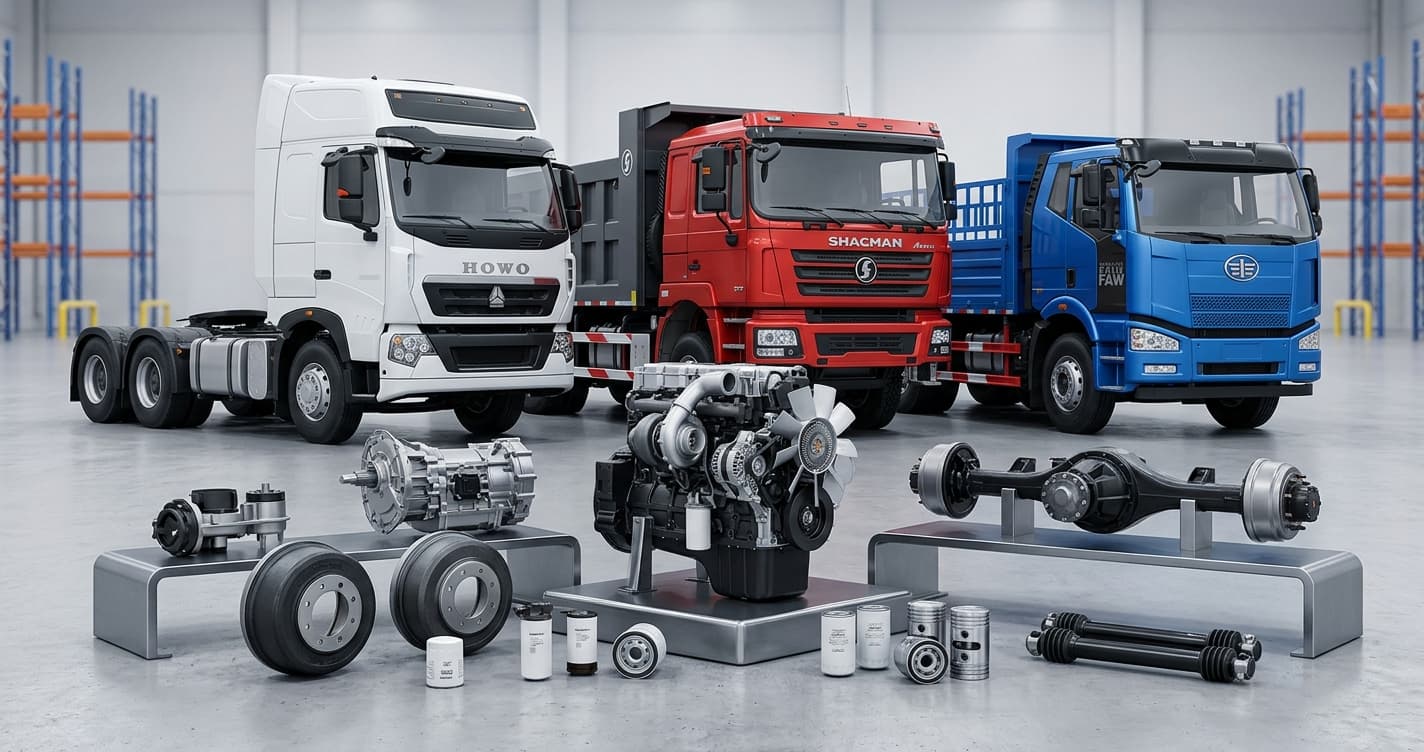
For fleets running Sinotruk HOWO, Shacman, FAW, Dongfeng, Foton, or JAC trucks, the consequences multiply quickly. These vehicles often operate in demanding conditions — mining roads, long-haul corridors, construction sites — where component failure isn’t just inconvenient, it’s dangerous.
Consider the numbers over a typical 12-month period:
| Cost Factor | Cheap Non-OEM Parts | Genuine OEM-Quality Parts |
|---|---|---|
| Replacement frequency (per truck/year) | 4–6 times | 1–2 times |
| Average downtime per failure | 3–5 days | Scheduled maintenance only |
| Labor costs (annual) | $2,800–$4,500 | $800–$1,200 |
| Revenue lost to downtime | $6,000–$12,000 | Minimal |
| Collateral damage risk | High | Low |
Consequently, the “savings” from cheaper parts evaporate within the first quarter. What remains is frustration, strained customer relationships, and a parts room full of components you can’t trust. This reality is precisely why truck parts manufacturing quality should be your first filter, not price.
What “OEM” Really Means (And Why People Get It Confused)
Let’s clear something up, because “OEM quality” has become perhaps the most overused phrase in supplier catalogs worldwide. If every supplier who claimed OEM quality actually delivered it, we’d all be living in a paradise of perfectly functioning trucks. Clearly, we are not.
Here’s the straightforward distinction:
- OEM (Original Equipment Manufacturer): The factory that produces parts for the truck maker’s assembly line. Same specs, same materials, same production line.
- OES (Original Equipment Supplier): Parts made by the OEM factory but sold through aftermarket channels, often under a different brand name.
- Aftermarket: Parts made by third-party manufacturers to fit the same application. Quality ranges from excellent to catastrophic.
The confusion arises because many aftermarket suppliers label their products “OEM quality” without any verification or certification to back that claim. Meanwhile, genuine OEM truck parts manufacturers — the ones actually supplying Dongfeng, Sinotruk, or Shacman assembly lines — often have less flashy marketing but far superior products.
7 Practical Steps to Identify a Reliable OEM Truck Parts Supplier
Step 1 — Verify Manufacturing Certifications (Don’t Just Take Their Word for It)
Certifications are the baseline, not the finish line. However, a supplier who can’t produce them quickly is already waving a yellow flag. Look specifically for ISO 9001 (quality management systems), IATF 16949 (automotive-specific quality standards), and any OEM authorization letters from Chinese truck manufacturers.
Here’s the key: don’t just accept a PDF. Verify the certificate number independently through the issuing body’s website. Legitimate certifications have traceable registration numbers, defined scopes, and expiration dates. Moreover, ask which specific product lines the certification covers — some suppliers certify one product and imply it covers everything.
A certified truck parts distributor with genuine credentials will hand over documentation without hesitation. The ones who stall, make excuses, or send blurry scans? Those are the ones to walk away from.
Step 2 — Assess Their Product Range and Brand Coverage
A reliable OEM truck parts manufacturer typically covers multiple Chinese truck brand systems. Why? Because manufacturing depth requires investment in tooling, engineering knowledge, and quality systems that naturally extend across platforms. A supplier who only offers parts for one model likely lacks the infrastructure for serious production.
Evaluate their coverage across these critical systems:
| Product System | Key Components | Why It Matters |
|---|---|---|
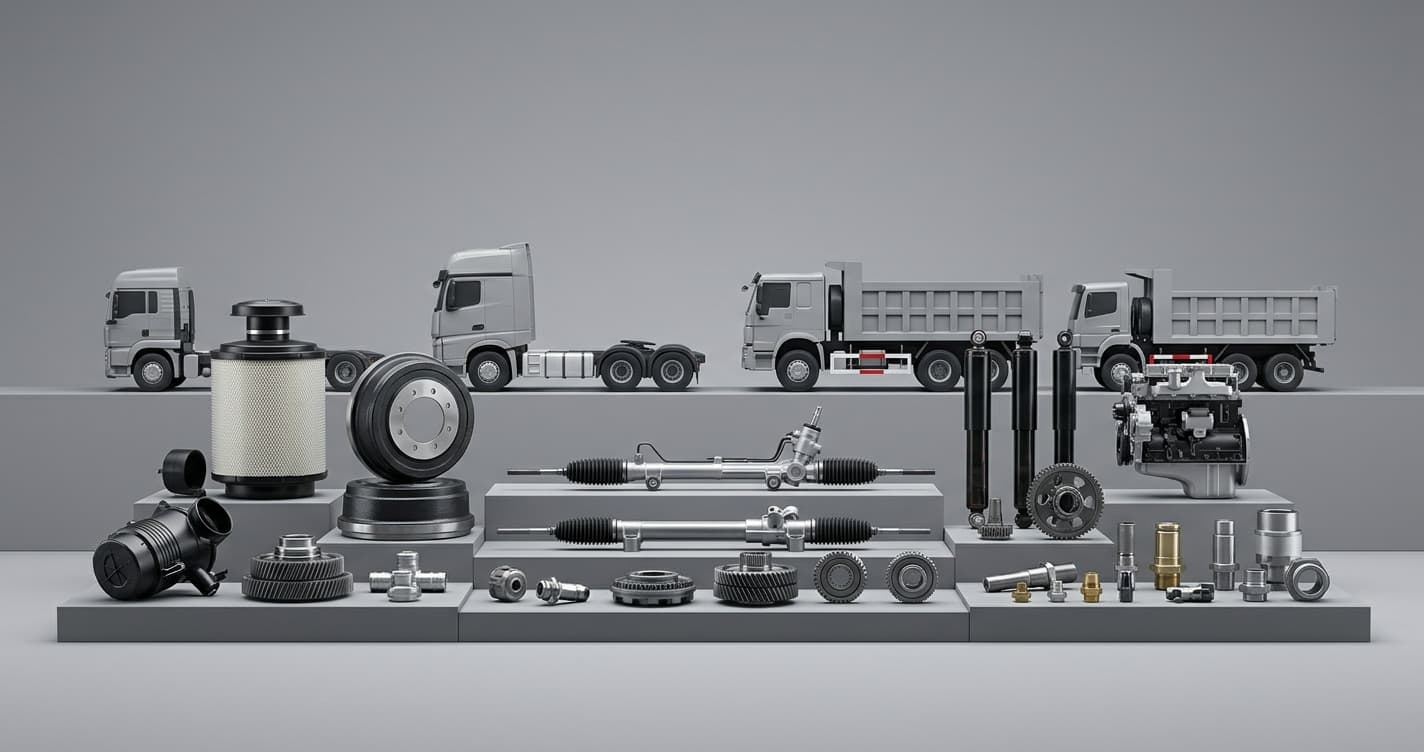
| Engine | Pistons, liners, bearings, gaskets | Core reliability — highest failure cost |
| Braking | Brake drums, pads, calipers, chambers | Safety-critical — zero tolerance for defects |
| Transmission | Gears, synchros, shafts, bearings | Expensive to replace, long lead times |
| Suspension | Leaf springs, shock absorbers, bushings | Affects load capacity and driver comfort |
| Electrical | Alternators, starters, sensors, wiring | Increasingly complex in modern models |
Specifically, look for suppliers who stock parts for Sinotruk HOWO, Shacman F2000/F3000/X3000, FAW J6/J7, Dongfeng Kinland, and Foton Auman series. Breadth of catalog signals manufacturing depth and genuine industry commitment. You can explore how a comprehensive product systems approach works in practice to understand what proper coverage looks like.
Step 3 — Request Sample Parts and Test Them
Words are cheap. Catalogs are cheaper. Samples, on the other hand, tell the truth. Any serious OEM truck parts manufacturer will gladly send samples because they know their products can withstand scrutiny. The nervous ones? They make excuses about minimum orders, shipping costs, or “company policy.”
When evaluating samples, measure what matters:
- Dimensional accuracy: Compare against OEM specifications with calipers and gauges
- Material composition: Request material certificates or conduct hardness testing
- Surface finish: Check for machining quality, coating consistency, and corrosion protection
- Fitment: Test-fit on the actual vehicle application whenever possible
Additionally, pay attention to packaging and labeling. Genuine manufacturers invest in proper packaging because they understand that a part damaged in transit is a part that damages their reputation. Trading companies, by contrast, often ship in generic boxes with handwritten labels.
Step 4 — Investigate Their Supply Chain Transparency
This step separates manufacturers from middlemen. Ask direct questions: Where do you source your raw steel? Do you cast and machine in-house, or subcontract? Can I visit your production facility?
A genuine manufacturer answers these questions without flinching. They’ll show you their foundry, their CNC lines, their quality testing lab. Trading companies, meanwhile, get vague. They’ll talk about “partner factories” and “cooperative relationships” — which is code for “we buy from whoever is cheapest this month.”
For commercial vehicle replacement parts, this distinction matters enormously. In-house manufacturing means consistent quality control from raw material to finished product. Subcontracting means your quality depends on whichever factory won the lowest bid that quarter. As a result, supply chain transparency directly predicts long-term reliability.
Step 5 — Check Real Customer References and Track Record
References are the supplier’s report card — and like any report card, the details matter more than the overall grade. Don’t just ask for references; ask for references from businesses similar to yours. A distributor in Southeast Asia has different needs than a fleet operator in Africa, and a supplier’s performance can vary by market.
Look for evidence of long-term partnerships rather than one-time transactions. A supplier who has served the same customers for five or ten years is demonstrating something that no certification can prove: consistent reliability over time. Furthermore, ask references about how the supplier handles problems — because problems will inevitably occur. The measure of a partner is not perfection but response.
You can see examples of how long-term partnerships develop in practice through real customer success stories that demonstrate what sustained collaboration looks like.
Step 6 — Evaluate Communication and After-Sales Support
Here’s a truth that experienced importers know well: the quality of communication before the sale predicts the quality of support after it. If a supplier takes five days to answer a simple product question now, imagine how responsive they’ll be when you have a warranty claim.
Benchmark their communication against these standards:
- Response time: Within 24 hours for routine inquiries, same-day for urgent issues
- Technical knowledge: Can they answer application-specific questions without “checking with the factory”?
- Problem resolution: Do they have a clear process for handling defective parts?
- Proactive updates: Do they notify you of production delays before you have to ask?
In addition, evaluate their warranty policy. A confident OEM truck parts manufacturer stands behind their products with clear, written warranty terms. Vague promises of “we’ll take care of it” are worth exactly nothing when you’re holding a box of cracked cylinder liners. If you want to understand what proper technical support and problem resolution should look like, that’s a good reference point.
Step 7 — Compare Pricing Structure (Not Just Price)
Let’s be honest: price matters. But the cheapest quote is often the most expensive decision you’ll make all year. Instead of comparing unit prices in isolation, evaluate the complete pricing structure.
What does a transparent pricing structure look like?
- Clear breakdown of product cost, packaging, and shipping
- Consistent pricing that doesn’t mysteriously drop 40% to win your order
- Reasonable MOQ flexibility for initial orders and testing
- Payment terms that share risk appropriately (not 100% T/T in advance)
- Volume discount tiers that reward growing partnerships
Ultimately, you’re not buying parts — you’re buying reliability, consistency, and peace of mind. The right OEM truck parts supplier prices their products to reflect genuine manufacturing costs, fair margins, and long-term partnership value. Suspiciously low prices almost always mean corners are being cut somewhere you can’t see — until the parts fail.
Common Problems When Sourcing OEM Truck Parts (And How to Solve Them)
Problem 1 — Parts Don’t Match OEM Specifications After Delivery
You ordered parts matching Sinotruk HOWO specifications. What arrived looks similar but measures 0.3mm off on critical dimensions. The supplier insists it’s “within tolerance.” Your mechanics disagree.
Why it happens: Supplier substitution is the most common cause. Some suppliers quote genuine OEM parts, then ship cheaper alternatives hoping you won’t notice. Poor quality control at the factory level compounds the issue — without proper inspection protocols, out-of-spec parts slip through.
How to solve it: Implement pre-shipment inspection protocols. Require third-party QC inspection before containers are sealed. Establish contractual spec-lock agreements that define exact specifications with measurable tolerances. Include penalty clauses for non-conformance. These steps cost a small percentage upfront but save enormous headaches downstream.
Problem 2 — Inconsistent Quality Between Batches
Your first order was excellent. The second was acceptable. The third made you question every decision that led to this supplier relationship. Batch inconsistency is maddening because it destroys the trust you thought you’d built.
Why it happens: Raw material variation is the primary culprit. When steel prices fluctuate, some manufacturers quietly downgrade material grades. Production line changes — new operators, different tooling, altered processes — also introduce variation without proper controls.
How to solve it: Establish batch testing requirements in your supply agreement. Schedule regular supplier audits (annually at minimum, quarterly for critical components). Define quality KPIs with your supplier and review them together. Transparency here benefits both parties — it helps the manufacturer maintain standards and gives you early warning of drift.
Problem 3 — Long Lead Times Disrupting Your Inventory
You were promised 30-day delivery. It’s now day 55, your warehouse is running low on Shacman brake drums, and your customers are getting impatient. The supplier keeps saying “next week” — a phrase that has lost all meaning.
Why it happens: Poor production planning is common, especially among suppliers who overcommit capacity. Undisclosed subcontracting adds another layer — when your supplier secretly outsources to another factory, they lose control of timelines entirely.
How to solve it: Negotiate safety stock agreements where the supplier maintains buffer inventory for your high-volume items. Demand production timeline visibility with milestone updates. Consider split-shipment arrangements for large orders — partial delivery at 30 days, remainder at 45 — to keep your inventory flowing even if production runs slightly behind.
Problem 4 — Supplier Disappears After Payment
This is the nightmare scenario, and it happens more often than the industry acknowledges. You wire payment, communication slows, then stops entirely. The phone number works but nobody answers. The “factory” address turns out to be a rented office.
Why it happens: Trading companies with no physical manufacturing assets have minimal accountability. They exist as intermediaries, and some operate with short-term thinking — take the money, deliver substandard goods (or nothing), then rebrand and repeat.
How to solve it: Verify before you pay. Confirm business registration, visit the factory (or hire someone local to visit), and check how long they’ve been operating. Use escrow payment options for new relationships. Start with small orders to build trust incrementally. Working with an established company with verifiable history eliminates this risk almost entirely.
Problem 5 — Difficulty Finding Parts for Specific Chinese Truck Models
You need a specific transmission gear for a 2014 FAW J6P, or suspension bushings for an early-model Dongfeng Kinland. Your current supplier draws a blank. You search online and find ten different part numbers for what should be the same component.
Why it happens: The Chinese truck parts market is fragmented, with numerous model-year variations, mid-cycle updates, and regional specifications. A single truck model might have three different engine configurations depending on emission standards and market destination.
How to solve it: Work with a specialist OEM truck parts manufacturer who maintains comprehensive cross-reference databases. These databases map part numbers across model years, engine variants, and regional specifications. A supplier with genuine manufacturing depth knows these variations intimately because they’ve produced parts for all of them. Explore the full range of Chinese truck brand coverage to understand what comprehensive sourcing looks like.
Here’s a summary of these common problems and their solutions:
| Problem | Root Cause | Recommended Solution | Prevention Difficulty |
|---|---|---|---|
| Spec mismatch | Supplier substitution | Pre-shipment QC + spec-lock contracts | Medium |
| Batch inconsistency | Material variation | Batch testing + audit schedule | Medium-High |
| Long lead times | Poor planning | Safety stock + timeline visibility | Low-Medium |
| Supplier vanishes | No accountability | Verification + escrow + small first orders | Low |
| Model-specific sourcing | Fragmented market | Specialist supplier with cross-reference DB | High (without right partner) |
Red Flags That Should Make You Walk Away
Think of these as the dating red flags of the truck parts world. Any single one warrants caution; two or more together mean you should run — not walk — in the other direction.
- No factory photos or video tours available: In 2024, every legitimate manufacturer can show you their production floor. Refusal suggests there’s nothing to show.
- Refuses video calls or live factory walkthroughs: A real factory has nothing to hide. Trading companies operating from small offices have everything to hide.
- Cannot produce certifications within 48 hours: Legitimate certifications are readily accessible. Delays usually mean they’re being fabricated or borrowed.
- Demands 100% payment upfront with no escrow option: Established manufacturers understand that trust is built gradually. Only desperate or dishonest operators demand full payment before delivery.
- Vague product descriptions without technical specifications: Real manufacturers speak in precise measurements, material grades, and tolerance ranges. Vague language masks ignorance or deception.
- Catalog images clearly copied from other suppliers: Reverse image search their product


