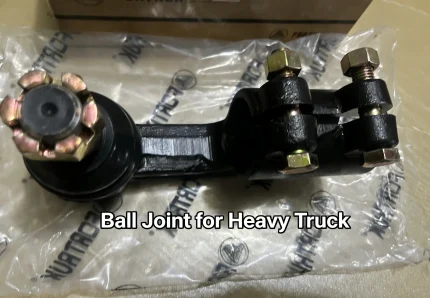
The ball jointis a core component of heavy-duty truck steering systems, and its performance directly determines the safety and stability of the entire vehicle during operation.
Unlike ordinary connecting parts, it bears the important responsibility of connecting the steering system and the wheels, transmitting steering force and ensuring flexible steering of the vehicle.
Many truck drivers often ignore the importance of it.
They regard it as just a small and insignificant connecting part in the truck’s steering system.
However, this kind of neglect is very dangerous. Once the ball joint fails, it will first affect the steering accuracy of the truck.
The driver may feel that the steering wheel is not responsive or accurate when operating.
In more serious cases, it may even lead to serious safety accidents such as vehicle loss of control, which threatens the driver’s personal safety and the safety of the goods being transported.
Therefore, mastering the relevant knowledge of it, including its basic functions, common faults, maintenance methods, and selection skills, is crucial for every truck driver and operator.
Basic Knowledge of Heavy Truck Ball Joint
First of all, we need to clearly understand what a heavy truck ball joint is and what role it plays in the entire steering system.
It is a movable connecting part in the steering system.
It is mainly composed of four key components: a ball head, a ball socket, a dust cover and a locking structure.
Each component plays an irreplaceable role in ensuring the normal operation of it.
Its core function is to connect the steering and the wheel hub, realize the flexible rotation of the wheel, and ensure that the vehicle can turn smoothly according to the driver’s operation.
Its core function is to connect the steering and the wheel hub, realize the flexible rotation of the wheel, and ensure that the vehicle can turn smoothly according to the driver’s operation.
In the process of driving, the ball joint bears multiple pressures at the same time.
It needs to bear the weight of the entire vehicle, the impact force from uneven road surfaces, and the steering force transmitted by the steering system.
Therefore, it has very high requirements for the material’s performance.
The material must have strong wear resistance, corrosion resistance, and structural stability to adapt to long-term harsh working conditions.
Different from the wheel hub bearing that supports the wheel rotation, the ball joint focuses on transmitting steering force and ensuring steering flexibility, which is an indispensable part of the steering system.
🧠 Ball Joint Is a Load Pivot Point in Heavy Truck Suspension Systems
In heavy-duty trucks, ball joints are not just simple connectors. They act as load-bearing pivot points that link the control arm and steering knuckle, allowing controlled movement while supporting vehicle weight.
During operation, ball joints continuously handle vertical load from the suspension system and horizontal steering force from driver input.Because of this dual function, ball joints play a critical role in maintaining both steering precision and suspension geometry stability.
When a ball joint wears out, it directly affects wheel alignment, steering response, and load distribution across the front axle.
Ball joint wear begins gradually due to friction, contamination, and loss of lubrication inside the socket.At early stages, the joint may still function normally with minor looseness that is not easily noticeable during driving.
However, as wear increases, internal clearance expands, causing instability in wheel positioning under load. This leads to vibration, steering wander, and uneven tire contact with the road.Once wear reaches a critical point, the joint can no longer maintain structural alignment, significantly increasing safety risk.
🔥 Why Ball Joint Failure Affects Multiple Front-End Systems
Ball joint failure does not remain isolated within a single component.Because it connects suspension and steering systems, any looseness or damage affects multiple areas simultaneously:
steering accuracy decreases
tire wear becomes uneven
suspension geometry shifts
vibration increases under load
This interconnected effect makes ball joints one of the most critical failure points in front axle systems.
⚠️ Why Ball Joint Problems Are Often Misdiagnosed
Ball joint issues are frequently misdiagnosed because their symptoms overlap with other suspension and steering components.For example:
steering vibration may be mistaken for wheel bearing failure
clunking noise may be attributed to tie rod issues
vehicle drifting may be blamed on alignment alone
Without proper inspection under load, technicians may replace incorrect components while the real issue remains unresolved.
💰 Fleet Impact of Ball Joint Failure
In commercial trucking operations, ball joint failure can lead to serious operational risks.A worn ball joint may not immediately disable the vehicle, but it gradually reduces steering precision and increases tire wear.
Over time, this leads to higher maintenance costs, reduced tire lifespan, and increased downtime due to repeated alignment and suspension corrections.
Common Faults and Troubleshooting of Ball Joint
Common Fault Phenomena
After long-term use, the ball joint is prone to various faults.
These faults are usually caused by multiple factors, such as long-term road vibration, excessive load pressure, and improper daily maintenance.
Among these faults, three types are the most common: loose connection, abnormal noise during steering, and poor steering flexibility.
Each of these faults has obvious performance characteristics, which are easy for drivers to find.
When it is loose, the driver will feel that the steering wheel is empty, the steering is not accurate, and there is even a slight shaking when driving at high speed, which seriously affects driving safety.
Abnormal noise during steering is another typical fault.
When turning, there will be a “creaking” or “clicking” sound, which indicates that the ball head is worn or the lubrication is insufficient, and it needs to be checked and handled in time.
Practical Troubleshooting Methods
When encountering the above faults, the driver should first take safe measures.
Park the truck in a safe and flat area, turn off the engine, and avoid further damage to the steering system.
For loose connections, the first step is to check whether the fixing bolts of the ball joint are loose.
If they are loose, use a professional wrench to tighten them properly to ensure the ball joint is firmly fixed.
Its core function is to connect the steering and the wheel hub, realize the flexible rotation of the wheel, and ensure that the vehicle can turn smoothly according to the driver’s operation.
If there is abnormal noise, you can apply a small amount of lubricating oil to the ball joint.
If the noise still exists, it means the ball head is seriously worn and needs to be replaced in time.
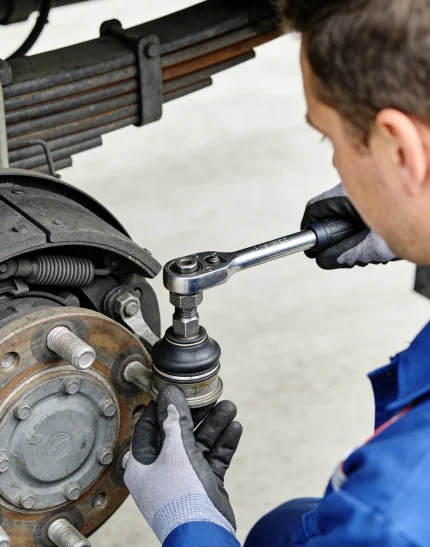
A technician inspecting heavy truck ball joint
For detailed troubleshooting steps, consult our professional technical team directly.
They will provide you with targeted solutions according to the specific fault situation, avoiding blind operation leading to more serious problems.
Daily Maintenance Tips for Ball Joint
Regular maintenance is the key to extending the service life of the ball joint and reducing the occurrence of faults.
The first step of maintenance is regular inspection.
It is recommended that truck drivers check the ball joint once a month.
The focus of the inspection is whether there is looseness, oil leakage, corrosion on the surface of it, or damage to the dust cover.
Its core function is to connect the steering and the wheel hub, realize the flexible rotation of the wheel, and ensure that the vehicle can turn smoothly according to the driver’s operation.
The dust cover is an important part to protect the ball joint from dust and water.
If it is damaged, it should be replaced immediately to avoid dust and water entering the internal structure and causing wear and corrosion.
Secondly, regular lubrication: every 3 months or 5000 kilometers, add special lubricating oil to it to reduce internal friction and wear, and avoid using inferior lubricating oil, which may corrode the ball head and ball socket.
In addition, avoid long-term overloading of the truck.
Excessive load will greatly increase the pressure on the ball joint, accelerate its wear, and even cause the ball head to fall off in severe cases, leading to serious safety accidents.
How to Choose a High-Quality Ball Joint
Choosing a high-quality ball joint is the premise to ensure the stable operation of the truck’s steering system.
First of all, it is necessary to confirm that the ball joint matches the truck’s model and load capacity.
Do not choose products with inappropriate specifications, as this will directly affect the performance of the steering system and even cause safety hazards.
Secondly, pay attention to the material of the product: high-quality ball joints are made of high-strength alloy steel.
Which has strong wear resistance and corrosion resistance and can adapt to harsh working environments such as high temperature and humidity.
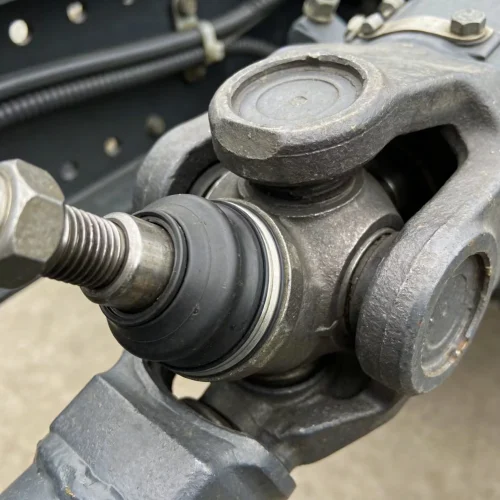
Close-up of heavy truck ball joint structure
Finally, choose products from regular manufacturers with complete quality certification.
Such products have passed strict quality inspection, and their performance and service life are more guaranteed.
How does a ball joint function within a heavy truck front axle system?
A ball joint functions as a critical pivot point within the front axle suspension system. It connects the control arm to the steering knuckle while allowing controlled movement in multiple directions.
During operation, it simultaneously handles vertical suspension load and horizontal steering force. This dual-load environment allows the wheel to move smoothly with road conditions while maintaining steering accuracy.
Because it supports both motion and load transfer, any wear in the ball joint directly affects the stability of the entire front axle system.
Why is the ball joint considered a load-bearing component in trucks?
In heavy-duty trucks, the ball joint is not only a motion connector but also a load-bearing structure.It continuously transfers vehicle weight from the chassis through the control arm to the wheel assembly while allowing steering articulation.
Under heavy load conditions, this constant stress accelerates internal wear. Unlike passenger vehicles, truck ball joints operate under higher torque and vibration levels, making them more critical to structural integrity.
What happens when a ball joint starts to wear internally?
When a ball joint begins to wear internally, clearance between the ball and socket gradually increases.At first, this may only cause slight looseness in steering response or minor vibration at certain speeds. However, as wear progresses, the wheel begins to lose precise alignment under load.
This leads to unstable tire contact, inconsistent steering feedback, and increased stress on surrounding suspension components.Over time, the system becomes progressively less stable, especially during cornering or heavy braking.
Can a worn ball joint affect vehicle alignment even if the alignment is recently adjusted?
Yes, a worn ball joint can override a recent wheel alignment because alignment settings depend on stable suspension geometry.If the ball joint has excessive play, the wheel position will shift dynamically during driving, making static alignment measurements unreliable.
This means the vehicle may still show correct alignment on paper, but behave inconsistently on the road due to movement in the suspension linkage.
Why does ball joint failure cause steering wandering at high speeds?
Steering wandering occurs because a worn ball joint allows unintended movement between the suspension arm and steering knuckle.At higher speeds, even small directional inconsistencies become amplified due to increased tire-road interaction forces.
This results in continuous minor steering corrections required by the driver, creating a feeling of instability or drifting.
Can a bad ball joint cause vibration in the steering wheel?
Yes, a bad ball joint can cause steering wheel vibration due to uneven load transfer and unstable wheel positioning.When the joint loses tight engagement, the wheel may oscillate slightly during rotation, especially under load or on uneven road surfaces.
This vibration is often mistaken for wheel imbalance or tire issues, leading to incorrect diagnosis.
Why do ball joints fail faster under heavy load conditions?
Ball joints fail faster under heavy load conditions because increased vehicle weight amplifies pressure on the joint’s internal contact surfaces.Continuous stress accelerates material fatigue and lubrication breakdown inside the socket. In long-haul or construction trucks, this process is significantly faster due to constant load variation and rough terrain exposure.
What are the risks of ignoring early ball joint wear?
Ignoring early ball joint wear can lead to progressive suspension instability and increased safety risk.As wear increases, steering precision decreases and wheel alignment becomes unstable under dynamic driving conditions.
In severe cases, the joint may reach a critical failure point where structural integrity is compromised, increasing the risk of sudden suspension failure.
How is ball joint wear properly diagnosed in heavy trucks?
Ball joint wear is diagnosed by checking for excessive movement in the suspension system under both static and dynamic conditions.Technicians typically inspect vertical and lateral play by lifting the wheel and applying controlled force to detect looseness.
In more advanced diagnostics, road testing is used to evaluate behavior under load, since some failures only appear during actual driving conditions.
Why does ball joint failure feel worse when the truck is fully loaded?
Ball joint failure becomes more noticeable under full load because increased weight amplifies any existing looseness or instability in the joint.
The added stress causes more pronounced movement in the suspension system, making steering response less predictable and increasing vibration intensity.
Conclusion
The ball joint is an indispensable core component in the steering system of heavy trucks.
Its performance directly affects the driving safety and transportation efficiency of the vehicle.
For truck drivers and operators, mastering the basic knowledge, fault troubleshooting methods, daily maintenance skills, and selection skills of it is very important.
This can effectively extend the service life of it, reduce maintenance costs, and ensure the stable and safe operation of the truck.
First of all, it is necessary to confirm that the ball joint matches the truck’s model and load capacity.